



Begin of page section:
Page sections:

  • Go to contents (Accesskey 1)
  • Go to position marker (Accesskey 2)
  • Go to main navigation (Accesskey 3)
  • Go to sub navigation (Accesskey 4)
  • Go to additional information (Accesskey 5)
  • Go to page settings (user/language) (Accesskey 8)
  • Go to search (Accesskey 9)

End of this page section. Go to overview of page sections

Begin of page section:
Page settings:

English en
Deutsch de
Search
Login

End of this page section. Go to overview of page sections

Begin of page section:
Search:

Search for details about Uni Graz
Close

End of this page section. Go to overview of page sections


Search

Begin of page section:
Main navigation:

Page navigation:

  • University

    University
    • About the University
    • Organisation
    • Faculties
    • Library
    • Working at University of Graz
    • Campus
    Developing solutions for the world of tomorrow - that is our mission. Our students and our researchers take on the great challenges of society and carry the knowledge out.
  • Research Profile

    Research Profile
    • Our Expertise
    • Research Questions
    • Research Portal
    • Promoting Research
    • Research Transfer
    • Ethics in Research
    • Commission for Scientific Integrity
    Scientific excellence and the courage to break new ground. Research at the University of Graz creates the foundations for making the future worth living.
  • Studies

    Studies
    • Prospective Students
    • Students
  • Community

    Community
    • International
    • Location
    • Research and Business
    • Alumni
    The University of Graz is a hub for international research and brings together scientists and business experts. Moreover, it fosters the exchange and cooperation in study and teaching.
Topics
  • Sustainable University
  • Researchers answer
  • Work for us
Close menu

End of this page section. Go to overview of page sections

Begin of page section:
You are here:

University of Graz News Im Dutzend besser

End of this page section. Go to overview of page sections

Tuesday, 05 October 2021

Im Dutzend besser

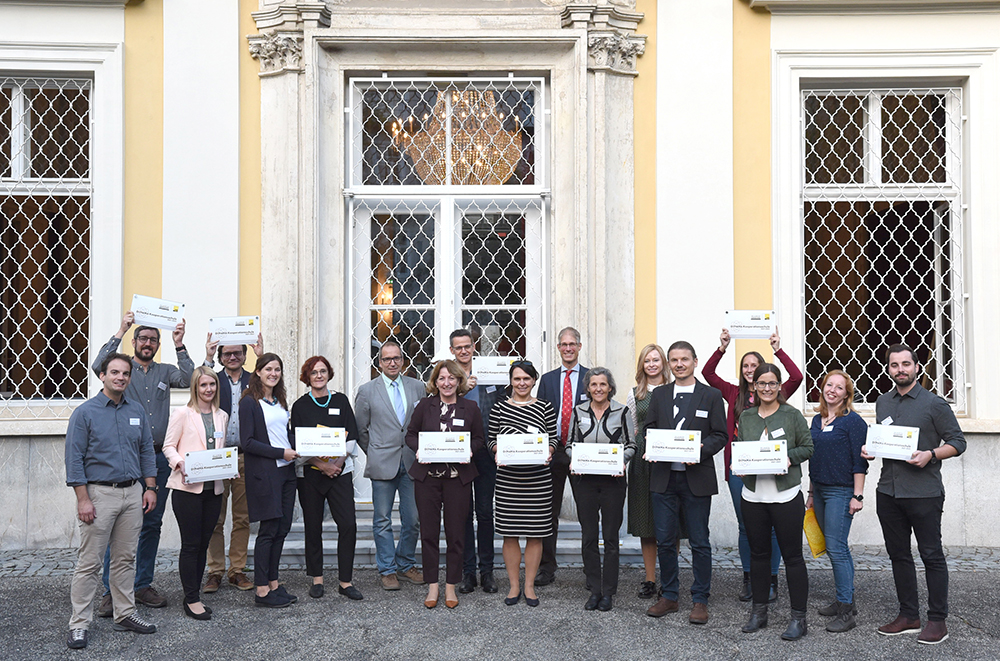
Schulterschluss von Uni Graz und zwölf steirischen Schulen. Am 1. Oktober erfolgte der Auftakt für die Kooperation in den Naturwissesnchaften und in Mathematik. Foto: Uni Graz/Schweiger

Schulterschluss von Uni Graz und zwölf steirischen Schulen. Am 1. Oktober erfolgte der Auftakt für die Kooperation in den Naturwissenschaften und in Mathematik. Foto: Uni Graz/Schweiger

Uni Graz und zwölf Schulen rücken zusammen, um Naturwissenschaften im Unterricht zu stärken

Biologie, Chemie, Physik und Mathematik: In der Schule gehören sie oft zu den weniger beliebten Fächern. Mehr Lust drauf will die Universität Graz machen. Das Didaktikzentrum für Naturwissenschaften und Mathematik (DINAMA) hat eine Initiative gestartet, um die Zusammenarbeit zwischen Schulen der Sekundarstufe und Universität zu intensivieren und weiterzuentwickeln. Den Anfang macht ein Schulterschluss mit zwölf steirischen Schulen, die am 1. Oktober 2021 mit der Verleihung von Kooperationsvereinbarungen aus der Taufe gehoben wurde.

Vernetzung

„Wir stellen eine bereits erfolgreiche Zusammenarbeit zwischen Universität und Schule auf eine breite Basis. Es handelt sich um eine aktive Partnerschaft, die über Einzelaktivitäten weit hinausgeht und mit konkreten Projekten auf Augenhöhe gelebt wird“, erläutert Claudia Haagen-Schützenhöfer, Professorin für Physikdidaktik und Leiterin des Didaktikzentrums für Naturwissenschaften und Mathematik. „Zum einen wird der regelmäßige Austausch zwischen FachdidaktikerInnen und LehrerInnen verdichtet. Zum anderen die Vernetzung mit den MentorInnen, die unsere Studierenden im Rahmen der PädagogInnenbildung betreuen, gestärkt“, betont Haagen-Schützenhöfer.  

Wissenschaft hautnah

Unterstützt werden ebenso SchülerInnen: durch themenspezifische Workshops, Mitarbeit bei Forschungsprojekten sowie Kennenlernen von WissenschafterInnen. Damit verbunden sind die Ziele, bei vorwissenschaftlichen Arbeiten unter die Arme zu greifen sowie den Übergang von Schule zu Universität zu erleichtern. Das begrüßt auch Wolfgang Kasper, Direktor des Grazer BG/BRG Seebacher: „Die DINAMA-Kooperation wird Praxis und Wissenschaft verbinden – zum Vorteil aller Beteiligten. Schülerinnen und Schüler werden ,hautnah‘ Wissenschaft erleben können und von zahlreichen, innovativen Ideen und ,Schauplätzen‘ des Fachdidaktikzentrums profitieren. Lehrkräfte können gemeinsam mit Studierenden und Forschenden Unterricht entwickeln und im Schulalltag implementieren. Und das nützt eben auch der Wissenschaft.“

Die Kooperationsschulen: Akademisches Gymnasium, BG und BRG Carneri, BG und BRG Seebacher, Bischöfliches Gymnasium, BRG Kepler, BRG Petersgasse, KLEX. Klusemann extern, MS Graz-St. Johann (alle Graz), BG und BRG Fürstenfeld, BG und BRG Leibnitz, BG und BRG Weiz sowie HLW Deutschlandsberg

>> Über das Didaktikzentrum für Naturwissenschaften und Mathematik mehr erfahren
created by Andreas Schweiger

Related news

A substantial community: the key role of soil crusts in the earth system

They are often overshadowed by the plant world: lichens, fungi, mosses and bacteria, which form unique communities on rocks and trees or as soil crusts. Bettina Weber from the University of Graz is bringing this biological alliance into the research spotlight. Her research shows that these communities form an essential part of the Earth’s critical zone and play a key role in the interactions between land and atmosphere. Bettina Weber was honoured by the European Geosciences Union for her groundbreaking research at the beginning of May.

The digital world of tomorrow: University of Graz works with people to shape the future

Digitalisation is supposed to make everything better: artificial intelligence that even organises travel. The car that drives itself. Robots that care for us in our old age. But what kind of future do people actually want? What role should technology play in this? The University of Graz is exploring these questions through a new research facility. At the Graz Sociodigital and Participatory Futures Studio – or GraSP Futures Studio for short – young and old work together with researchers to design visions of the future that also critically examine technical innovations.

Eurovision: Why the Song Contest is always political

The 2026 Eurovision Song Contest sits at the intersection of music, geopolitics and culture. Josef Mühlbauer from the University of Graz explains why the ESC has always been a reflection of European politics, and how this major event highlights cultural affinities and social change.

Superti-Furga will becomefounding director of the CORI Institute in Graz

The Austrian Academy of Sciences (ÖAW) is establishing a new flagship centre for research into metabolic diseases in collaboration with the three universities in Graz. This innovative research approach combines mathematics and experimental biology with artificial intelligence

Begin of page section:
Additional information:

University of Graz
Universitaetsplatz 3
8010 Graz
Austria
  • Contact
  • Web Editors
  • Moodle
  • UNIGRAZonline
  • Imprint
  • Data Protection Declaration
  • Accessibility Declaration
Weatherstation
Uni Graz

End of this page section. Go to overview of page sections

End of this page section. Go to overview of page sections

Begin of page section:

End of this page section. Go to overview of page sections


