Begin of page section:
Page sections:

  • Go to contents (Accesskey 1)
  • Go to position marker (Accesskey 2)
  • Go to main navigation (Accesskey 3)
  • Go to sub navigation (Accesskey 4)
  • Go to additional information (Accesskey 5)
  • Go to page settings (user/language) (Accesskey 8)
  • Go to search (Accesskey 9)

End of this page section. Go to overview of page sections

Begin of page section:
Page settings:

English en
Deutsch de
Search
Login

End of this page section. Go to overview of page sections

Begin of page section:
Search:

Search for details about Uni Graz
Close

End of this page section. Go to overview of page sections


Search

Begin of page section:
Main navigation:

Page navigation:

  • University

    University
    • About the University
    • Organisation
    • Faculties
    • Library
    • Working at University of Graz
    • Campus
    Developing solutions for the world of tomorrow - that is our mission. Our students and our researchers take on the great challenges of society and carry the knowledge out.
  • Research Profile

    Research Profile
    • Our Expertise
    • Research Questions
    • Research Portal
    • Promoting Research
    • Research Transfer
    • Ethics in Research
    Scientific excellence and the courage to break new ground. Research at the University of Graz creates the foundations for making the future worth living.
  • Studies

    Studies
    • Prospective Students
    • Students
  • Community

    Community
    • International
    • Location
    • Research and Business
    • Alumni
    The University of Graz is a hub for international research and brings together scientists and business experts. Moreover, it fosters the exchange and cooperation in study and teaching.
  • Spotlight
Topics
  • Sustainable University
  • Researchers answer
  • Work for us
Close menu

End of this page section. Go to overview of page sections

Begin of page section:
You are here:

University of Graz News Im Dutzend besser

End of this page section. Go to overview of page sections

Tuesday, 05 October 2021

Im Dutzend besser

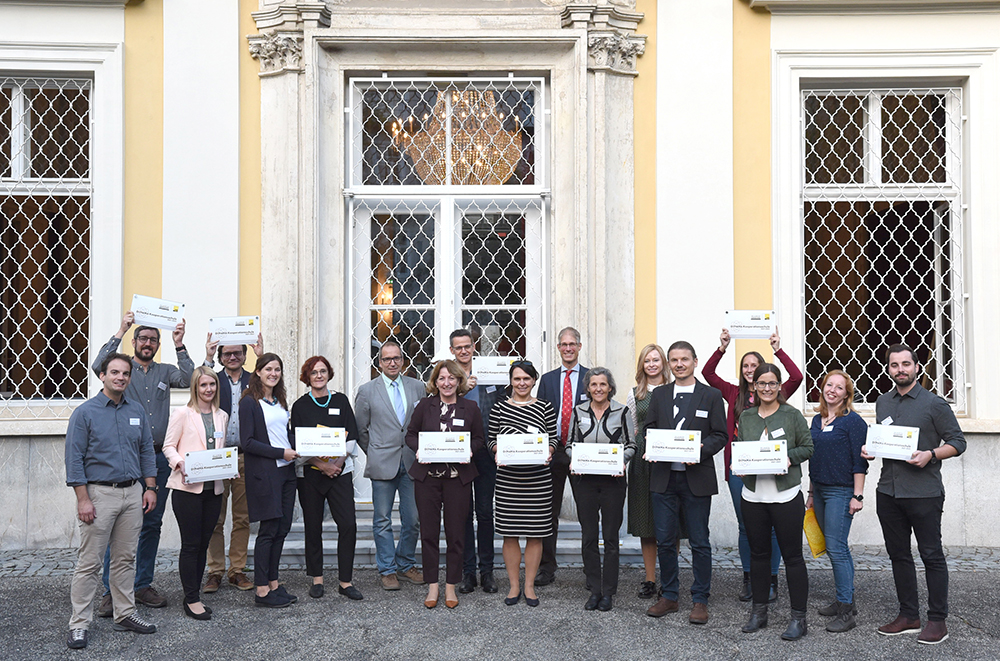
Schulterschluss von Uni Graz und zwölf steirischen Schulen. Am 1. Oktober erfolgte der Auftakt für die Kooperation in den Naturwissesnchaften und in Mathematik. Foto: Uni Graz/Schweiger

Schulterschluss von Uni Graz und zwölf steirischen Schulen. Am 1. Oktober erfolgte der Auftakt für die Kooperation in den Naturwissenschaften und in Mathematik. Foto: Uni Graz/Schweiger

Uni Graz und zwölf Schulen rücken zusammen, um Naturwissenschaften im Unterricht zu stärken

Biologie, Chemie, Physik und Mathematik: In der Schule gehören sie oft zu den weniger beliebten Fächern. Mehr Lust drauf will die Universität Graz machen. Das Didaktikzentrum für Naturwissenschaften und Mathematik (DINAMA) hat eine Initiative gestartet, um die Zusammenarbeit zwischen Schulen der Sekundarstufe und Universität zu intensivieren und weiterzuentwickeln. Den Anfang macht ein Schulterschluss mit zwölf steirischen Schulen, die am 1. Oktober 2021 mit der Verleihung von Kooperationsvereinbarungen aus der Taufe gehoben wurde.

Vernetzung

„Wir stellen eine bereits erfolgreiche Zusammenarbeit zwischen Universität und Schule auf eine breite Basis. Es handelt sich um eine aktive Partnerschaft, die über Einzelaktivitäten weit hinausgeht und mit konkreten Projekten auf Augenhöhe gelebt wird“, erläutert Claudia Haagen-Schützenhöfer, Professorin für Physikdidaktik und Leiterin des Didaktikzentrums für Naturwissenschaften und Mathematik. „Zum einen wird der regelmäßige Austausch zwischen FachdidaktikerInnen und LehrerInnen verdichtet. Zum anderen die Vernetzung mit den MentorInnen, die unsere Studierenden im Rahmen der PädagogInnenbildung betreuen, gestärkt“, betont Haagen-Schützenhöfer.  

Wissenschaft hautnah

Unterstützt werden ebenso SchülerInnen: durch themenspezifische Workshops, Mitarbeit bei Forschungsprojekten sowie Kennenlernen von WissenschafterInnen. Damit verbunden sind die Ziele, bei vorwissenschaftlichen Arbeiten unter die Arme zu greifen sowie den Übergang von Schule zu Universität zu erleichtern. Das begrüßt auch Wolfgang Kasper, Direktor des Grazer BG/BRG Seebacher: „Die DINAMA-Kooperation wird Praxis und Wissenschaft verbinden – zum Vorteil aller Beteiligten. Schülerinnen und Schüler werden ,hautnah‘ Wissenschaft erleben können und von zahlreichen, innovativen Ideen und ,Schauplätzen‘ des Fachdidaktikzentrums profitieren. Lehrkräfte können gemeinsam mit Studierenden und Forschenden Unterricht entwickeln und im Schulalltag implementieren. Und das nützt eben auch der Wissenschaft.“

Die Kooperationsschulen: Akademisches Gymnasium, BG und BRG Carneri, BG und BRG Seebacher, Bischöfliches Gymnasium, BRG Kepler, BRG Petersgasse, KLEX. Klusemann extern, MS Graz-St. Johann (alle Graz), BG und BRG Fürstenfeld, BG und BRG Leibnitz, BG und BRG Weiz sowie HLW Deutschlandsberg

>> Über das Didaktikzentrum für Naturwissenschaften und Mathematik mehr erfahren

created by Andreas Schweiger

Related news

Cosmetics in the environment: University of Graz proves danger to ants

Titanium dioxide, which is found in cosmetics, for example, is increasingly entering the environment in the form of nanoparticles. This could also put insects at risk. If ants ingest the substance in combination with the pesticide glyphosate, it disturbs the development of their offspring. Scientists at the University of Graz are drawing attention to the negative consequences of this toxic cocktail.

How are tech companies changing democracy? Uni Graz designs exhibition for schools

Filtered information, conspiracy theories, fake news – certain groups and corporations are using social media and algorithms to try to influence public opinion in their favour. Their goal: to weaken fundamental rights and diversity of opinion and seize power. In a new exhibition, researchers at the University of Graz are working with pupils to explore the impact of social media and AI on democracy. In accompanying workshops, the scientists want to encourage young people to develop their own ideas for a socially and ecologically viable future and to actively help shape it. The exhibition, designed as a travelling exhibition for schools, will open on 9 March 2026 at the Dreihackengasse Gymnasium in Graz.

Step by step: What motivates Mireille van Poppel as a scientist and vice-rector

Improving people's health and eliminating inequalities: Mireille van Poppel pursues these goals both as a public health researcher and as vice-rector for Internationalisation and Equality. In both roles, she pays particular attention to individual needs.

Master's degree in psychotherapy in Graz: registration opens in March

Graz is becoming a hotspot for psychotherapy: from 2026, the University of Graz and the Medical University of Graz will jointly offer the new master's programme. Registration for the admission procedure for the 140 study places will start in March.

Begin of page section:
Additional information:

University of Graz
Universitaetsplatz 3
8010 Graz
Austria
  • Contact
  • Web Editors
  • Moodle
  • UNIGRAZonline
  • Imprint
  • Data Protection Declaration
  • Accessibility Declaration
Weatherstation
Uni Graz

End of this page section. Go to overview of page sections

End of this page section. Go to overview of page sections

Begin of page section:

End of this page section. Go to overview of page sections