



Begin of page section:
Page sections:

  • Go to contents (Accesskey 1)
  • Go to position marker (Accesskey 2)
  • Go to main navigation (Accesskey 3)
  • Go to sub navigation (Accesskey 4)
  • Go to additional information (Accesskey 5)
  • Go to page settings (user/language) (Accesskey 8)
  • Go to search (Accesskey 9)

End of this page section. Go to overview of page sections

Begin of page section:
Page settings:

English en
Deutsch de
Search
Login

End of this page section. Go to overview of page sections

Begin of page section:
Search:

Search for details about Uni Graz
Close

End of this page section. Go to overview of page sections


Search

Begin of page section:
Main navigation:

Page navigation:

  • University

    University
    • About the University
    • Organisation
    • Faculties
    • Library
    • Working at University of Graz
    • Campus
    Developing solutions for the world of tomorrow - that is our mission. Our students and our researchers take on the great challenges of society and carry the knowledge out.
  • Research Profile

    Research Profile
    • Our Expertise
    • Research Questions
    • Research Portal
    • Promoting Research
    • Research Transfer
    • Ethics in Research
    • Commission for Scientific Integrity
    Scientific excellence and the courage to break new ground. Research at the University of Graz creates the foundations for making the future worth living.
  • Studies

    Studies
    • Prospective Students
    • Students
  • Community

    Community
    • International
    • Location
    • Research and Business
    • Alumni
    The University of Graz is a hub for international research and brings together scientists and business experts. Moreover, it fosters the exchange and cooperation in study and teaching.
Topics
  • Sustainable University
  • Researchers answer
  • Work for us
Close menu

End of this page section. Go to overview of page sections

Begin of page section:
You are here:

University of Graz News Homocystein, das „neue Cholesterin“

End of this page section. Go to overview of page sections

Thursday, 19 April 2018

Homocystein, das „neue Cholesterin“
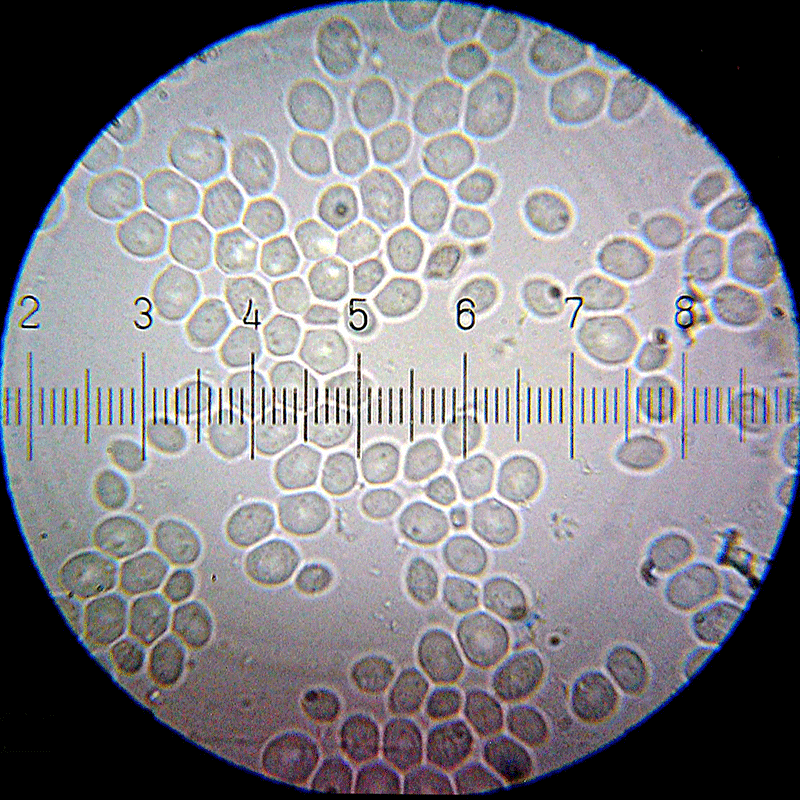
Als Basis für ihre Arbeit diente den ForscherInnen der Modellorganismus Hefe, der in zellulärer Organisation und biochemischen Stoffwechselprozessen humanen Zellen sehr ähnlich ist. Foto: Bob Blaylock/commons.wikimedia.org.
Als Basis für ihre Arbeit diente den ForscherInnen der Modellorganismus Hefe, der in zellulärer Organisation und biochemischen Stoffwechselprozessen humanen Zellen sehr ähnlich ist. Foto: Bob Blaylock/commons.wikimedia.org.

ForscherInnen nutzen Hefezellen für die Erforschung pathologischer Wirkmechanismen

Herz-Kreislauf-Erkrankungen gehören weltweit zu den häufigsten Todesursachen und werden durch Atherosklerose, einer chronisch entzündlichen Verengung und Versteifung der Aorta, verursacht. Allerdings kann nur zirka die Hälfte aller Fälle durch bekannte Risikofaktoren, wie etwa einen erhöhten Cholesterinspiegel, erklärt werden. Jetzt tritt zunehmend ein bislang unbekannter „Schuldiger“, die Aminosäure Homocystein, als neuer, weitgehend unerforschter unabhängiger Risikofaktor für die Entwicklung von Atherosklerose in den Fokus der biomedizinischen Forschung. Nicht nur kardiovaskuläre Erkrankungen, sondern auch Schädigungen des Nervensystems und der Atemwege sowie Fettleber, Insulinresistenz und Krebs stehen in Zusammenhang mit Homocystein und machen dessen Stoffwechsel zu einem wichtigen Ansatzpunkt für mögliche Therapien. Allerdings sind die Mechanismen, wie Homocystein diese Krankheiten verursachen oder begünstigen kann, kaum verstanden, was die Entwicklung von neuen Therapie-Ansätzen maßgeblich erschwert.

In der aktuellen Ausgabe des „Journal of Biological Chemistry“ belegen die ForscherInnen der Karl-Franzens-Universität Graz eine entscheidende Rolle für das Enzym, das für die Synthese von Homocystein verantwortlich ist, an der Regulation des Fettstoffwechsels. Als Basis für diese Arbeit diente den ForscherInnen der Modellorganismus Hefe, der in zellulärer Organisation und biochemischen Stoffwechselprozessen humanen Zellen sehr ähnlich ist. Deshalb lassen sich viele an Hefezellen gewonnene Erkenntnisse auch auf menschliche oder tierische Zellen übertragen. „Unsere Resultate zeigen eine unerwartete Reaktion zentraler regulatorischer Prozesse, die die Zellen brauchen, um auf die verschiedenen Reize reagieren zu können, auf einen veränderten Homocystein-Haushalt“, schildert die federführende Wissenschafterin Dr. Oksana Tehlivets vom Institut für Molekulare Biowissenschaften der Uni Graz. Insbesondere die dramatischen Auswirkungen auf den Fettstoffwechsel, die auch für die humanen Erkrankungen charakteristisch sind, lassen sich nunmehr mechanistisch erklären. „Wir beginnen erst jetzt zu verstehen, welch enorm großen Einfluss diese spezielle Aminosäure, die nicht in Eiweißen vorkommt, auf die zelluläre Physiologie insgesamt haben könnte. Um auf die Homocystein-assoziierten Erkrankungen entsprechend reagieren zu können, ist ein umfassendes Verständnis dieser Prozesse notwendig", bekräftigt Tehlivets.

Publikation:
Myriam Visram; Maja Radulovic; Sabine Steiner; Nermina Malanovic; Thomas O. Eichmann; Heimo Wolinski; Gerald N. Rechberger; Oksana Tehlivets (2018). Homocysteine regulates fatty acid and lipid metabolism in yeast. The Journal of Biological Chemistry, Vol. 293, Issue 15, 5544-5555.

created by Gerhild Leljak

Related news

Complying with the norm: Why Do Standards Shape Our Lives, Elisabeth Staudegger?

Standards determine whether a sheet of paper fits in a printer or whether a charging plug can power multiple devices. These standards shape our everyday lives. But who actually sets these standards? Where are the weaknesses, and how could science help to improve them? Elisabeth Staudegger, Head of the ‘Law and IT’ Department at the Institute for Legal Foundations at the University of Graz, host the Academic Standards Day on 16 June. Here she relays how sciences can contribute to the topic of standardisation and reveals her personal favourite standard.

More body awareness than a culture war

In Italy, sex education lessons will in future only be permitted with parental consent, and will be banned entirely in nurseries and primary schools. At the same time, Pride Month highlights why knowledge about the body, relationships, boundaries and diversity is important for young people. A study by the University of Graz shows how important knowledge about the body, contraception, relationship skills and protection against violence is

Will Austria win the World Cup? Mathematician reveals calculation method

Michael Fischer uses the football tournament as a practical example for highschool lessons.

Survival strategies: How plants respond to drought

According to Geosphere Austria, this spring was the driest in Austria since records began around 170 years ago. The low rainfall put particular pressure on the agricultural sector. And climate change is set to make the situation even worse in the coming decades. We asked Johannes Liesche, a professor at the Department of Biology at the University of Graz, how plants react to water shortages and how they survive periods of drought.

Begin of page section:
Additional information:

University of Graz
Universitaetsplatz 3
8010 Graz
Austria
  • Contact
  • Web Editors
  • Moodle
  • UNIGRAZonline
  • Imprint
  • Data Protection Declaration
  • Accessibility Declaration
Weatherstation
Uni Graz

End of this page section. Go to overview of page sections

End of this page section. Go to overview of page sections

Begin of page section:

End of this page section. Go to overview of page sections


