



Begin of page section:
Page sections:

  • Go to contents (Accesskey 1)
  • Go to position marker (Accesskey 2)
  • Go to main navigation (Accesskey 3)
  • Go to sub navigation (Accesskey 4)
  • Go to additional information (Accesskey 5)
  • Go to page settings (user/language) (Accesskey 8)
  • Go to search (Accesskey 9)

End of this page section. Go to overview of page sections

Begin of page section:
Page settings:

English en
Deutsch de
Search
Login

End of this page section. Go to overview of page sections

Begin of page section:
Search:

Search for details about Uni Graz
Close

End of this page section. Go to overview of page sections


Search

Begin of page section:
Main navigation:

Page navigation:

  • University

    University
    • About the University
    • Organisation
    • Faculties
    • Library
    • Working at University of Graz
    • Campus
    Developing solutions for the world of tomorrow - that is our mission. Our students and our researchers take on the great challenges of society and carry the knowledge out.
  • Research Profile

    Research Profile
    • Our Expertise
    • Research Questions
    • Research Portal
    • Promoting Research
    • Research Transfer
    • Ethics in Research
    • Commission for Scientific Integrity
    Scientific excellence and the courage to break new ground. Research at the University of Graz creates the foundations for making the future worth living.
  • Studies

    Studies
    • Prospective Students
    • Students
  • Community

    Community
    • International
    • Location
    • Research and Business
    • Alumni
    The University of Graz is a hub for international research and brings together scientists and business experts. Moreover, it fosters the exchange and cooperation in study and teaching.
Topics
  • Sustainable University
  • Researchers answer
  • Work for us
Close menu

End of this page section. Go to overview of page sections

Begin of page section:
You are here:

University of Graz News Graz Declaration aims to strengthen academic freedom at universities

End of this page section. Go to overview of page sections

Friday, 12 September 2025

Graz Declaration aims to strengthen academic freedom at universities

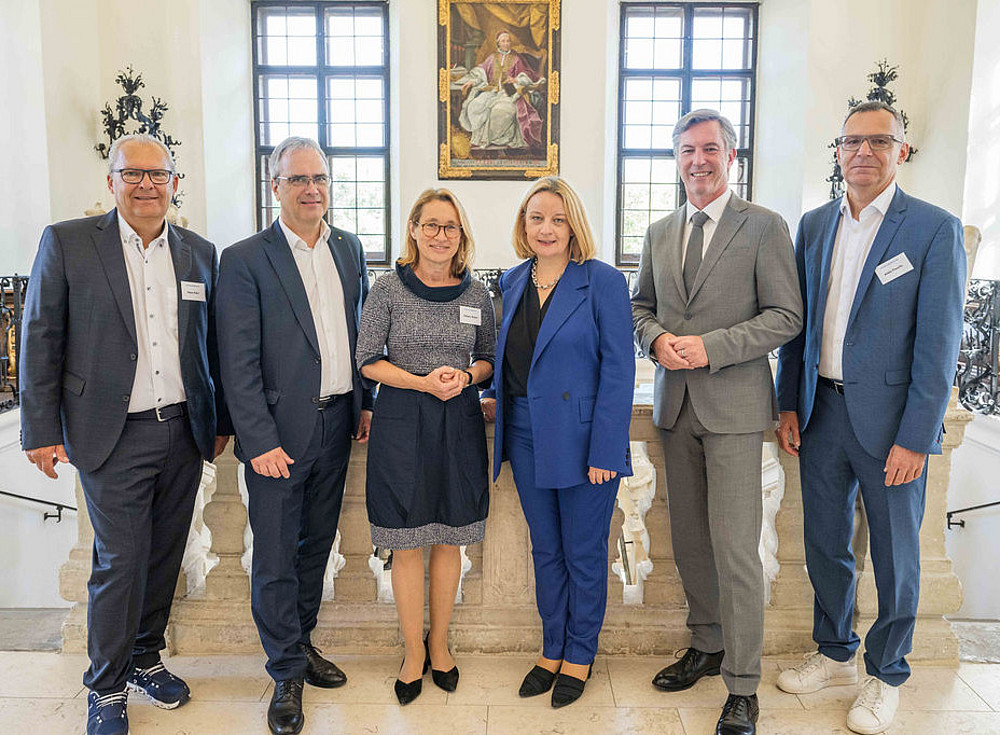
a group photo of a university summit with three men and two women standing next to each other smiling at camera, wearing business attire. ©Juergen Fuchs

Klaus Poier, professor at the University of Graz; Peter Riedler, rector of the University of Graz and chair of the Styrian University Conference; Victoria Weber, rector of the University for Continuing Education Krems; Brigitte Hütter, president of uniko and rector of the University of Art and Design Linz; Elmar Pichl, section head at the Federal Ministry for Women, Science, and Research; Attila Pausitsch, department head at the University for Continuing Education Krems

At the 2025 University Talks, held in Graz for the first time, experts discussed current threats to academic freedom. With the adoption of the Graz Declaration, colleges and universities are sending a strong signal for protection, responsibility, and shaping the future in science.

Following last year's University Dialogue Krems, this year's university discussions took place in Graz for the first time. Under the title “Academic Freedom: Current Threats - Necessary Barriers - Innovative Governance,” around 75 participants from university management, ministries, the Austrian National Union of Students (ÖH), European institutions, science, politics, and civil society discussed one of the most central questions for the future of higher education in the historic setting of the Minoritenzentrum.

The exchange took place in a highly topical context, as freedom of research and teaching is coming under increasing pressure worldwide due to political influence, economic constraints, growing pressure to conform, funding gaps, and dependence on third-party funding. These threats are already being felt in Europe as well. The aim of the university talks was therefore to clearly identify these challenges and to highlight ways in which academic freedom can be protected and secured. Alice Senarclens de Grancy, senior editor of the knowledge section at the daily newspaper Die Presse, ensured a lively and pointed discussion.

Graz Declaration

As a result of the intensive debates, the Graz Declaration on Academic Freedom was adopted by the organizers.

  • Raise awareness of academic freedom as a cornerstone of democracy. It is a cultural achievement that must be lived, respected, and promoted not only individually, but also institutionally and socially.
  • Take on more responsibility nationally and globally for safeguarding academic freedom and autonomy. Structural threats such as precarious employment, dependence on third-party funding, or political influence require sustainable financing, innovative governance, and leadership that is oriented toward academic freedom.
  • Ensure free scientific and artistic research to enable the shaping of the future. Only with secure spaces for discourse, sufficient basic funding, and targeted promotion of young talent can universities remain laboratories of the future.

With the adoption of the Graz Declaration by the organizers, the 2025 University Talks sent a strong signal. Academic freedom cannot be taken for granted, they said; it must be made conscious, defended, and actively secured.

The Higher Education Talks were organized by Klaus Poier, head of the Center for Higher Education Law at the University of Graz, and Attila Pausits, head of the Department of Higher Education Research at the University for Continuing Education Krems. Both emphasized that the series of events will alternate between Lower Austria and Styria in the future and will serve as a forum for exchange, orientation, and networking on the future of universities.

The university talks thrive on open exchange between science, politics, society, and culture. Especially in times when academic freedom is under pressure, this dialogue is indispensable. Thanks go to the organizers, all contributors, and the numerous supporters who have helped make Graz a place of lively debate and clear signals for the future of universities.

Download: The Graz Declaration

created by Gerlinde Tuscher

Related news

Uni Vibes: Where science and art come together

At the third Uni Vibes event hosted by the University of Graz, visitors enjoyed science, music and performances on campus. Guided tours focusing on democracy, educational sciences and the Graz Centre of Physics demonstrated how research shapes community life, urban development and culture.

Protest against budget cuts: universities send a united message in Graz

On 28 May, thousands of students, researchers and staff from all Styrian universities demonstrated in Graz against the announced budget cuts. University management and student representatives warned of severe consequences for research, teaching and the region’s standing as a centre of academic excellence.

Overcoming boundaries: Can we manage without prisons and camps?

The US immigration agency ICE has sparked fear and horror. Not only are migrants criminalised and brutally persecuted, but earlier this year, ICE officers killed two US citizens in Minneapolis. Against the backdrop of these dramatic events, the University of Graz is shedding light on the role of deportation and detention centres as part of the international conference ‘Camps, Belonging, and Abolition Democracy’. Researchers aim to develop scenarios for how a future without prisons and the death penalty can become a reality.

From one to many: Uni Graz researchers identify a mechanism for the origin of species

When a habitat changes, animals, plants and even humans must adapt to the new environmental conditions. Those who manage this fastest and best will prevail. Over time, new species that are specialised for specific habitats also develop. Zoologist Christian Sturmbauer and his research group at the University of Graz, together with international partners, have now demonstrated that the molecular biological process of “alternative splicing” – contrary to previous assumptions – contributes highly effectively to the formation of new species. Different combinations of parts of the same gene give rise to various, structurally slightly different variants of functional proteins. This leads very rapidly to significant changes. The research findings were published in the renowned journal Proceedings of the National Academy of Sciences.

Begin of page section:
Additional information:

University of Graz
Universitaetsplatz 3
8010 Graz
Austria
  • Contact
  • Web Editors
  • Moodle
  • UNIGRAZonline
  • Imprint
  • Data Protection Declaration
  • Accessibility Declaration
Weatherstation
Uni Graz

End of this page section. Go to overview of page sections

End of this page section. Go to overview of page sections

Begin of page section:

End of this page section. Go to overview of page sections