



Begin of page section:
Page sections:

  • Go to contents (Accesskey 1)
  • Go to position marker (Accesskey 2)
  • Go to main navigation (Accesskey 3)
  • Go to sub navigation (Accesskey 4)
  • Go to additional information (Accesskey 5)
  • Go to page settings (user/language) (Accesskey 8)
  • Go to search (Accesskey 9)

End of this page section. Go to overview of page sections

Begin of page section:
Page settings:

English en
Deutsch de
Search
Login

End of this page section. Go to overview of page sections

Begin of page section:
Search:

Search for details about Uni Graz
Close

End of this page section. Go to overview of page sections


Search

Begin of page section:
Main navigation:

Page navigation:

  • University

    University
    • About the University
    • Organisation
    • Faculties
    • Library
    • Working at University of Graz
    • Campus
    Developing solutions for the world of tomorrow - that is our mission. Our students and our researchers take on the great challenges of society and carry the knowledge out.
  • Research Profile

    Research Profile
    • Our Expertise
    • Research Questions
    • Research Portal
    • Promoting Research
    • Research Transfer
    • Ethics in Research
    • Commission for Scientific Integrity
    Scientific excellence and the courage to break new ground. Research at the University of Graz creates the foundations for making the future worth living.
  • Studies

    Studies
    • Prospective Students
    • Students
    • Welcome Weeks for First Year Students
  • Community

    Community
    • International
    • Location
    • Research and Business
    • Alumni
    The University of Graz is a hub for international research and brings together scientists and business experts. Moreover, it fosters the exchange and cooperation in study and teaching.
Topics
  • Sustainable University
  • Researchers answer
  • Work for us
Close menu

End of this page section. Go to overview of page sections

Begin of page section:
You are here:

University of Graz News Hochdotierte EU-Förderung

End of this page section. Go to overview of page sections

Thursday, 29 August 2013

Hochdotierte EU-Förderung

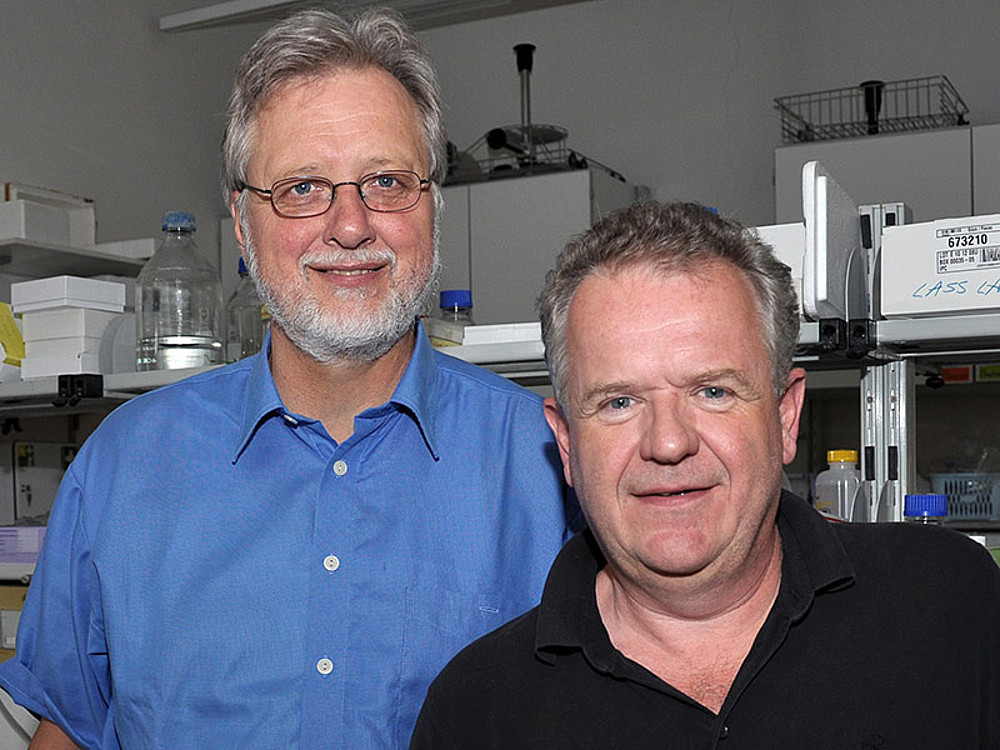
Rudolf Zechner (l.) wird im Rahmen des ERC Advanced Grant eng mit Gerald Höfler zusammenarbeiten.

Rudolf Zechner (l.) wird im Rahmen des ERC Advanced Grant eng mit Gerald Höfler zusammenarbeiten.

Rudolf Zechner, Biochemiker der Uni Graz, erhält 2,5 Millionen Euro ERC Advanced Grant für Stoffwechselforschung

Die komplexen Zusammenhänge zwischen Störungen des Fettstoffwechsels und damit verbundenen Erkrankungen stehen im Fokus der Forschungen von Univ.-Prof. Dr. Rudolf Zechner, Biochemiker am Institut für Molekulare Biowissenschaften der Karl-Franzens-Universität Graz. Als einer der führenden Forscher auf diesem Gebiet erhält Rudolf Zechner nun einen mit 2,5 Millionen Euro dotierten ERC Advanced Grant des Europäischen Forschungsrates (European Research Council, ERC). Die Förderschiene ist für herausragende Forschungspersönlichkeiten in der Europäischen Union reserviert, die besonders innovative und zukunftsweisende Forschungsansätze einbringen. „Die Zuerkennung des ERC Advanced Grant ist ein klares Signal dafür, dass an der Uni Graz exzellente, international sichtbare Forschung betrieben wird“, freut sich Christa Neuper, Rektorin der Karl-Franzens-Universität Graz, über die hoch dotierte Drittmittel-Einwerbung.


Rudolf Zechner ist erfolgreicher Projektleiter sowie Koordinator mehrerer Forschungskonsortien, unter anderem des vom Österreichischen Wissenschaftsfonds FWF geförderten Spezialforschungsbereichs (SFB) LIPOTOX. Der Grazer Wissenschafter erhielt bereits zahlreiche Auszeichnungen, unter anderem den Wittgensteinpreis 2007, Österreichs höchstdotierten Forschungspreis.


Im Mittelpunkt der wissenschaftlichen Arbeit von Rudolf Zechner steht die Erforschung des Zusammenhangs zwischen dem Fettstoffwechsel und der sogenannten krebsassoziierten Kachexie. Der Begriff bezeichnet eine lebensbedrohliche Abmagerung, die häufig bei schweren Erkrankungen wie Krebs oder AIDS auftritt. Kachexie wird nicht nur durch eine zu geringe Nahrungsaufnahme bedingt, sondern ist auch das Resultat komplexer Stoffwechselstörungen, die noch nicht vollständig aufgeklärt sind. Dabei kommt es neben dem massiven Abbau von Fettgewebe auch zu einem Verlust an Muskelmasse. Die derart geschwächten PatientInnen sind anfälliger für Infektionen und können für ihre Grunderkrankung notwendige Therapien wie Chemo- oder Strahlentherapie schlechter verkraften. Schätzungen zufolge stirbt ungefähr ein Drittel der PatientInnen an den Folgen der Kachexie, nicht an der Grunderkrankung selbst.


Im Jahr 2011  gelang es den Arbeitsgruppen von Rudolf Zechner und Univ.-Prof. Dr. Gerald Höfler vom Institut für Pathologie der Medizinischen Universität Graz, einen direkten Zusammenhang zwischen dem Fettstoffwechsel und der krebsassoziierten Kachexie herzustellen. Die beiden Wissenschafter, die seit Jahren eng zusammenarbeiten, publizierten ihre Erkenntnisse im renommierten Fachmagazin Science.

Dieser herausragende Forschungserfolg ist ein Beispiel für die fruchtbringende Zusammenarbeit der Grazer Universitäten im Bereich der biomedizinischen Forschung, die 2012 mit der Gründung der Forschungsplattform BioTechMed-Graz institutionalisiert wurde. Sie führt Arbeitsgruppen der Karl-Franzens-Universität, der Medizinischen Universität und der TU Graz zusammen.


In dem 2014 anlaufenden ERC Advanced Grant „LipoChEX“ wird die enge und interdisziplinäre Zusammenarbeit von Rudolf Zechner und Gerald Höfler wieder eine wichtige Grundlage bilden. „Es gilt herauszufinden, wie verschiedene Krebsarten den Fettstoffwechsel beeinflussen und wie sich umgekehrt die Modulierung des Fettstoffwechsels auf das Entstehen von Krebs und Kachexie auswirkt“, so Zechner. Auch eine mögliche medikamentöse Intervention soll erforscht werden.

 

>> Foto zum Download

created by Caroline Schober und Gudrun Pichler

Related news

Austria’s emissions rose in 2025: University of Graz researchers analyse the causes

The Environment Agency Austria has today published the figures for the country’s greenhouse gas emissions in 2025. While emissions fell sharply year on year from 2022 to 2024, they rose again by just under 0.7 per cent in 2025. Researchers at the University of Graz have analysed how much of this increase was due to structural changes in the economy and how much was attributable to external factors over which there is little control. “In 2025, the colder winter compared with 2024 increased emissions by 0.81 per cent, while the weak economy reduced them by 0.38 per cent. If we factor out these influences, we find an underlying increase of 0.26 per cent compared with the previous year,” reports economist Karl Steininger. “This clearly means that Austria is not on track to meet its climate targets, which require a substantial reduction in emissions by 2030.”

Electrifying: Researchers film the first moments on the way from light to electricity

Physicists at the University of Graz (Austria), in collaboration with colleagues from Marburg University and Forschungszentrum Jülich (Germany), have achieved a scientific breakthrough. For the first time, the generation of electrical energy from light has been filmed and described theoretically. This work is of far-reaching significance, not least for optimising sustainable energy production from photovoltaics. This is because it provides fundamental building blocks for understanding the physical processes that take place, for example, in organic solar cells. The paper was published in the journal Physical Review X, one of the world’s most prestigious physics journals.

University of Graz: Working together to make Styria a sustainable centre of learning

Round table calls for sustainable funding for the 2028–2030 performance agreement period between the five Styrian universities and the federal government.

How can we teach using YouTube and AI? The University of Graz is strengthening media education in schools

A journey through the blood vessels using VR headsets brings biology lessons to life. An interactive quiz brings physics to life. The YouTube video explains the First World War. Whilst mobile phones are increasingly being banned from the classroom, social media platforms, apps and AI are playing an ever-greater role in knowledge transfer at school. But how can teaching with media be made even more effective? What are the challenges in media-based teaching? At the University of Graz, researchers are discussing these issues at a conference being held in Austria for the first time.

Begin of page section:
Additional information:

University of Graz
Universitaetsplatz 3
8010 Graz
Austria
  • Contact
  • Web Editors
  • Moodle
  • UNIGRAZonline
  • Imprint
  • Data Protection Declaration
  • Accessibility Declaration
Weatherstation
Uni Graz

End of this page section. Go to overview of page sections

End of this page section. Go to overview of page sections

Begin of page section:

End of this page section. Go to overview of page sections

