Begin of page section:
Page sections:

  • Go to contents (Accesskey 1)
  • Go to position marker (Accesskey 2)
  • Go to main navigation (Accesskey 3)
  • Go to sub navigation (Accesskey 4)
  • Go to additional information (Accesskey 5)
  • Go to page settings (user/language) (Accesskey 8)
  • Go to search (Accesskey 9)

End of this page section. Go to overview of page sections

Begin of page section:
Page settings:

English en
Deutsch de
Search
Login

End of this page section. Go to overview of page sections

Begin of page section:
Search:

Search for details about Uni Graz
Close

End of this page section. Go to overview of page sections


Search

Begin of page section:
Main navigation:

Page navigation:

  • University

    University
    • About the University
    • Organisation
    • Faculties
    • Library
    • Working at University of Graz
    • Campus
    Developing solutions for the world of tomorrow - that is our mission. Our students and our researchers take on the great challenges of society and carry the knowledge out.
  • Research Profile

    Research Profile
    • Our Expertise
    • Research Questions
    • Research Portal
    • Promoting Research
    • Research Transfer
    • Ethics in Research
    • Commission for Scientific Integrity
    Scientific excellence and the courage to break new ground. Research at the University of Graz creates the foundations for making the future worth living.
  • Studies

    Studies
    • Prospective Students
    • Students
  • Community

    Community
    • International
    • Location
    • Research and Business
    • Alumni
    The University of Graz is a hub for international research and brings together scientists and business experts. Moreover, it fosters the exchange and cooperation in study and teaching.
  • Spotlight
Topics
  • Sustainable University
  • Researchers answer
  • Work for us
Close menu

End of this page section. Go to overview of page sections

Begin of page section:
You are here:

University of Graz News Heatwaves: University of Graz presents Plan for seamless early warning system

End of this page section. Go to overview of page sections

Monday, 08 July 2024

Heatwaves: University of Graz presents Plan for seamless early warning system

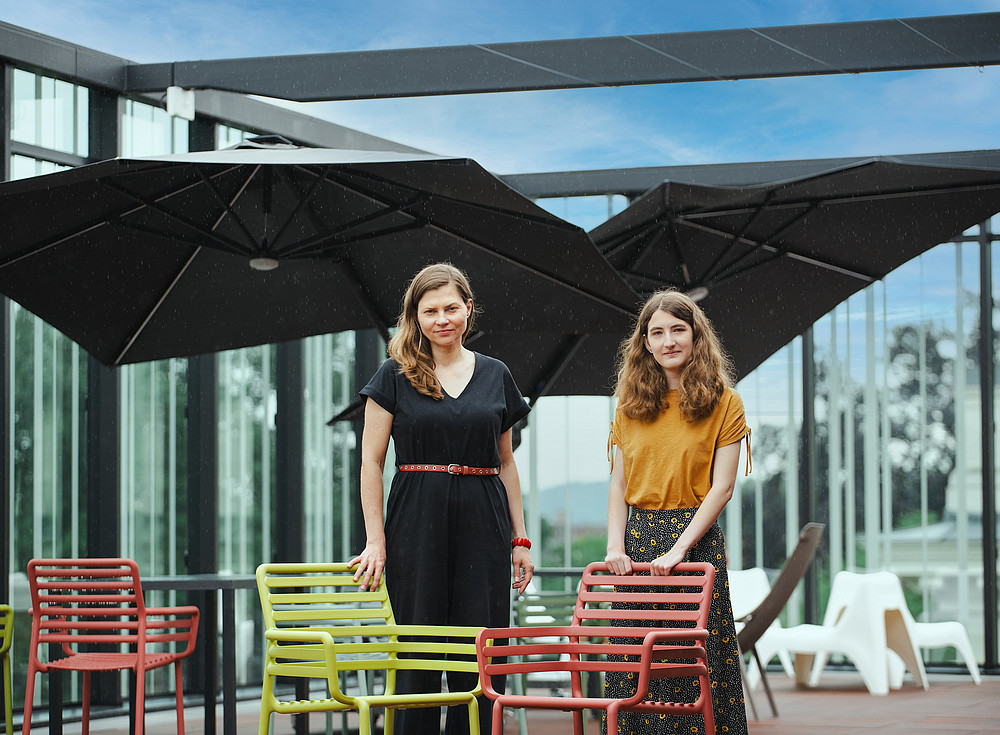
Two women are standing on the terrace of the University Library in Graz under a blue sky. ©Uni Graz/Tzivanopoulos

Ilona Otto and Chloe Brimicombe are working on improving early warning systems for heatwaves. Photo: Uni Graz/Tzivanopoulos

An international research team led by the University of Graz is investigating the challenges of a global early warning system for heat. The researchers want to better protect vulnerable groups (such as the elderly and children) and prepare them for risks in key sectors such as agriculture and health at an early stage.

The concrete jungle of our cities is turning into glowing heat islands, balconies are becoming unbearable ovens and even the night sometimes offers no relief: heat waves are silent killers and are becoming more frequent, occurring at higher temperatures, affecting more people and lasting longer.

This heat is not only unpleasant, but also poses a serious health risk for many people. The World Meteorological Organisation and World Health Organisation has had a long-standing mandate for heat health early warning systems to alert the population in the affected regions in good time.

The development of a global early warning system requires cooperation and consensus. One step in this process is to identify potential obstacles. That is why an international team of climate experts, guided by Chloe Brimicombe from the Wegener Center at the University of Graz, has analysed the major challenges and presents a vision for the way forward in detail in a study.

People at risk

"There are already some well-functioning warning systems in place worldwide," explains Brimicombe. “However, there are gaps. There is no internationally standardised definition of heat, and in some regions the monitoring data is patchy. In addition, social aspects are often not sufficiently taken into account in the current efforts.”

Ilona M. Otto from the Wegener Center at the University of Graz examined this aspect as part of the study. "Heat does not affect everyone equally. People who have to work outdoors are particularly at risk," explains Otto. An early warning system could help here by suggesting adjustments to working hours or providing more protective clothing and water.

Jennifer Runkle of North Carolina State University, co-author of the study, emphasizes the additional benefits of such early warning systems beyond health care. "A global heatwave early warning system can not only protect particularly vulnerable groups such as pregnant women and children, but also provide warning for risks in critical areas such as forestry, agriculture and education."

Publication

Preventing heat-related deaths: The urgent need for a global early warning system for heat; Chloe Brimicombe, Jennifer D. Runkle, Cascade Tuholske, Daniela I. V. Domeisen, Chuansi Gao, Jørn Toftum, Ilona M. Otto

https://journals.plos.org/climate/article?id=10.1371/journal.pclm.0000437

created by Roman Vilgut

Related news

Forscher:innen entdecken natürlichen Wirkstoff zum Schutz vor Lebererkrankungen

Die Leber leidet still. „Fetteinlagerungen, strukturelle Zerstörung des Gewebes oder mutierende Tumorzellen – all das fliegt eine Weile unter dem Radar. Begleitet werden diese Veränderungen oft von leichten, jedoch chronischen Entzündungen“, erklärt Andreas Koeberle, Pharmazeut an der Universität Graz. Er hat mit seinem Team und Kolleg:innen der Universität Innsbruck den Wirkstoff Mitrephoron B untersucht, der neue Behandlungsansätze ermöglicht. Die Ergebnisse der Studie wurden kürzlich in der Open-Access-Fachzeitschrift „Theranostics“ veröffentlicht.

Climate at the cliffs: Researchers unravel the evolution of the Greenland ice margin

Vertical ice walls, up to 40 metres high: in "Game of Thrones" they were dramatised as fortifications; during the Cold War, they were studied with great interest. How these imposing walls along Greenland’s 80,000-kilometre-long ice margin formed, how they are evolving, and what impact they have on the climate is not yet fully understood. Researchers from the Universities of Graz and Innsbruck have come one step closer to solving the mystery. The results of their latest study have been published in the journal The Cryosphere.

Achieving climate goals: Researchers highlight need for fair country shares in CO2

As the war in the Middle East is currently reminding us once again, many countries around the world are heavily reliant on oil and gas. Lax climate policy and limited options for removing CO₂ from the atmosphere could cement this dependence for future generations. Scientists at the University of Graz highlight this danger in a new study published in the journal Global Environmental Change. They find that rights to carbon dioxide removal should be distributed across countries just as fairly as emission budgets in order to halt global warming.

Electrons and AI: New approaches to the search for new medicines

Researchers at the University of Graz are revolutionising the development of new medicines by combining electrochemistry and artificial intelligence. Thanks to smart optimisation, the search for new active ingredients will in future be faster, more sustainable and safer.

Begin of page section:
Additional information:

University of Graz
Universitaetsplatz 3
8010 Graz
Austria
  • Contact
  • Web Editors
  • Moodle
  • UNIGRAZonline
  • Imprint
  • Data Protection Declaration
  • Accessibility Declaration
Weatherstation
Uni Graz

End of this page section. Go to overview of page sections

End of this page section. Go to overview of page sections

Begin of page section:

End of this page section. Go to overview of page sections