Begin of page section:
Page sections:

  • Go to contents (Accesskey 1)
  • Go to position marker (Accesskey 2)
  • Go to main navigation (Accesskey 3)
  • Go to sub navigation (Accesskey 4)
  • Go to additional information (Accesskey 5)
  • Go to page settings (user/language) (Accesskey 8)
  • Go to search (Accesskey 9)

End of this page section. Go to overview of page sections

Begin of page section:
Page settings:

English en
Deutsch de
Search
Login

End of this page section. Go to overview of page sections

Begin of page section:
Search:

Search for details about Uni Graz
Close

End of this page section. Go to overview of page sections


Search

Begin of page section:
Main navigation:

Page navigation:

  • University

    University
    • About the University
    • Organisation
    • Faculties
    • Library
    • Working at University of Graz
    • Campus
    Developing solutions for the world of tomorrow - that is our mission. Our students and our researchers take on the great challenges of society and carry the knowledge out.
  • Research Profile

    Research Profile
    • Our Expertise
    • Research Questions
    • Research Portal
    • Promoting Research
    • Research Transfer
    • Ethics in Research
    • Commission for Scientific Integrity
    Scientific excellence and the courage to break new ground. Research at the University of Graz creates the foundations for making the future worth living.
  • Studies

    Studies
    • Prospective Students
    • Students
    • Registration for Study Programme (Winter semester 2026/27)
    • Welcome Weeks for First Year Students
  • Community

    Community
    • International
    • Location
    • Research and Business
    • Alumni
    The University of Graz is a hub for international research and brings together scientists and business experts. Moreover, it fosters the exchange and cooperation in study and teaching.
Topics
  • Sustainable University
  • Researchers answer
  • Work for us
Close menu

End of this page section. Go to overview of page sections

Begin of page section:
You are here:

University of Graz News Heatwaves: University of Graz presents Plan for seamless early warning system

End of this page section. Go to overview of page sections

Monday, 08 July 2024

Heatwaves: University of Graz presents Plan for seamless early warning system

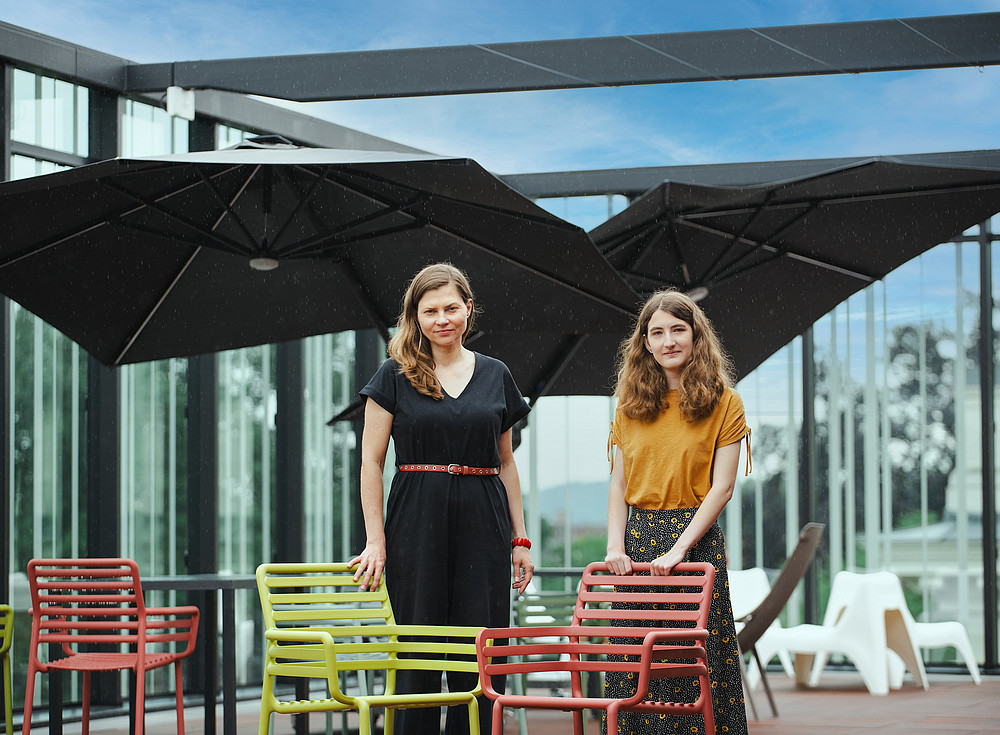
Two women are standing on the terrace of the University Library in Graz under a blue sky. ©Uni Graz/Tzivanopoulos
©Uni Graz/Tzivanopoulos

Ilona Otto and Chloe Brimicombe are working on improving early warning systems for heatwaves. Photo: Uni Graz/Tzivanopoulos

An international research team led by the University of Graz is investigating the challenges of a global early warning system for heat. The researchers want to better protect vulnerable groups (such as the elderly and children) and prepare them for risks in key sectors such as agriculture and health at an early stage.

The concrete jungle of our cities is turning into glowing heat islands, balconies are becoming unbearable ovens and even the night sometimes offers no relief: heat waves are silent killers and are becoming more frequent, occurring at higher temperatures, affecting more people and lasting longer.

This heat is not only unpleasant, but also poses a serious health risk for many people. The World Meteorological Organisation and World Health Organisation has had a long-standing mandate for heat health early warning systems to alert the population in the affected regions in good time.

The development of a global early warning system requires cooperation and consensus. One step in this process is to identify potential obstacles. That is why an international team of climate experts, guided by Chloe Brimicombe from the Wegener Center at the University of Graz, has analysed the major challenges and presents a vision for the way forward in detail in a study.

People at risk

"There are already some well-functioning warning systems in place worldwide," explains Brimicombe. “However, there are gaps. There is no internationally standardised definition of heat, and in some regions the monitoring data is patchy. In addition, social aspects are often not sufficiently taken into account in the current efforts.”

Ilona M. Otto from the Wegener Center at the University of Graz examined this aspect as part of the study. "Heat does not affect everyone equally. People who have to work outdoors are particularly at risk," explains Otto. An early warning system could help here by suggesting adjustments to working hours or providing more protective clothing and water.

Jennifer Runkle of North Carolina State University, co-author of the study, emphasizes the additional benefits of such early warning systems beyond health care. "A global heatwave early warning system can not only protect particularly vulnerable groups such as pregnant women and children, but also provide warning for risks in critical areas such as forestry, agriculture and education."

Publication

Preventing heat-related deaths: The urgent need for a global early warning system for heat; Chloe Brimicombe, Jennifer D. Runkle, Cascade Tuholske, Daniela I. V. Domeisen, Chuansi Gao, Jørn Toftum, Ilona M. Otto

https://journals.plos.org/climate/article?id=10.1371/journal.pclm.0000437
created by Roman Vilgut

Related news

Preserving cultural heritage: Graz researchers make Roman inscriptions legible again

Researchers from the University of Graz and Graz University of Technology are working to save inscriptions carved in stone in Styria during Roman times from disappearing. They have developed a simple and cost-effective method to make inscriptions on tombs and votive altars – which have been weathered or damaged – legible again. They are currently testing the method on Roman stones at several sites across Styria. The aim is to provide other historians with a tool to preserve cultural heritage when expensive research equipment is not available. The method was recently published in the research journal Heritage Science.

When the sun goes dark: Enlightening for science and the people of Graz

When the moon partially passes in front of the sun in Graz on 12 August 2026, the event will once again captivate many people. This includes Manuela Temmer, an astrophysicist at the University of Graz. The scientist confirms that this celestial phenomenon offers significant value for research: “During a solar eclipse, the corona can be observed more clearly than with any instrument.”

Courtly Love and Aubergines: What Medieval Literature Has in Common with Emojis

Plants and fruits were already used as symbols of love in the Middle Ages. German studies scholar Isabella Managò, together with her colleagues Brigitte Spreitzer-Fleck and Julia Zimmermann, explains how this came about and why this figurative language remains familiar to us to this day.

New technology from the University of Graz reveals the hidden properties of tumour cells

It sounds like science fiction, but it could advance cancer research in the future: a team at the University of Graz, led by physicist Jan Enenkel, is developing a new laboratory device using laser technology that can be used to examine individual tumour cells. The idea is reminiscent of the medical tricorder from the Star Trek film series – albeit as a high-precision measurement platform. A spin-off fellowship from the Austrian Research Promotion Agency (FFG) is supporting the development of the technology at the University of Graz with around 500,000 euros.

Begin of page section:
Additional information:

University of Graz
Universitaetsplatz 3
8010 Graz
Austria
  • Contact
  • Web Editors
  • Moodle
  • UNIGRAZonline
  • Imprint
  • Data Protection Declaration
  • Accessibility Declaration
Weatherstation
Uni Graz

End of this page section. Go to overview of page sections

End of this page section. Go to overview of page sections

Begin of page section:

End of this page section. Go to overview of page sections