Begin of page section:
Page sections:

  • Go to contents (Accesskey 1)
  • Go to position marker (Accesskey 2)
  • Go to main navigation (Accesskey 3)
  • Go to sub navigation (Accesskey 4)
  • Go to additional information (Accesskey 5)
  • Go to page settings (user/language) (Accesskey 8)
  • Go to search (Accesskey 9)

End of this page section. Go to overview of page sections

Begin of page section:
Page settings:

English en
Deutsch de
Search
Login

End of this page section. Go to overview of page sections

Begin of page section:
Search:

Search for details about Uni Graz
Close

End of this page section. Go to overview of page sections


Search

Begin of page section:
Main navigation:

Page navigation:

  • University

    University
    • About the University
    • Organisation
    • Faculties
    • Library
    • Working at University of Graz
    • Campus
    Developing solutions for the world of tomorrow - that is our mission. Our students and our researchers take on the great challenges of society and carry the knowledge out.
  • Research Profile

    Research Profile
    • Our Expertise
    • Research Questions
    • Research Portal
    • Promoting Research
    • Research Transfer
    • Ethics in Research
    Scientific excellence and the courage to break new ground. Research at the University of Graz creates the foundations for making the future worth living.
  • Studies

    Studies
    • Prospective Students
    • Students
  • Community

    Community
    • International
    • Location
    • Research and Business
    • Alumni
    The University of Graz is a hub for international research and brings together scientists and business experts. Moreover, it fosters the exchange and cooperation in study and teaching.
  • Spotlight
Topics
  • Our digital Advent calendar
  • Sustainable University
  • Researchers answer
  • Work for us
Close menu

End of this page section. Go to overview of page sections

Begin of page section:
You are here:

University of Graz News Gut oder böse?

End of this page section. Go to overview of page sections

Thursday, 13 June 2013

Gut oder böse?

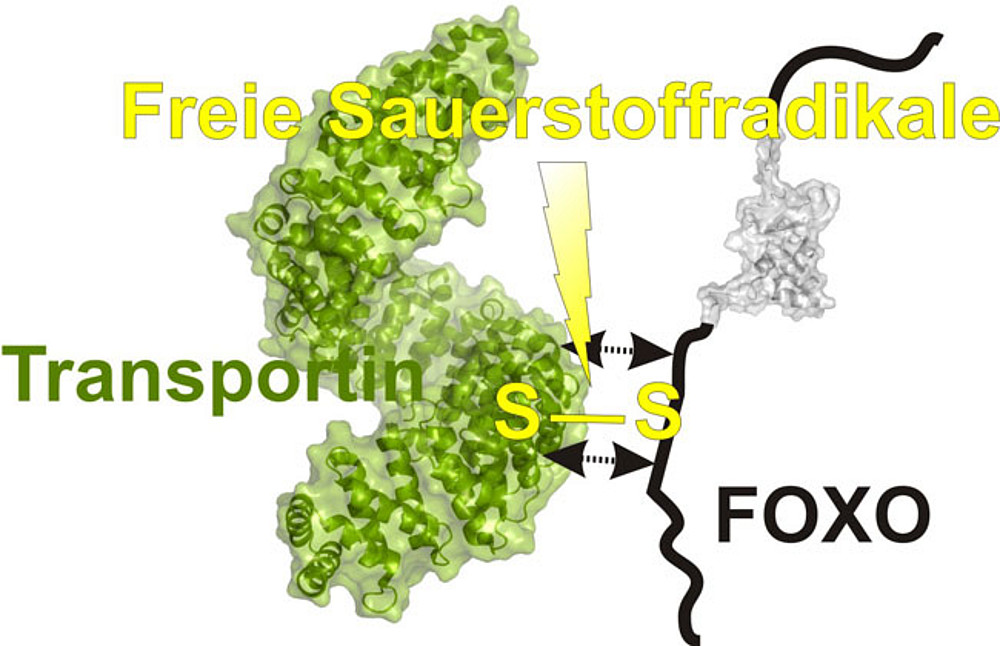
Uni Graz-ForscherInnen erforschen Mechanismen in der Zelle. Foto: Madl.

Uni Graz-ForscherInnen erforschen Mechanismen in der Zelle. Foto: Madl.

ForscherInnen der Uni Graz klären die Funktion von Freien Radikalen im Zellstoffwechsel auf

Freie Sauerstoffradikale sind aggressive Moleküle, die großen Schaden anrichten können, indem sie unkontrolliert chemische Reaktionen eingehen. Sie spielen bei der Alterung und auch bei der Entstehung vieler Krankheiten – wie zum Beispiel Krebs – eine zentrale Rolle. Radikale sind aber auch wichtig für das normale Funktionieren von Zellen im Organismus – sie initiieren ein Signal, das wiederum jene Gene aktiviert, die Zellen vor schädlichen äußeren Einflüssen schützen. Unter der Mitarbeit von Dr. Tobias Madl vom Institut für Chemie der Karl-Franzens-Universität Graz konnte nun ein internationales ForscherInnenteam die molekularen Mechanismen aufklären, die zeigen, wie Radikale die Gene aktivieren. Die Arbeit wurde in der aktuellen Ausgabe der renommierten Fachzeitschrift „Molecular Cell“ publiziert.


Unkontrollierte Zellteilung und Schäden in der Zelle sind die Hauptursachen von Krebs und altersbedingten Krankheiten wie Alzheimer und Parkinson. WissenschafterInnen konnten nun zeigen, dass Sauerstoffradikale eine bestimmte Klasse von Proteinen – sogenannte FOXO Transkriptionsfaktoren – anregen. „Die Proteine sammeln sich im Zellkern an und aktivieren eine Reihe von Genen, die dafür sorgen, dass sich die Zelle nicht mehr teilt und sich somit gegen Schäden schützt“, erklärt Madl. Der von ihm und dem Forschungsteam entdeckte Mechanismus ermöglicht es nun erstmalig, diesen Selbstschutzmechanismus der Zelle zu verstehen. „Mit diesem Wissen können neue Ansätze entwickelt und so eine Reihe von Krebsarten und altersbedingten Krankheiten bekämpft werden“, führt der Chemiker aus.


Der Grazer Tobias Madl forscht an der Universität Graz sowie an der Technischen Universität München und am Helmholtz Zentrum München. Seine Forschungsgruppe arbeitet auf dem Gebiet der Strukturbiologie. Ziel der Vorhaben ist es, die grundlegenden molekularen Mechanismen der Wechselwirkungen unstrukturierter Proteine aufzuklären und damit Einblick in die komplizierte Verbindung zwischen deren Funktion und Krankheiten zu erhalten.


Publikation:
Redox-Dependent Control of FOXO/DAF-16 by Transportin-1,
Putker Marrit, Madl Tobias, Vos Harmjan, de Ruiter Hester, Visscher Marieke, van den Berg MC, Kaplan Mohammed, Korswagen HC, Boelens Rolf, Vermeulen Michiel, Burgering Boudewijn, Dansen Tobias,
Molecular Cell 21. Februar 2013


Online verfügbar unter http://www.cell.com/molecular-cell/abstract/S1097-2765%2812%2901050-7
 

Rückfragen:
Dr. Tobias Madl
Institut für Chemie, Bereich Organische und Bioorganische Chemie
Karl-Franzens-Universität Graz
Tel.: 0316 / 380 – 5340
Mobil: 0699 12182896
E-Mail: tobias.madl(at)uni-graz.at

created by Tobias Madl & Konstantinos Tzivanopoulos

Related news

Chemical Christmas show at the University of Graz: An explosive evening at the Schauspielh

At the beginning of December, the University of Graz transformed the theater into a laboratory: as part of “Chemical Life,” teacher training students staged a chemical Christmas show for Styrian school classes—complete with ethanol rockets, nitrogen snow, and glowing effects. An evening designed to inspire interest in studying chemistry.

Train by train: Koralm railway accelerates exchange between the Universities

Lectures at the University of Klagenfurt in the morning, seminars at the University of Graz in the afternoon: Austria's longest tunnel and a journey time of around 45 minutes make it easy. The Koralm railway increases the speed of networking between the two university locations. The collaboration builds on existing cooperation - for example in the areas of teacher training, Slavic studies and as employers, the universities are well coordinated.

On the trail of the Big Bang: University of Graz receives 1.5 million euros for doctoral programmes

The Austrian Science Fund FWF has selected the Doctoral Programme in Theoretical Particle Physics at the University of Graz for funding from the Doc.funds. Six young scientists will be funded for 3.5 years. They will gain fundamentally new insights into the origins of the world.

From trans women and knee prostheses: sports science prizes awarded

Walking better with a prosthesis, successfully getting rid of excess weight, training more effectively, more fairness for trans people in sport: these were the topics addressed by the students at the University of Graz who were awarded the sports science prizes for their Master's theses on 3 December 2025.

Begin of page section:
Additional information:

University of Graz
Universitaetsplatz 3
8010 Graz
Austria
  • Contact
  • Web Editors
  • Moodle
  • UNIGRAZonline
  • Imprint
  • Data Protection Declaration
  • Accessibility Declaration
Weatherstation
Uni Graz

End of this page section. Go to overview of page sections

End of this page section. Go to overview of page sections

Begin of page section:

End of this page section. Go to overview of page sections