Begin of page section:
Page sections:

  • Go to contents (Accesskey 1)
  • Go to position marker (Accesskey 2)
  • Go to main navigation (Accesskey 3)
  • Go to sub navigation (Accesskey 4)
  • Go to additional information (Accesskey 5)
  • Go to page settings (user/language) (Accesskey 8)
  • Go to search (Accesskey 9)

End of this page section. Go to overview of page sections

Begin of page section:
Page settings:

English en
Deutsch de
Search
Login

End of this page section. Go to overview of page sections

Begin of page section:
Search:

Search for details about Uni Graz
Close

End of this page section. Go to overview of page sections


Search

Begin of page section:
Main navigation:

Page navigation:

  • University

    University
    • About the University
    • Organisation
    • Faculties
    • Library
    • Working at University of Graz
    • Campus
    Developing solutions for the world of tomorrow - that is our mission. Our students and our researchers take on the great challenges of society and carry the knowledge out.
  • Research Profile

    Research Profile
    • Our Expertise
    • Research Questions
    • Research Portal
    • Promoting Research
    • Research Transfer
    • Ethics in Research
    Scientific excellence and the courage to break new ground. Research at the University of Graz creates the foundations for making the future worth living.
  • Studies

    Studies
    • Prospective Students
    • Students
  • Community

    Community
    • International
    • Location
    • Research and Business
    • Alumni
    The University of Graz is a hub for international research and brings together scientists and business experts. Moreover, it fosters the exchange and cooperation in study and teaching.
  • Spotlight
Topics
  • Our digital Advent calendar
  • Sustainable University
  • Researchers answer
  • Work for us
Close menu

End of this page section. Go to overview of page sections

Begin of page section:
You are here:

University of Graz News Gut Holz!

End of this page section. Go to overview of page sections

Wednesday, 16 December 2020

Gut Holz!

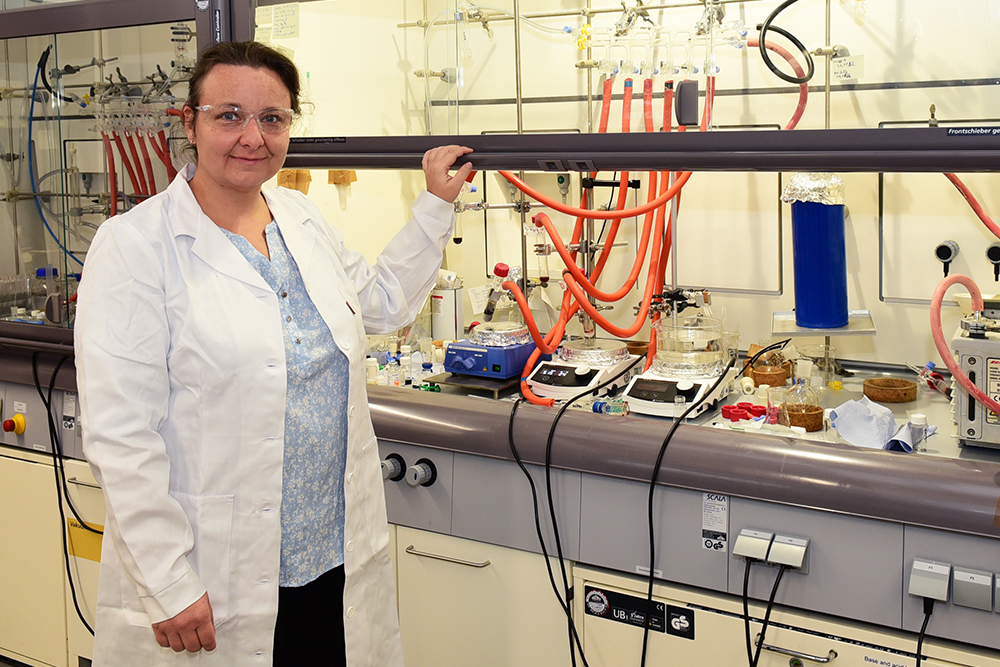
Katalin Barta Weissert arbeitet seit Anfang des Jahres als Professorin für Chemie an der Universität Graz. Die ERC Grant-Trägerin erforscht die Katalyse von Biomasse. Foto: Uni Graz/Schweiger

Katalin Barta Weissert arbeitet seit Anfang des Jahres als Professorin für Chemie an der Universität Graz. Die ERC Grant-Trägerin erforscht die Katalyse von Biomasse. Foto: Uni Graz/Schweiger

Katalin Barta Weissert, neue Professorin für Chemie und ERC Grant-Trägerin, erforscht die Katalyse von Biomasse

Nachhaltige Methoden, nachwachsende Rohstoffe und umweltfreundliche Reaktionen stehen in der sogenannten „Grünen Chemie“ im Fokus. ChemikerInnen der Universität Graz arbeiten erfolgreich auf diesem Gebiet. Mit der neuen Professorin Katalin Barta Weissert, zuletzt an der Universität Groningen (NL) tätig, haben dieser Sektor und zugleich der Profilbildende Bereich „Climate Change Graz“ Verstärkung erfahren. „Ich hatte bereits zuvor Kontakt mit ChemikerInnen der Universität Graz und wusste, es ist ein sehr gutes Institut“, begründet Barta Weissert ihren Entschluss, Anfang des Jahres von den Niederlanden nach Österreich zu wechseln.

Erneuerbare Ressourcen
Die Wissenschafterin hat neben vielen Auszeichnungen einen ERC Grant in der Höhe von 1,5 Millionen Euro mit im Gepäck. Ein besonderer Fokus ihrer Forschung liegt auf der Katalyse von Biomasse. Und passend zum riesigen Waldbestand der Steiermark widmet sich die Wissenschafterin der Ressource Holz. „Wir entwickeln ganz neue, kreative Methoden, um Stoffe wie etwa Zellulose und Lignin in seine kleinsten Bestandteile zu zerlegen und dann wieder aufzubauen“, erklärt Katalin Barta Weissert. „Dabei achten wir darauf, dass zum Beispiel weniger Nebenprodukte entstehen und die Reaktionsprozesse effizienter ablaufen.“ Dank der Arbeit mit erneuerbaren Ressourcen werde zugleich der Einsatz fossiler Substanzen reduziert, was sich wiederum auf die Klimabilanz positiv auswirkt.
Katalin Barta Weissert und ihrem Team ist es unter anderem bereits gelungen, auf Basis von Holz neuartige Möglichkeiten für die Entwicklung von Arzneimitteln, Polymeren und Biotreibstoffen zu eröffnen. Diese Erkenntnisse sind daher sowohl für die Entwicklung von Patenten als auch für IndustriepartnerInnen interessant. Dieses Ziel verfolgt die Forscherin ebenso in ihrem ERC Starting Grant „CatASus“, in dem sie die Rolle von Aminen, also Stickstoffverbindungen, bei der Katalyse von Biomasse untersucht und der noch bis zum nächsten Jahr läuft.

Damit die Chemie stimmt
Auch in der Zusammenarbeit muss für Barta Weissert die sprichwörtliche Chemie passen. Speziell wenn sich das Team der gebürtigen Slowakin, die in Aachen promovierte und danach vier Jahre an der University of California sowie an der Yale University arbeitete, international zusammensetzt. Ihrer Gruppe gehören DissertantInnen und PostDocs im Moment aus Österreich, Italien, Ungarn, China, Mexiko, Russland, Indien, Brasilien, Belgien und Rumänien an. „Verschiedene Kulturen sind sehr bereichernd“, so die Forscherin. „Respekt und Begegnung auf Augenhöhe sind essenziell.“

created by Andreas Schweiger

Related news

Semester abroad without barriers: University of Graz wins award for promoting inclusion

The University of Graz has been awarded the Internationalization Award for its new inclusion initiative. Students with fewer opportunities now also receive financial support for their semester abroad outside Europe.

Fair distribution: Researchers determine just greenhouse gas budgets for all EU regions

Ten years ago, on 12 December 2015, the Paris Climate Agreement was signed at the UN Climate Conference. In order to limit global warming to well below two degrees, only a certain amount of CO2 may be emitted worldwide. While the focus was originally on national emission targets, more than 200 subnational regions and almost 300 cities have now adopted their own targets. But how many emissions are they fairly entitled to? Researchers at the University of Graz have now developed transparent criteria for fair distribution at the subnational level for the first time and determined corresponding greenhouse gas budgets for all European regions. The paper was published today in the scientific journal Nature Communications.

Chemical Christmas show at the University of Graz: An explosive evening at the Schauspielh

At the beginning of December, the University of Graz transformed the theater into a laboratory: as part of “Chemical Life,” teacher training students staged a chemical Christmas show for Styrian school classes—complete with ethanol rockets, nitrogen snow, and glowing effects. An evening designed to inspire interest in studying chemistry.

Train by train: Koralm railway accelerates exchange between the Universities

Lectures at the University of Klagenfurt in the morning, seminars at the University of Graz in the afternoon: Austria's longest tunnel and a journey time of around 45 minutes make it easy. The Koralm railway increases the speed of networking between the two university locations. The collaboration builds on existing cooperation - for example in the areas of teacher training, Slavic studies and as employers, the universities are well coordinated.

Begin of page section:
Additional information:

University of Graz
Universitaetsplatz 3
8010 Graz
Austria
  • Contact
  • Web Editors
  • Moodle
  • UNIGRAZonline
  • Imprint
  • Data Protection Declaration
  • Accessibility Declaration
Weatherstation
Uni Graz

End of this page section. Go to overview of page sections

End of this page section. Go to overview of page sections

Begin of page section:

End of this page section. Go to overview of page sections