



Begin of page section:
Page sections:

  • Go to contents (Accesskey 1)
  • Go to position marker (Accesskey 2)
  • Go to main navigation (Accesskey 3)
  • Go to sub navigation (Accesskey 4)
  • Go to additional information (Accesskey 5)
  • Go to page settings (user/language) (Accesskey 8)
  • Go to search (Accesskey 9)

End of this page section. Go to overview of page sections

Begin of page section:
Page settings:

English en
Deutsch de
Search
Login

End of this page section. Go to overview of page sections

Begin of page section:
Search:

Search for details about Uni Graz
Close

End of this page section. Go to overview of page sections


Search

Begin of page section:
Main navigation:

Page navigation:

  • University

    University
    • About the University
    • Organisation
    • Faculties
    • Library
    • Working at University of Graz
    • Campus
    Developing solutions for the world of tomorrow - that is our mission. Our students and our researchers take on the great challenges of society and carry the knowledge out.
  • Research Profile

    Research Profile
    • Our Expertise
    • Research Questions
    • Research Portal
    • Promoting Research
    • Research Transfer
    • Ethics in Research
    • Commission for Scientific Integrity
    Scientific excellence and the courage to break new ground. Research at the University of Graz creates the foundations for making the future worth living.
  • Studies

    Studies
    • Prospective Students
    • Students
    • Registration for Study Programme (Winter semester 2026/27)
    • Study Days 22-26 June 2026
  • Community

    Community
    • International
    • Location
    • Research and Business
    • Alumni
    The University of Graz is a hub for international research and brings together scientists and business experts. Moreover, it fosters the exchange and cooperation in study and teaching.
Topics
  • Sustainable University
  • Researchers answer
  • Work for us
Close menu

End of this page section. Go to overview of page sections

Begin of page section:
You are here:

University of Graz News Gut Holz!

End of this page section. Go to overview of page sections

Wednesday, 16 December 2020

Gut Holz!

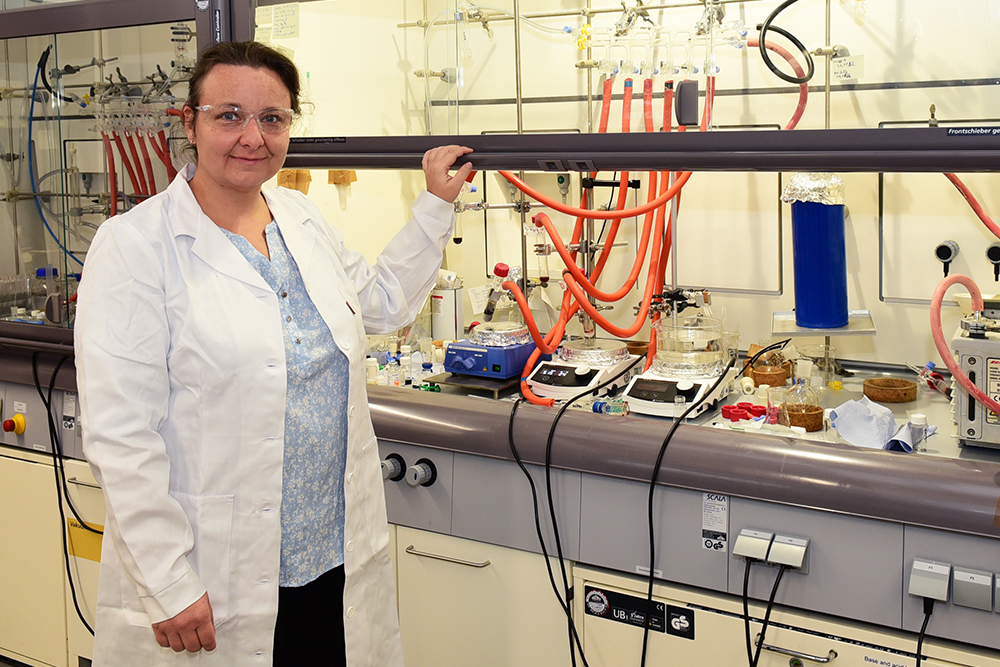
Katalin Barta Weissert arbeitet seit Anfang des Jahres als Professorin für Chemie an der Universität Graz. Die ERC Grant-Trägerin erforscht die Katalyse von Biomasse. Foto: Uni Graz/Schweiger

Katalin Barta Weissert arbeitet seit Anfang des Jahres als Professorin für Chemie an der Universität Graz. Die ERC Grant-Trägerin erforscht die Katalyse von Biomasse. Foto: Uni Graz/Schweiger

Katalin Barta Weissert, neue Professorin für Chemie und ERC Grant-Trägerin, erforscht die Katalyse von Biomasse

Nachhaltige Methoden, nachwachsende Rohstoffe und umweltfreundliche Reaktionen stehen in der sogenannten „Grünen Chemie“ im Fokus. ChemikerInnen der Universität Graz arbeiten erfolgreich auf diesem Gebiet. Mit der neuen Professorin Katalin Barta Weissert, zuletzt an der Universität Groningen (NL) tätig, haben dieser Sektor und zugleich der Profilbildende Bereich „Climate Change Graz“ Verstärkung erfahren. „Ich hatte bereits zuvor Kontakt mit ChemikerInnen der Universität Graz und wusste, es ist ein sehr gutes Institut“, begründet Barta Weissert ihren Entschluss, Anfang des Jahres von den Niederlanden nach Österreich zu wechseln.

Erneuerbare Ressourcen
Die Wissenschafterin hat neben vielen Auszeichnungen einen ERC Grant in der Höhe von 1,5 Millionen Euro mit im Gepäck. Ein besonderer Fokus ihrer Forschung liegt auf der Katalyse von Biomasse. Und passend zum riesigen Waldbestand der Steiermark widmet sich die Wissenschafterin der Ressource Holz. „Wir entwickeln ganz neue, kreative Methoden, um Stoffe wie etwa Zellulose und Lignin in seine kleinsten Bestandteile zu zerlegen und dann wieder aufzubauen“, erklärt Katalin Barta Weissert. „Dabei achten wir darauf, dass zum Beispiel weniger Nebenprodukte entstehen und die Reaktionsprozesse effizienter ablaufen.“ Dank der Arbeit mit erneuerbaren Ressourcen werde zugleich der Einsatz fossiler Substanzen reduziert, was sich wiederum auf die Klimabilanz positiv auswirkt.
Katalin Barta Weissert und ihrem Team ist es unter anderem bereits gelungen, auf Basis von Holz neuartige Möglichkeiten für die Entwicklung von Arzneimitteln, Polymeren und Biotreibstoffen zu eröffnen. Diese Erkenntnisse sind daher sowohl für die Entwicklung von Patenten als auch für IndustriepartnerInnen interessant. Dieses Ziel verfolgt die Forscherin ebenso in ihrem ERC Starting Grant „CatASus“, in dem sie die Rolle von Aminen, also Stickstoffverbindungen, bei der Katalyse von Biomasse untersucht und der noch bis zum nächsten Jahr läuft.

Damit die Chemie stimmt
Auch in der Zusammenarbeit muss für Barta Weissert die sprichwörtliche Chemie passen. Speziell wenn sich das Team der gebürtigen Slowakin, die in Aachen promovierte und danach vier Jahre an der University of California sowie an der Yale University arbeitete, international zusammensetzt. Ihrer Gruppe gehören DissertantInnen und PostDocs im Moment aus Österreich, Italien, Ungarn, China, Mexiko, Russland, Indien, Brasilien, Belgien und Rumänien an. „Verschiedene Kulturen sind sehr bereichernd“, so die Forscherin. „Respekt und Begegnung auf Augenhöhe sind essenziell.“


created by Andreas Schweiger

Related news

Staying fit during the holidays: summer sports on the University of Graz campus

The Kleeblattlauf is not the end of the fitness term. Following last year’s successful launch, the University of Graz is once again offering summer sports on campus this year. From 30 June to 16 July 2026, there will be a free exercise programme in the open air. On the shady Südwiese (between the main building and Universitätsplatz 2), anyone interested can get in shape in the afternoons with body workouts, fascia training and yoga.

Getting even hotter: Researchers predict global warming of 1.7 degrees by 2027

While Europe is currently sweltering in the heat, global temperatures are also rising towards concerning record levels. In 2026, Earth’s surface air temperature is expected to reach 1.62 degrees, and in 2027 even 1.71 degrees Celsius above pre-industrial levels. The long-term temperature rise – an average over a 20-year period – is predicted to exceed the 1.5-degree threshold of the Paris Agreement as of 2026 already. For the first time, researchers at the University of Graz have been able to make such a forecast so far in advance. The intensifying El Niño climate event favors forecast skill and thereby facilitates a reliable computation.

Forest fire at Rosenhain: Volunteer fire brigade carried out an evacuation drill at the Jesuit refectory

Thick smoke in the stairwell, flames at the edge of the forest, people missing in the Jesuit refectory at the University of Graz: at Rosenhain, the Graz Volunteer Fire Brigade carried out a drill simulating a scenario that is becoming increasingly realistic given the heat and drought

Full effort in the heat: the Sports Centre was in full swing at the Kleeblattlauf

On 19 June 2026, 2,000 runners and hundreds of supporters made their way to the Rosenhain for a sporting end-of-term event.

Begin of page section:
Additional information:

University of Graz
Universitaetsplatz 3
8010 Graz
Austria
  • Contact
  • Web Editors
  • Moodle
  • UNIGRAZonline
  • Imprint
  • Data Protection Declaration
  • Accessibility Declaration
Weatherstation
Uni Graz

End of this page section. Go to overview of page sections

End of this page section. Go to overview of page sections

Begin of page section:

End of this page section. Go to overview of page sections

