



Begin of page section:
Page sections:

  • Go to contents (Accesskey 1)
  • Go to position marker (Accesskey 2)
  • Go to main navigation (Accesskey 3)
  • Go to sub navigation (Accesskey 4)
  • Go to additional information (Accesskey 5)
  • Go to page settings (user/language) (Accesskey 8)
  • Go to search (Accesskey 9)

End of this page section. Go to overview of page sections

Begin of page section:
Page settings:

English en
Deutsch de
Search
Login

End of this page section. Go to overview of page sections

Begin of page section:
Search:

Search for details about Uni Graz
Close

End of this page section. Go to overview of page sections


Search

Begin of page section:
Main navigation:

Page navigation:

  • University

    University
    • About the University
    • Organisation
    • Faculties
    • Library
    • Working at University of Graz
    • Campus
    Developing solutions for the world of tomorrow - that is our mission. Our students and our researchers take on the great challenges of society and carry the knowledge out.
  • Research Profile

    Research Profile
    • Our Expertise
    • Research Questions
    • Research Portal
    • Promoting Research
    • Research Transfer
    • Ethics in Research
    • Commission for Scientific Integrity
    Scientific excellence and the courage to break new ground. Research at the University of Graz creates the foundations for making the future worth living.
  • Studies

    Studies
    • Prospective Students
    • Students
    • Registration for Study Programme (Winter semester 2026/27)
  • Community

    Community
    • International
    • Location
    • Research and Business
    • Alumni
    The University of Graz is a hub for international research and brings together scientists and business experts. Moreover, it fosters the exchange and cooperation in study and teaching.
Topics
  • Sustainable University
  • Researchers answer
  • Work for us
Close menu

End of this page section. Go to overview of page sections

Begin of page section:
You are here:

University of Graz News Grüne Geheimnisse

End of this page section. Go to overview of page sections

Wednesday, 25 January 2017

Grüne Geheimnisse

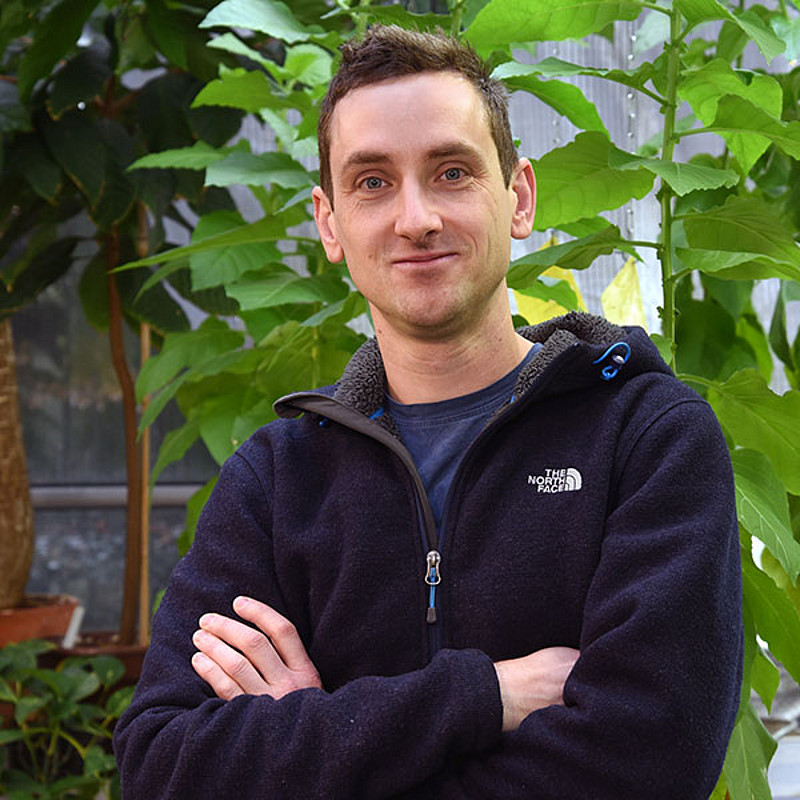
Tomáš Werner ist seit 1. Oktober 2016 Professor für Molekulare Pflanzenphysiologie an der Uni Graz. Foto: Uni Graz/Pichler

Tomáš Werner ist seit 1. Oktober 2016 Professor für Molekulare Pflanzenphysiologie an der Uni Graz. Foto: Uni Graz/Pichler

Tomáš Werner erforscht das Innenleben von Pflanzen

Dem Wachstum, der Entwicklung und den Reaktionen von Pflanzen auf sich verändernde Umweltbedingungen liegen vielfältige molekulare und biochemische Prozesse zugrunde. Dabei spielen Phytohormone eine wesentliche Rolle. Sie bilden einen Forschungsschwerpunkt von Univ.-Prof. Dr. Tomáš Werner, seit 1. Oktober 2016 Professor für Molekulare Pflanzenphysiologie an der Universität Graz.

„Hormone steuern und koordinieren das Wachstum und die Entwicklung von Pflanzen, indem sie Informationen zwischen den pflanzlichen Zellen und Geweben austauschen und spezifische Änderungen der Genaktivitäten bewirken“, fasst Tomáš Werner ihre Funktion vereinfacht zusammen. Die Aufklärung der komplexen molekularen Mechanismen ist Gegenstand der Untersuchungen des aus Tschechien stammenden Wissenschafters, der von 2009 bis 2016 Junior-Professor an der Freien Universität Berlin war.

Einen speziellen Fokus richtet Tomáš Werner auf die Hormonklasse der Cytokinine. „Das sind Signalmoleküle, die die Zellteilung und -differenzierung und damit das Wachstum sowie die Fortpflanzung steuern“, erklärt er. „Durch Veränderungen der Konzentration der Cytokinine lässt sich die Entwicklung der Pflanzen wesentlich beeinflussen.“ Das könnte unter anderem angesichts des Klimawandels Bedeutung bekommen, durch die Möglichkeit der Anpassung an veränderte Bedingungen. So konnten der Biologe und sein Forschungsteam zum Beispiel bereits das Wurzelwachstum verstärken und damit die Wasseraufnahme von Pflanzen optimieren oder eine vermehrte Samenbildung und erhöhten Ertrag erzielen.

Als Modellpflanze dient Werners Team die Ackerschmalwand. Das unscheinbare Unkraut wächst an Feldrainen, Wald- und Wegrändern. Sein relativ kleines, mittlerweile vollständig entschlüsseltes Genom und der kurze Generationszyklus von nur wenigen Wochen machen es zum perfekten Modellorganismus der genetischen Forschung und bieten beste Voraussetzungen für tiefe Einblicke in das Leben von Pflanzen.

created by Gudrun Pichler

Related news

Heat-resistant: Eva Preinfalk explains how cities can protect their residents

Certain demographic and some occupational groups are particularly vulnerable to high temperatures. A range of measures is needed to provide relief for everyone, explains climate economist Eva Preinfalk.

Baby health: University of Graz is seeking study participants to investigate early risk factors

Why does the body composition of babies vary so much? Some children gain a significant amount of fat mass within a few weeks, whilst others show hardly any change over the same period. “At the same time, initial observations suggest that fat distribution in all babies may follow a similar pattern, regardless of their total body fat,” explains Marco Höfler from the Institute of Movement Sciences, Sport and Health at the University of Graz. He is coordinating the research project ‘Small Bodies – Big Questions’, for which participants are currently still being sought: pregnant women and babies up to four weeks old.

In hot water: New Report reveals record losses in glaciers, permafrost and snow cover

Climate change is driving up temperatures not only in summer. Winters are also getting warmer – with dramatic consequences for glaciers, permafrost, snow cover and the freezing of lakes. The recently published cryosphere report provides specific figures for Austria. “Our monitoring shows a clear trend with record losses of ice and snow,” says project leader Wolfgang Schöner from the University of Graz.

Theologian at the University of Graz: What the excommunication of the Society of St Pius X

Following the schism involving the Society of St Pius X, there is a need for discussion. Bernd Hillebrand from the University of Graz explains why the Vatican took this step, what role anti-democratic tendencies play, and why the Society’s sacraments are no longer recognised as valid under canon law for Catholics with immediate effect.

Begin of page section:
Additional information:

University of Graz
Universitaetsplatz 3
8010 Graz
Austria
  • Contact
  • Web Editors
  • Moodle
  • UNIGRAZonline
  • Imprint
  • Data Protection Declaration
  • Accessibility Declaration
Weatherstation
Uni Graz

End of this page section. Go to overview of page sections

End of this page section. Go to overview of page sections

Begin of page section:

End of this page section. Go to overview of page sections