Begin of page section:
Page sections:

  • Go to contents (Accesskey 1)
  • Go to position marker (Accesskey 2)
  • Go to main navigation (Accesskey 3)
  • Go to sub navigation (Accesskey 4)
  • Go to additional information (Accesskey 5)
  • Go to page settings (user/language) (Accesskey 8)
  • Go to search (Accesskey 9)

End of this page section. Go to overview of page sections

Begin of page section:
Page settings:

English en
Deutsch de
Search
Login

End of this page section. Go to overview of page sections

Begin of page section:
Search:

Search for details about Uni Graz
Close

End of this page section. Go to overview of page sections


Search

Begin of page section:
Main navigation:

Page navigation:

  • University

    University
    • About the University
    • Organisation
    • Faculties
    • Library
    • Working at University of Graz
    • Campus
    Developing solutions for the world of tomorrow - that is our mission. Our students and our researchers take on the great challenges of society and carry the knowledge out.
  • Research Profile

    Research Profile
    • Our Expertise
    • Research Questions
    • Research Portal
    • Promoting Research
    • Research Transfer
    • Ethics in Research
    Scientific excellence and the courage to break new ground. Research at the University of Graz creates the foundations for making the future worth living.
  • Studies

    Studies
    • Prospective Students
    • Students
  • Community

    Community
    • International
    • Location
    • Research and Business
    • Alumni
    The University of Graz is a hub for international research and brings together scientists and business experts. Moreover, it fosters the exchange and cooperation in study and teaching.
  • Spotlight
Topics
  • Our digital Advent calendar
  • Sustainable University
  • Researchers answer
  • Work for us
Close menu

End of this page section. Go to overview of page sections

Begin of page section:
You are here:

University of Graz News Green and fair

End of this page section. Go to overview of page sections

Tuesday, 28 June 2022

Green and fair

Smoke from chimneys in front of EU flag

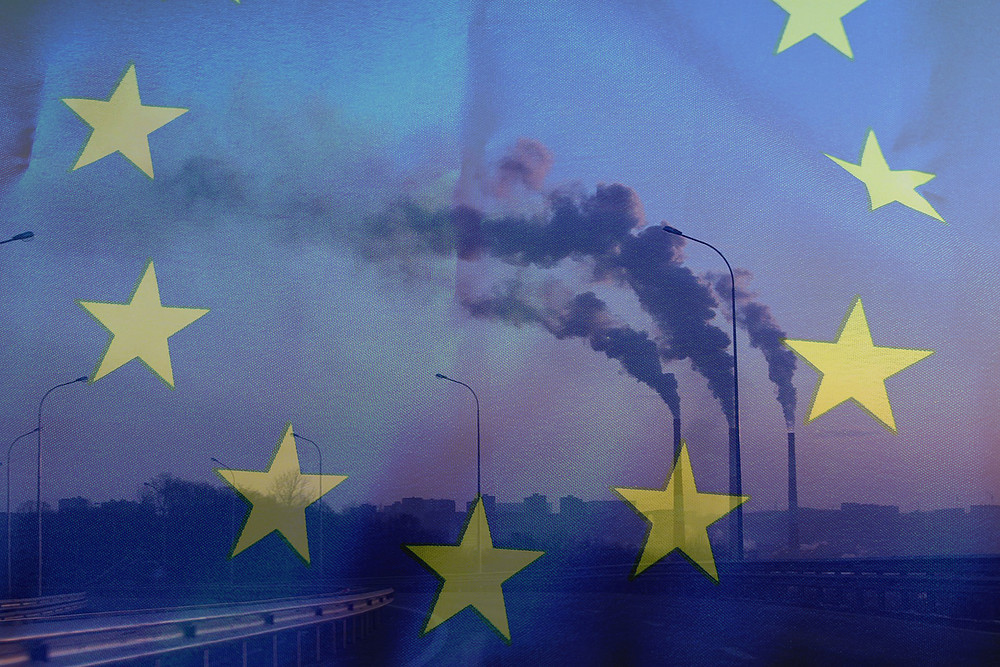
How can the emissions onus be distributed fairly among each of the EU member states? Researchers from the Wegener Center for Climate and Global Change have developed a model Picture: pixabay

University of Graz distributes emission reductions to the 27 EU countries in the "Green Deal"

It is a hot struggle ‒ and not only in climate terms. Even the political discussions in the European Union on how industry, transport, energy supply and agriculture can become climate-neutral by 2050 are on the boil. The EU Parliament is currently working on the laws and directives that will help us reduce emissions in accordance with the "Green Deal". Ultimately, this will mean some countries will have to make greater efforts, while others will have less to do. But how can the emissions onus be distributed fairly among each of the EU member states?
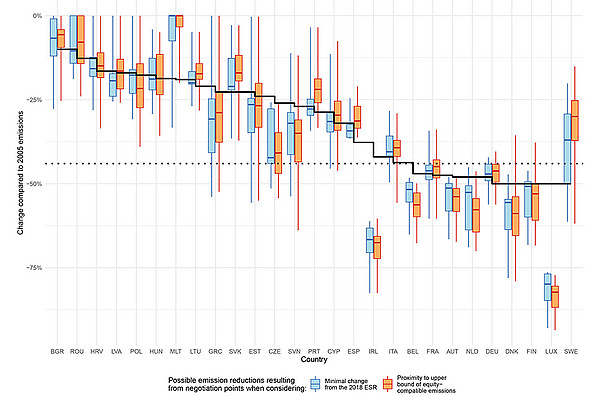
Researchers from the Wegener Center for Climate and Global Change and the International Institutes for Applied Systems Analysis (IIASA) have developed a model that uses 15 indicators to evaluate each of the 27 member states on a fair basis. In addition to financial aspects, these indicators also take social aspects into account.

As a result, many countries will have to increase their efforts even more in the future. Among those countries with greater burdens are the Netherlands, Belgium, Denmark and Austria. Others have more leeway, as climate economist Karl Steininger explains: “Germany, for example, has already invested in a more environmentally friendly way over the past two decades. Or Bulgaria and Romania if their lower income is taken into account.” Similarly, Spain and Italy will also be less burdened because they have produced comparatively lower quantities of greenhouse gases in the past. "Austria has expanded renewable energies, but at the same time it is facing a backlog due to consistently high emissions in the past," says Steininger.

This distribution of effort is the result of combining indicators from the three areas performance, responsibility and equality. However, the research team assessed more than just nominal wealth based on gross domestic product by considering:
- What potential does the infrastructure hold, how efficient are administration and politics?
- How high is the proportion of the poorer population and their energy requirements to cover basic needs?
- How high have the emissions of a country been since 1995, and does this mean it may already have used up much of its long-term greenhouse gas budget?

“This tool is available for national negotiations on the Green Deal," Steininger says, confirming the great interest expressed by the EU bodies.

>> Learn more about the tool
>> Paper in Nature Communications

Figure
created by Andreas Schweiger

Related news

Semester abroad without barriers: University of Graz wins award for promoting inclusion

The University of Graz has been awarded the Internationalization Award for its new inclusion initiative. Students with fewer opportunities now also receive financial support for their semester abroad outside Europe.

Fair distribution: Researchers determine just greenhouse gas budgets for all EU regions

Ten years ago, on 12 December 2015, the Paris Climate Agreement was signed at the UN Climate Conference. In order to limit global warming to well below two degrees, only a certain amount of CO2 may be emitted worldwide. While the focus was originally on national emission targets, more than 200 subnational regions and almost 300 cities have now adopted their own targets. But how many emissions are they fairly entitled to? Researchers at the University of Graz have now developed transparent criteria for fair distribution at the subnational level for the first time and determined corresponding greenhouse gas budgets for all European regions. The paper was published today in the scientific journal Nature Communications.

Chemical Christmas show at the University of Graz: An explosive evening at the Schauspielh

At the beginning of December, the University of Graz transformed the theater into a laboratory: as part of “Chemical Life,” teacher training students staged a chemical Christmas show for Styrian school classes—complete with ethanol rockets, nitrogen snow, and glowing effects. An evening designed to inspire interest in studying chemistry.

Train by train: Koralm railway accelerates exchange between the Universities

Lectures at the University of Klagenfurt in the morning, seminars at the University of Graz in the afternoon: Austria's longest tunnel and a journey time of around 45 minutes make it easy. The Koralm railway increases the speed of networking between the two university locations. The collaboration builds on existing cooperation - for example in the areas of teacher training, Slavic studies and as employers, the universities are well coordinated.

Begin of page section:
Additional information:

University of Graz
Universitaetsplatz 3
8010 Graz
Austria
  • Contact
  • Web Editors
  • Moodle
  • UNIGRAZonline
  • Imprint
  • Data Protection Declaration
  • Accessibility Declaration
Weatherstation
Uni Graz

End of this page section. Go to overview of page sections

End of this page section. Go to overview of page sections

Begin of page section:

End of this page section. Go to overview of page sections