Begin of page section:
Page sections:

  • Go to contents (Accesskey 1)
  • Go to position marker (Accesskey 2)
  • Go to main navigation (Accesskey 3)
  • Go to sub navigation (Accesskey 4)
  • Go to additional information (Accesskey 5)
  • Go to page settings (user/language) (Accesskey 8)
  • Go to search (Accesskey 9)

End of this page section. Go to overview of page sections

Begin of page section:
Page settings:

English en
Deutsch de
Search
Login

End of this page section. Go to overview of page sections

Begin of page section:
Search:

Search for details about Uni Graz
Close

End of this page section. Go to overview of page sections


Search

Begin of page section:
Main navigation:

Page navigation:

  • University

    University
    • About the University
    • Organisation
    • Faculties
    • Library
    • Working at University of Graz
    • Campus
    Developing solutions for the world of tomorrow - that is our mission. Our students and our researchers take on the great challenges of society and carry the knowledge out.
  • Research Profile

    Research Profile
    • Our Expertise
    • Research Questions
    • Research Portal
    • Promoting Research
    • Research Transfer
    • Ethics in Research
    Scientific excellence and the courage to break new ground. Research at the University of Graz creates the foundations for making the future worth living.
  • Studies

    Studies
    • Prospective Students
    • Students
  • Community

    Community
    • International
    • Location
    • Research and Business
    • Alumni
    The University of Graz is a hub for international research and brings together scientists and business experts. Moreover, it fosters the exchange and cooperation in study and teaching.
  • Spotlight
Topics
  • Our digital Advent calendar
  • Sustainable University
  • Researchers answer
  • Work for us
Close menu

End of this page section. Go to overview of page sections

Begin of page section:
You are here:

University of Graz News Great for the climate

End of this page section. Go to overview of page sections

Tuesday, 21 December 2021

Great for the climate

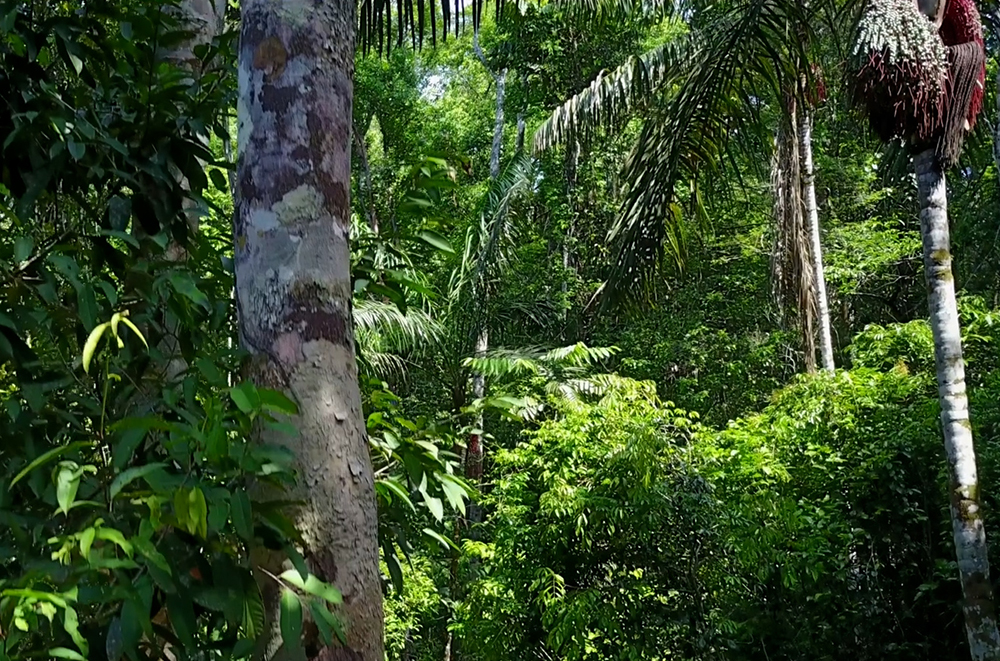
Mosses and lichens cover up to three quarters of the trunks in the rainforest. Photo: Achim Edtbauer

Mosses and lichens cover up to three quarters of the trunks in the rainforest. They contribute to both the binding of pollutants and the self-purification of the atmosphere. Photo: Achim Edtbauer

How lichens and mosses affect the weather

We know that rain forests are essential for our global climate. So far, so good. However, latest research has found out that it’s not just those mighty crest coronets that are responsible for binding harmful substances and helping to clean up the atmosphere, but also a variety of non-descript mosses and lichens. Biologists from University of Graz made that discovery as members of an international team in the Amazon region.
One tends to overlook them. Even in science. “But that’s not doing them justice at all”, says Bettina Weber, Professor at the Institute of Biology, University of Graz, in their defence. According to her calculations, lichens and mosses contribute to binding about 7% of global carbon dioxide and even around 50% of nitrogen emission. A fact that we must not underestimate, especially in times of climate change, as Professor Weber emphasises, because lichens and mosses exist on all continents and in all climate zones, whether mountains, deserts or in the Arctic. That goes for tropical rainforests as well, such as in the Amazon region, where the biologist investigated the situation between 2016 and 2018 in collaboration with scientists from Max-Planck Institute for Chemistry in Mainz (D) and the National Institute of Amazonian Research (INPA) in Manaus (BRA).

Clip

What was thought to apply solely to rainforest trees can also be attributed to organisms that cover up to three-quarters of their trunks. Mosses and lichens produce substantial amounts of specific chemical compounds called sesquiterpenoids. The latter, in turn, react swiftly with ozone to form oxygenated compounds and particles in the air. These processes influence cloud formation and precipitation, as well as stimulating the atmosphere’s assimilative capacity.
“We measure volatile organic compounds emitted by the rainforest at different heights”, explains Jonathan Williams, team leader at Max-Planck Institute for Chemistry in Mainz. “If we extrapolate the emissions of mosses and lichens, we arrive at similar values such as for trees”, confirms Achim Edtbauer, scientist at the said institute and first author of the study. In further projects along with other international colleagues, Bettina Weber aims to clarify which role temperature, light and air humidity play in releasing sesquiterpeniods. In that way, their emissions could be integrated in atmospheric and climatic models, for instance to map the effects of drought on rainforests more accurately.    

Consolidation of desert soils
It is already proven that biological soil crusts – a community of mosses, lichens, cyanobacteria, fungi and other bacteria – are essential for the consolidation of soils in arid areas, concludes Bettina Weber with reference to her research work: “They bind the substrate very effectively and slow down desert formation. Fungi and cyanobacteria, for instance, do that by enclosing sand grains and covering them with mucelage. That stops them from being blown away by the wind, binds nutrients and establishes the basis for other plants in the first place.”   

Publication
The study was published on 21 December 2021 in the latest issue of “Nature Communications Earth & Environment”.

created by Andreas Schweiger

Related news

Semester abroad without barriers: University of Graz wins award for promoting inclusion

The University of Graz has been awarded the Internationalization Award for its new inclusion initiative. Students with fewer opportunities now also receive financial support for their semester abroad outside Europe.

Fair distribution: Researchers determine just greenhouse gas budgets for all EU regions

Ten years ago, on 12 December 2015, the Paris Climate Agreement was signed at the UN Climate Conference. In order to limit global warming to well below two degrees, only a certain amount of CO2 may be emitted worldwide. While the focus was originally on national emission targets, more than 200 subnational regions and almost 300 cities have now adopted their own targets. But how many emissions are they fairly entitled to? Researchers at the University of Graz have now developed transparent criteria for fair distribution at the subnational level for the first time and determined corresponding greenhouse gas budgets for all European regions. The paper was published today in the scientific journal Nature Communications.

Chemical Christmas show at the University of Graz: An explosive evening at the Schauspielh

At the beginning of December, the University of Graz transformed the theater into a laboratory: as part of “Chemical Life,” teacher training students staged a chemical Christmas show for Styrian school classes—complete with ethanol rockets, nitrogen snow, and glowing effects. An evening designed to inspire interest in studying chemistry.

Train by train: Koralm railway accelerates exchange between the Universities

Lectures at the University of Klagenfurt in the morning, seminars at the University of Graz in the afternoon: Austria's longest tunnel and a journey time of around 45 minutes make it easy. The Koralm railway increases the speed of networking between the two university locations. The collaboration builds on existing cooperation - for example in the areas of teacher training, Slavic studies and as employers, the universities are well coordinated.

Begin of page section:
Additional information:

University of Graz
Universitaetsplatz 3
8010 Graz
Austria
  • Contact
  • Web Editors
  • Moodle
  • UNIGRAZonline
  • Imprint
  • Data Protection Declaration
  • Accessibility Declaration
Weatherstation
Uni Graz

End of this page section. Go to overview of page sections

End of this page section. Go to overview of page sections

Begin of page section:

End of this page section. Go to overview of page sections