



Begin of page section:
Page sections:

  • Go to contents (Accesskey 1)
  • Go to position marker (Accesskey 2)
  • Go to main navigation (Accesskey 3)
  • Go to sub navigation (Accesskey 4)
  • Go to additional information (Accesskey 5)
  • Go to page settings (user/language) (Accesskey 8)
  • Go to search (Accesskey 9)

End of this page section. Go to overview of page sections

Begin of page section:
Page settings:

English en
Deutsch de
Search
Login

End of this page section. Go to overview of page sections

Begin of page section:
Search:

Search for details about Uni Graz
Close

End of this page section. Go to overview of page sections


Search

Begin of page section:
Main navigation:

Page navigation:

  • University

    University
    • About the University
    • Organisation
    • Faculties
    • Library
    • Working at University of Graz
    • Campus
    Developing solutions for the world of tomorrow - that is our mission. Our students and our researchers take on the great challenges of society and carry the knowledge out.
  • Research Profile

    Research Profile
    • Our Expertise
    • Research Questions
    • Research Portal
    • Promoting Research
    • Research Transfer
    • Ethics in Research
    • Commission for Scientific Integrity
    Scientific excellence and the courage to break new ground. Research at the University of Graz creates the foundations for making the future worth living.
  • Studies

    Studies
    • Prospective Students
    • Students
  • Community

    Community
    • International
    • Location
    • Research and Business
    • Alumni
    The University of Graz is a hub for international research and brings together scientists and business experts. Moreover, it fosters the exchange and cooperation in study and teaching.
  • Spotlight
Topics
  • Sustainable University
  • Researchers answer
  • Work for us
Close menu

End of this page section. Go to overview of page sections

Begin of page section:
You are here:

University of Graz News Great for the climate

End of this page section. Go to overview of page sections

Tuesday, 21 December 2021

Great for the climate

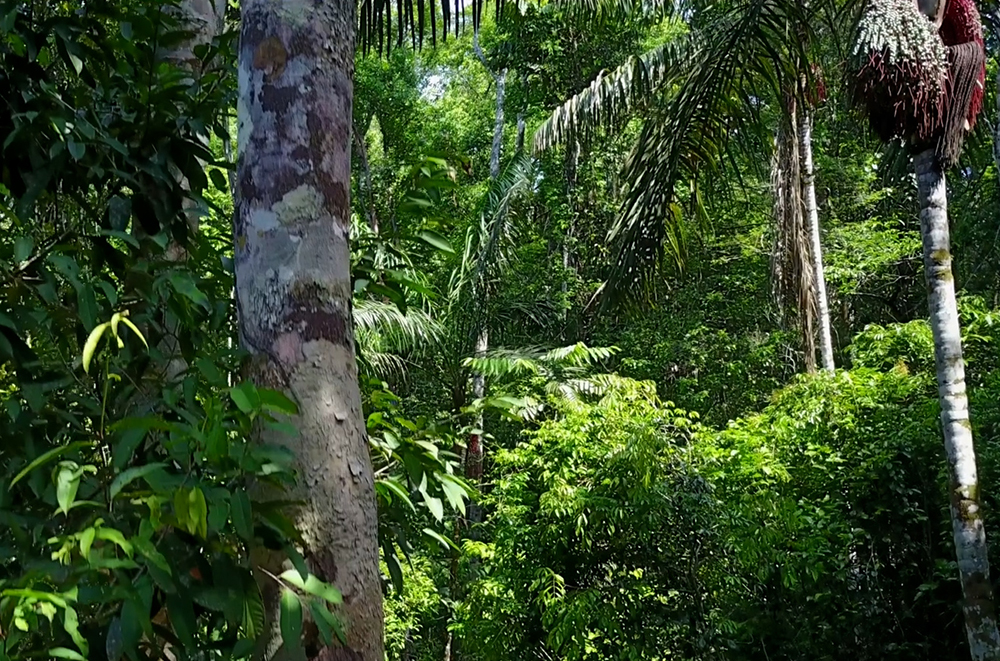
Mosses and lichens cover up to three quarters of the trunks in the rainforest. Photo: Achim Edtbauer

Mosses and lichens cover up to three quarters of the trunks in the rainforest. They contribute to both the binding of pollutants and the self-purification of the atmosphere. Photo: Achim Edtbauer

How lichens and mosses affect the weather

We know that rain forests are essential for our global climate. So far, so good. However, latest research has found out that it’s not just those mighty crest coronets that are responsible for binding harmful substances and helping to clean up the atmosphere, but also a variety of non-descript mosses and lichens. Biologists from University of Graz made that discovery as members of an international team in the Amazon region.
One tends to overlook them. Even in science. “But that’s not doing them justice at all”, says Bettina Weber, Professor at the Institute of Biology, University of Graz, in their defence. According to her calculations, lichens and mosses contribute to binding about 7% of global carbon dioxide and even around 50% of nitrogen emission. A fact that we must not underestimate, especially in times of climate change, as Professor Weber emphasises, because lichens and mosses exist on all continents and in all climate zones, whether mountains, deserts or in the Arctic. That goes for tropical rainforests as well, such as in the Amazon region, where the biologist investigated the situation between 2016 and 2018 in collaboration with scientists from Max-Planck Institute for Chemistry in Mainz (D) and the National Institute of Amazonian Research (INPA) in Manaus (BRA).

Clip

What was thought to apply solely to rainforest trees can also be attributed to organisms that cover up to three-quarters of their trunks. Mosses and lichens produce substantial amounts of specific chemical compounds called sesquiterpenoids. The latter, in turn, react swiftly with ozone to form oxygenated compounds and particles in the air. These processes influence cloud formation and precipitation, as well as stimulating the atmosphere’s assimilative capacity.
“We measure volatile organic compounds emitted by the rainforest at different heights”, explains Jonathan Williams, team leader at Max-Planck Institute for Chemistry in Mainz. “If we extrapolate the emissions of mosses and lichens, we arrive at similar values such as for trees”, confirms Achim Edtbauer, scientist at the said institute and first author of the study. In further projects along with other international colleagues, Bettina Weber aims to clarify which role temperature, light and air humidity play in releasing sesquiterpeniods. In that way, their emissions could be integrated in atmospheric and climatic models, for instance to map the effects of drought on rainforests more accurately.    

Consolidation of desert soils
It is already proven that biological soil crusts – a community of mosses, lichens, cyanobacteria, fungi and other bacteria – are essential for the consolidation of soils in arid areas, concludes Bettina Weber with reference to her research work: “They bind the substrate very effectively and slow down desert formation. Fungi and cyanobacteria, for instance, do that by enclosing sand grains and covering them with mucelage. That stops them from being blown away by the wind, binds nutrients and establishes the basis for other plants in the first place.”   

Publication
The study was published on 21 December 2021 in the latest issue of “Nature Communications Earth & Environment”.


created by Andreas Schweiger

Related news

Greenery on the rise: over 500 new flowers, perennials and shrubs on campus

Bright blooms and fresh greenery make our hearts beat faster in spring. But it is not just us humans who delight in this colourful growth. For many animals, this splendour provides, above all, food and habitat. There has recently been an increase in this on the University of Graz campus. More than 500 native flowers, perennials and shrubs have been planted on strips of fallow land around Universitätsplatz 2.

Around the world in eight stops: the Long Night of Research at the University of Graz

On 24 April from 5 pm, you can take a short trip around the globe at the University of Graz, discovering pecularities of foreign countries or new local features in the entrance hall of the University Library. The itinerary takes you through introduced animal species, political attitudes and the omnipotence of algorithms. There will also be a programme in the historic reading hall, as well as at the UniGraz@Museum and the University Archive.

Building biological bridges: Chemist discovers an ecological tool for the pharmaceutical industry

Building a relationship on a solid foundation is also important in chemistry. To produce medicines, disinfectants or plant protection products, stable bonds between carbon atoms must be formed. Conventional chemical methods rely on environmentally harmful reagents and solvents to carry out the desired reaction. This process also produces unusable by-products. Chemist Lilla Gal has discovered an enzyme that enables the same process to take place efficiently and sustainably. The results of her research were recently published in the prestigious journal Angewandte Chemie.

Higher Education Strategy 2040: Austria’s universities on course for the future

Austria has 77 higher education institutions, which is above the EU average – but does this really make sense? The new Higher Education Strategy 2040 focuses on cooperation rather than mergers. As one of the six largest universities in Austria, the University of Graz plays a central role in this.

Begin of page section:
Additional information:

University of Graz
Universitaetsplatz 3
8010 Graz
Austria
  • Contact
  • Web Editors
  • Moodle
  • UNIGRAZonline
  • Imprint
  • Data Protection Declaration
  • Accessibility Declaration
Weatherstation
Uni Graz

End of this page section. Go to overview of page sections

End of this page section. Go to overview of page sections

Begin of page section:

End of this page section. Go to overview of page sections

