



Begin of page section:
Page sections:

  • Go to contents (Accesskey 1)
  • Go to position marker (Accesskey 2)
  • Go to main navigation (Accesskey 3)
  • Go to sub navigation (Accesskey 4)
  • Go to additional information (Accesskey 5)
  • Go to page settings (user/language) (Accesskey 8)
  • Go to search (Accesskey 9)

End of this page section. Go to overview of page sections

Begin of page section:
Page settings:

English en
Deutsch de
Search
Login

End of this page section. Go to overview of page sections

Begin of page section:
Search:

Search for details about Uni Graz
Close

End of this page section. Go to overview of page sections


Search

Begin of page section:
Main navigation:

Page navigation:

  • University

    University
    • About the University
    • Organisation
    • Faculties
    • Library
    • Working at University of Graz
    • Campus
    Developing solutions for the world of tomorrow - that is our mission. Our students and our researchers take on the great challenges of society and carry the knowledge out.
  • Research Profile

    Research Profile
    • Our Expertise
    • Research Questions
    • Research Portal
    • Promoting Research
    • Research Transfer
    • Ethics in Research
    • Commission for Scientific Integrity
    Scientific excellence and the courage to break new ground. Research at the University of Graz creates the foundations for making the future worth living.
  • Studies

    Studies
    • Prospective Students
    • Students
    • Registration for Study Programme (Winter semester 2026/27)
  • Community

    Community
    • International
    • Location
    • Research and Business
    • Alumni
    The University of Graz is a hub for international research and brings together scientists and business experts. Moreover, it fosters the exchange and cooperation in study and teaching.
Topics
  • Sustainable University
  • Researchers answer
  • Work for us
Close menu

End of this page section. Go to overview of page sections

Begin of page section:
You are here:

University of Graz News Beached whales: researchers at the University of Graz find arsenic in the brain

End of this page section. Go to overview of page sections

Friday, 04 October 2024

Beached whales: researchers at the University of Graz find arsenic in the brain

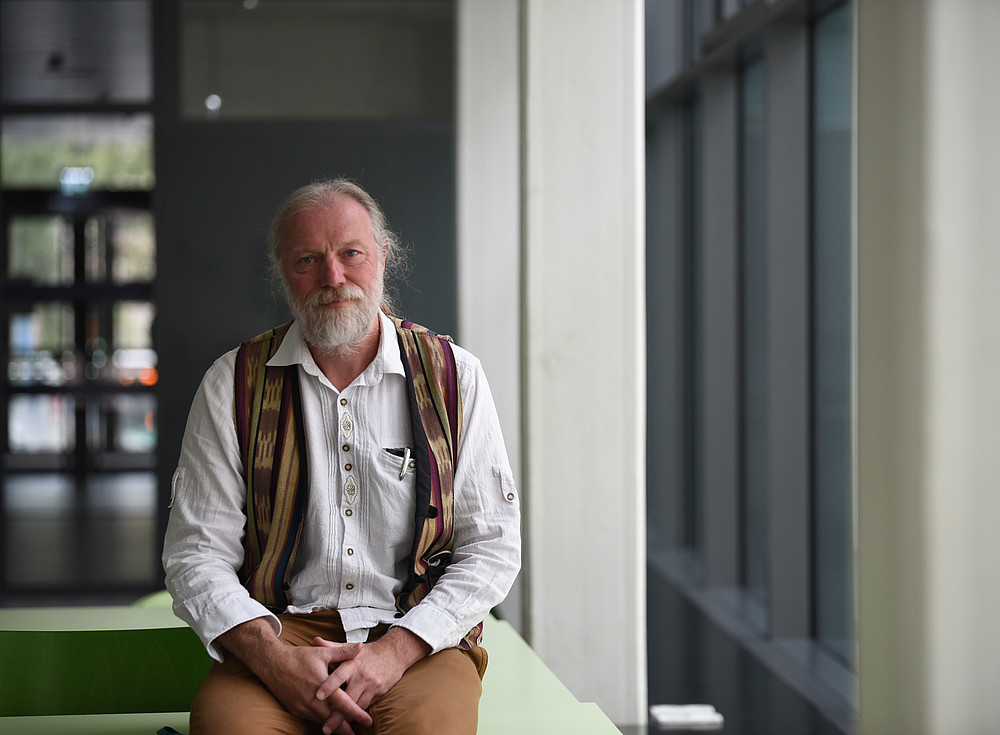
A photo of an professor with gray hair and beard, wearing a white shirt and colorful vest at his university, smiling for the camera in a full body shot

Jörg Feldmann specialises in the analysis of arsenic in the environment. Photo: Uni Graz/Tzivanolpoulos

The chemist Jörg Feldmann from the University of Graz has discovered toxic arsenic compounds in the brains of pilot whales. The concentration increases with age. The reason: arsenic in the food. This could also have consequences for humans.

It is a sad sight, and unfortunately not an uncommon one in Scotland: dozens of pilot whales lie in the sand, slowly dying. When an animal of this very social species of whale gets into trouble, the other members of the family are immediately on hand to help. Unfortunately, in doing so they also seal their fate.

But their death is a rare opportunity for researchers to study these animals. Such an event enabled Jörg Feldmann, a professor of chemistry at the University of Graz, to examine the brains of these marine mammals. Specifically, he was looking for traces of arsenic, which occurs naturally in the sea and accumulates in marine life in various forms.

An opportunity for research

‘In 2012, a group of 20 individuals of all ages stranded,’ says Feldmann. “This gave us a unique opportunity to study the accumulation of arsenic in individuals of different ages.” Specifically, the chemist was looking for arsenolipids. In these, the arsenic is bound to fat molecules, making it easier for it to penetrate cells. These are naturally present in all seafood and saltwater fish.

Feldmann was actually able to find these molecules in the bodies of whales. Surprisingly, they were found mainly in the brain. The concentration increased with age. ‘The value only stabilises in adulthood.’

Caution advised

For the chemist, this is a cause for concern. ‘This is an indication that these arsenolipids cross the blood-brain barrier, at least in young years.’ And experiments with cell cultures show that these compounds are highly toxic. Since the metabolism of whales is similar to that of humans, the scientist fears that arsenolipids could also accumulate in the brains of children and adolescents.

Feldmann therefore advises caution when eating fish fingers, shrimps, and calamari during the growth phase. It is not yet known what these compounds do to the brain. ‘We urgently need to do more research in this area.’

Publication

Toxic arsenolipids bioaccumulate in the developing brain of pilot whales; Johannes F. Kopp, Lhiam Paton, Zuzana Gajdosechova, Savarin Sinawivat, Andrea Raab, Andrew Brownlow, Jörg Feldmann


https://doi.org/10.1016/j.scitotenv.2024.173816

created by Roman Vilgut

Related news

Complying with the norm: Why Do Standards Shape Our Lives, Elisabeth Staudegger?

Standards determine whether a sheet of paper fits in a printer or whether a charging plug can power multiple devices. These standards shape our everyday lives. But who actually sets these standards? Where are the weaknesses, and how could science help to improve them? Elisabeth Staudegger, Head of the ‘Law and IT’ Department at the Institute for Legal Foundations at the University of Graz, host the Academic Standards Day on 16 June. Here she relays how sciences can contribute to the topic of standardisation and reveals her personal favourite standard.

More body awareness than a culture war

In Italy, sex education lessons will in future only be permitted with parental consent, and will be banned entirely in nurseries and primary schools. At the same time, Pride Month highlights why knowledge about the body, relationships, boundaries and diversity is important for young people. A study by the University of Graz shows how important knowledge about the body, contraception, relationship skills and protection against violence is

Will Austria win the World Cup? Mathematician reveals calculation method

Michael Fischer uses the football tournament as a practical example for highschool lessons.

Survival strategies: How plants respond to drought

According to Geosphere Austria, this spring was the driest in Austria since records began around 170 years ago. The low rainfall put particular pressure on the agricultural sector. And climate change is set to make the situation even worse in the coming decades. We asked Johannes Liesche, a professor at the Department of Biology at the University of Graz, how plants react to water shortages and how they survive periods of drought.

Begin of page section:
Additional information:

University of Graz
Universitaetsplatz 3
8010 Graz
Austria
  • Contact
  • Web Editors
  • Moodle
  • UNIGRAZonline
  • Imprint
  • Data Protection Declaration
  • Accessibility Declaration
Weatherstation
Uni Graz

End of this page section. Go to overview of page sections

End of this page section. Go to overview of page sections

Begin of page section:

End of this page section. Go to overview of page sections

