



Begin of page section:
Page sections:

  • Go to contents (Accesskey 1)
  • Go to position marker (Accesskey 2)
  • Go to main navigation (Accesskey 3)
  • Go to sub navigation (Accesskey 4)
  • Go to additional information (Accesskey 5)
  • Go to page settings (user/language) (Accesskey 8)
  • Go to search (Accesskey 9)

End of this page section. Go to overview of page sections

Begin of page section:
Page settings:

English en
Deutsch de
Search
Login

End of this page section. Go to overview of page sections

Begin of page section:
Search:

Search for details about Uni Graz
Close

End of this page section. Go to overview of page sections


Search

Begin of page section:
Main navigation:

Page navigation:

  • University

    University
    • About the University
    • Organisation
    • Faculties
    • Library
    • Working at University of Graz
    • Campus
    Developing solutions for the world of tomorrow - that is our mission. Our students and our researchers take on the great challenges of society and carry the knowledge out.
  • Research Profile

    Research Profile
    • Our Expertise
    • Research Questions
    • Research Portal
    • Promoting Research
    • Research Transfer
    • Ethics in Research
    • Commission for Scientific Integrity
    Scientific excellence and the courage to break new ground. Research at the University of Graz creates the foundations for making the future worth living.
  • Studies

    Studies
    • Prospective Students
    • Students
    • Welcome Weeks for First Year Students
  • Community

    Community
    • International
    • Location
    • Research and Business
    • Alumni
    The University of Graz is a hub for international research and brings together scientists and business experts. Moreover, it fosters the exchange and cooperation in study and teaching.
Topics
  • Sustainable University
  • Researchers answer
  • Work for us
Close menu

End of this page section. Go to overview of page sections

Begin of page section:
You are here:

University of Graz News Dangerous torrents

End of this page section. Go to overview of page sections

Thursday, 09 June 2022

Dangerous torrents

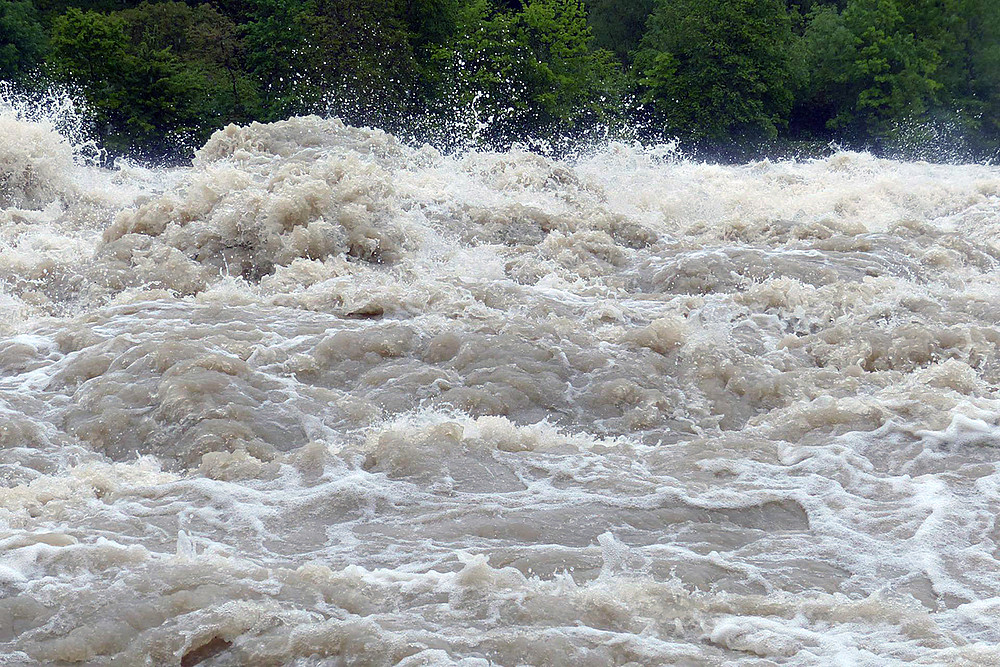
Floods are among the most significant natural hazards in the Alps. Photo: pixabay

Floods are among the most significant natural hazards in the Alps. Photo: pixabay

Climate change increases risk of floods and mudflows

Persistent rainfall increases the fear of flooding. During flood events, rivers and streams can transport large amounts of sediment as well as a lot of water, which can lead to severe mudflows and considerable damage. Floods are therefore among the most significant natural hazards in the Alps. The increase in extreme precipitation due to climate change will further increase the risk of such events. This has now been confirmed by research conducted by scientists at the University of Graz and Graz University of Technology using the Schöttlbach in Upper Styria as an example. The results provide an important basis for better hazard assessment and damage limitation.

In 2011 and 2017, the Styrian town of Oberwölz experienced particularly bad floods with severe mudflows. "In 2017 alone, well over 100,000 cubic metres of sediment material were mobilised in the catchment area of the Schöttlbach, of which only 30,000 cubic metres could be collected in an existing retention basin," says Wolfgang Schöner from the Institute of Geography and Regional Sciences at the University of Graz, illustrating the extent of the masses moved. The consequences included mudslides as well as destroyed roads and thus enormous damage.

In order to be able to estimate the further development of this natural hazard, the researchers simulated various scenarios for the near and distant future up to the year 2100 using the Schöttlbach as an example. To do this, they combined models of runoff and sediment transport with extensive data from field measurements and sensors in the area of the Schöttlbach. Lasers and cameras mounted on drones to determine erosion areas, radio transmitters integrated into stones and metal plates with acceleration sensors installed in torrent beds to measure sediment transport, precipitation and runoff stations as well as a variety of other measurement methods were used to obtain data bases for the modelling carried out.

Torrents can no longer recover
Climate change is increasing the risk of more frequent heavy precipitation. For alpine rivers like the Schöttlbach, extreme flood discharges will increase by up to ten percent by the end of the century, according to the calculations of the Graz researchers, Schöner summarises one result of the study. "If torrent systems, including their bank slopes, do not have time to stabilise again between such floods, disproportionately more silt and debris is carried along each time," the scientist explains. Floods that follow one another at intervals of less than ten years are therefore particularly critical. In this case, even smaller events could become a problem. "It can therefore be assumed that the quantities of transported sediments will become larger overall. This should be taken into account in torrent engineering in the future The results of this project can thus be incorporated into the dimensioning of protective structures such as bedload barriers," says Josef Schneider from the Institute of Hydraulic Engineering and Water Resources Management at Graz University of Technology.

The project >>RunSed-CC "Modelling future runoff and sediment transport in alpine torrents"<< was financed by the Austrian Climate and Energy Fund.
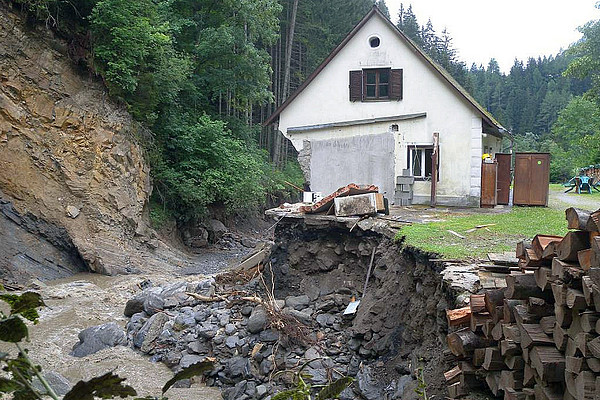
If torrent systems, including their bank slopes, do not have time to stabilise again between floods, disproportionately more silt and debris is carried along each time. Photo: Wildbach- und Lawinenverbauung Steiermark-West
created by Gudrun Pichler

Related news

Legal scholar Clarissa Groß on European values at the EU’s external borders

The tense situation in the Spanish exclave of Ceuta has been making headlines for weeks. The exodus of thousands of Moroccans has once again placed migration and border policy at the very top of the EU’s agenda. Clarissa Groß, a research assistant at the Institute for European Law, is examining the reform of the Common European Asylum System (CEAS), the design and practical implementation of the new border procedures, and their compatibility with the right to personal liberty as part of her doctoral thesis. She recently visited the Greek island of Lesbos, which remains a migration hotspot, to assess the situation on the ground.

Graz is a magnet for 750 physicists: international conference on campus

Whether in mobile phones, medical devices or solar power systems: physical phenomena are part of our everyday lives. The vast scope of this discipline will be explored at a major conference taking place at the University of Graz from 20 to 25 September 2026. More than 750 scientists will transform the campus into a European hub for physics.

A fresh start, a calling, holidays: what draws people from other career paths to teaching

They used to develop software; now they teach maths in the classroom. Career changers are expected to help address the shortage of qualified teachers in Austria’s schools. In their doctoral theses at the Institute for Educational Research and Teacher Training at the University of Graz, Melanie Gürentz and Claudia Mair examined how these new teachers perceive their new professional roles.

Talent Talks bridge the gap in career guidance

The Styrian Chamber of Commerce (WKO Steiermark), the Styrian Chamber of Labour (AK Steiermark) and the AMS are joining forces when it comes to training young people and, through the “Talent Talks”, are creating a seamless pathway to career guidance. This takes preparation and follow-up support – just in time for the start of the term and the scheme’s tenth anniversary – to a whole new level. A new survey conducted by the Talent Centre among 2,687 former participants to mark the anniversary shows just how important this development is. Of the young people who received follow-up support from the Talent Report, 74.6 per cent stated that they had a good understanding of their own strengths and talents following the Talent Check. Without follow-up support, the figure was 66.5 per cent – a significant difference of 8.1 percentage points.

Begin of page section:
Additional information:

University of Graz
Universitaetsplatz 3
8010 Graz
Austria
  • Contact
  • Web Editors
  • Moodle
  • UNIGRAZonline
  • Imprint
  • Data Protection Declaration
  • Accessibility Declaration
Weatherstation
Uni Graz

End of this page section. Go to overview of page sections

End of this page section. Go to overview of page sections

Begin of page section:

End of this page section. Go to overview of page sections