Begin of page section:
Page sections:

  • Go to contents (Accesskey 1)
  • Go to position marker (Accesskey 2)
  • Go to main navigation (Accesskey 3)
  • Go to sub navigation (Accesskey 4)
  • Go to additional information (Accesskey 5)
  • Go to page settings (user/language) (Accesskey 8)
  • Go to search (Accesskey 9)

End of this page section. Go to overview of page sections

Begin of page section:
Page settings:

English en
Deutsch de
Search
Login

End of this page section. Go to overview of page sections

Begin of page section:
Search:

Search for details about Uni Graz
Close

End of this page section. Go to overview of page sections


Search

Begin of page section:
Main navigation:

Page navigation:

  • University

    University
    • About the University
    • Organisation
    • Faculties
    • Library
    • Working at University of Graz
    • Campus
    Developing solutions for the world of tomorrow - that is our mission. Our students and our researchers take on the great challenges of society and carry the knowledge out.
  • Research Profile

    Research Profile
    • Our Expertise
    • Research Questions
    • Research Portal
    • Promoting Research
    • Research Transfer
    • Ethics in Research
    • Commission for Scientific Integrity
    Scientific excellence and the courage to break new ground. Research at the University of Graz creates the foundations for making the future worth living.
  • Studies

    Studies
    • Prospective Students
    • Students
  • Community

    Community
    • International
    • Location
    • Research and Business
    • Alumni
    The University of Graz is a hub for international research and brings together scientists and business experts. Moreover, it fosters the exchange and cooperation in study and teaching.
  • Spotlight
Topics
  • Sustainable University
  • Researchers answer
  • Work for us
Close menu

End of this page section. Go to overview of page sections

Begin of page section:
You are here:

University of Graz News Geballte Power

End of this page section. Go to overview of page sections

Tuesday, 04 April 2023

Geballte Power

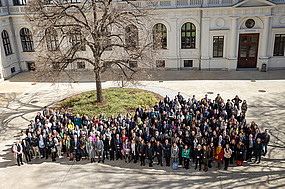
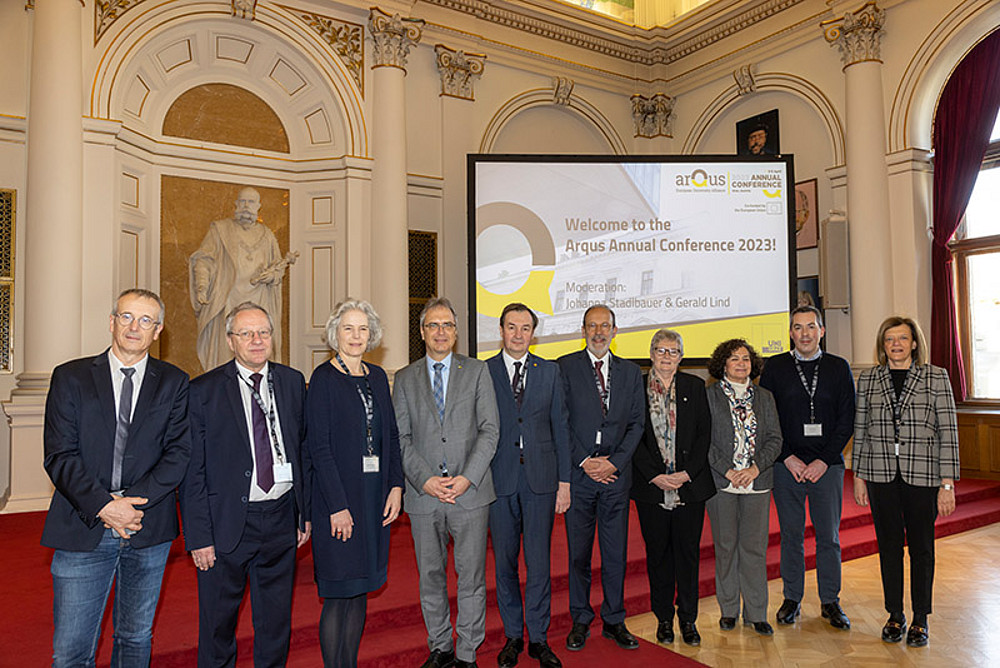
Rektor:innen und Vizerektor:innen der neun Arqus-Partneruniversitäten bei der Eröffnung der Jahreskonferenz in Graz. Alle Fotos: Uni Graz/Lunghammer. ©Helmut Lunghammer

Von links nach rechts: Fréderic Fleury (Rektor Lyon1), Robert Olkiewicz (Rektor Wroclaw), Eva Inés Obergfell (Rektorin Leipzig), Peter Riedler (Rektor Uni Graz), Rimvydas Petrauskas (Rektor Vilnius), Rui Vieira de Castro (Rektor Minho), Dorothy Kelly (Vizerektorin und Arqus-Koordinatorin Granada), María Pilar Aranda Ramírez (Rektorin Granada), Patrick McCole (Vice-President International Maynooth) und Cristina Basso (Vizerektorin Padova). Alle Fotos: Uni Graz/Lunghammer.

Die Zukunft europäischer Universitäten wird bei der Arqus-Jahreskonferenz entworfen

Über 300 Vertreter:innen aus Spanien, Deutschland, Frankreich, Irland, Portugal, Italien, Litauen und Polen treffen sich noch bis morgen an der Universität Graz, um die Grundlagen für einen Europäischen Campus zu entwerfen. Bei der Jahreskonferenz der Hochschul-Allianz Arqus werden gemeinsame Projekte der neun Partner-Universitäten in Forschung und Lehre sowie vertiefte Zusammenarbeiten in Bereichen Studium und Mobilität auf den Weg gebracht.

Die Europäische Hochschulallianz Arqus vereint die Universitäten Granada, Graz, Leipzig, Lyon1, Maynooth, Minho, Padua, Vilnius und Wroclaw. Das Hauptziel von Arqus ist eine tiefgehende Zusammenarbeit der Partner-Hochschulen, die über das selbstverständliche Maß hinaus geht. Diese Kooperation soll zur Grundlage eines Europäischen Campus werden, der die Anforderungen erfüllt, denen Universitäten im 21. Jahrhundert gewachsen sein müssen.

Peter Riedler, Rektor der Universität Graz, betonte in seiner Eröffnung der Konferenz heute, am 4. April 2023, wie wichtig die internationale Zusammenarbeit im Hochschulsektor ist: „Universitäten sind Orte, an denen seit jeher Bildung, Forschung und Innovation passiert. Heute müssen wir in Europa noch enger zusammenrücken und unsere Expertise bündeln. Als Rektor der zweitgrößten Universität Österreichs ist es mir eine besondere Freude, so viele Kolleg:innen aus ganz Europa in Graz zu begrüßen.“   

Mireille van Poppel, Vizerektorin für Internationalisierung und Gleichstellung der Uni Graz, ergänzt: „Die Mitgliedschaft bei Arqus hebt die internationale Positionierung der Universität Graz, die Konferenz ist ein sichtbares Zeichen für verstärkte Kooperation über Landesgrenzen hinweg. Nur so können wir gemeinsam Lösungen für große Herausforderungen wie Klimawandel oder Digitalisierung erarbeiten.“

Am zweiten Tag der Konferenz wurde der Arqus Teaching Award vergeben. Er zeichnet Lehrende der Partner-Universitäten aus, die Exzellenz und Innovation in ihrer Lehre vorleben. Vergeben wird der Award in zwei Kategorien, die beiden Gewinner:innen sind:

Kategorie 1: Enabling resarch-based teaching
Gewinner:innen: Margarida Correia-Neves und Jorge Hernȃni-Eusébio, Universität Minho

Kategorie 2: Enabling students
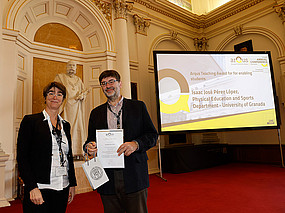
Gewinner: Isaac José Pérez López, Universität Granada

Vizerektorin Mireille van Poppel, die auch der Arqus-Koordination an der Uni Graz vorsteht, übergab die beiden Preise in der Aula der Universität.  

Mehr Infos unter: https://european-university.uni-graz.at/de/annualconference/
 ©Helmut Lunghammer
©Helmut Lunghammer
 ©Helmut Lunghammer
©Helmut Lunghammer
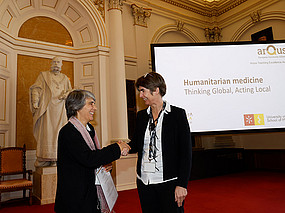
Margarida Correia-Neves (l.) nahm den Preis auch für ihren Kollegen Jorge Hernȃni-Eusébio in der Kategorie "Enabling resarch-based teaching" entgegen.
Margarida Correia-Neves (l.) nahm den Preis auch für ihren Kollegen Jorge Hernȃni-Eusébio in der Kategorie "Enabling resarch-based teaching" von Vizerektorin Mireille van Poppel entgegen.
Isaac José Pérez López ist heuer Preisträger in der Kategorie "Enabling students". Diego Pablo Ruiz Padillo nahm den Award in Vertretung von Vizerektorin Mireille van Poppel entgegen.
created by Gerhild Leljak

Related news

Around the world in eight stops: the Long Night of Research at the University of Graz

On 24 April from 5 pm, you can take a short trip around the globe at the University of Graz, discovering pecularities of foreign countries or new local features in the entrance hall of the University Library. The itinerary takes you through introduced animal species, political attitudes and the omnipotence of algorithms. There will also be a programme in the historic reading hall, as well as at the UniGraz@Museum and the University Archive.

Studying at the University of Graz: How to enrol

Ready for a new chapter in your life with the start of your studies at the University of Graz in the winter semester 2026/27? Here you will find information on deadlines, admission procedures, registration, and everything else you need to successfully start your studies in the fall.

Interpreting data: Why studies sometimes get it wrong

Hilmar Brohmer and Ziva Korda from the Institute of Psychology, together with 500 international colleagues, have re-evaluated a hundred scientific publications and have often come to different conclusions.

Crystal-clear: AI method revolutionises solar observation

The Sun makes life on Earth possible. However, its magnetic fields can also cause massive disruption. This makes it all the more important to gain a better understanding of the processes taking place on our nearest star. A research team from the University of Graz and the High Altitude Observatory in Boulder (USA) has succeeded in doing just that. The astrophysicists have developed an AI-supported method that makes even the smallest structures on the Sun visible. The scientists are convinced that this will bring about a lasting change in solar observation and that the new method can be used for the planned European Solar Telescope.

Begin of page section:
Additional information:

University of Graz
Universitaetsplatz 3
8010 Graz
Austria
  • Contact
  • Web Editors
  • Moodle
  • UNIGRAZonline
  • Imprint
  • Data Protection Declaration
  • Accessibility Declaration
Weatherstation
Uni Graz

End of this page section. Go to overview of page sections

End of this page section. Go to overview of page sections

Begin of page section:

End of this page section. Go to overview of page sections