Begin of page section:
Page sections:

  • Go to contents (Accesskey 1)
  • Go to position marker (Accesskey 2)
  • Go to main navigation (Accesskey 3)
  • Go to sub navigation (Accesskey 4)
  • Go to additional information (Accesskey 5)
  • Go to page settings (user/language) (Accesskey 8)
  • Go to search (Accesskey 9)

End of this page section. Go to overview of page sections

Begin of page section:
Page settings:

English en
Deutsch de
Search
Login

End of this page section. Go to overview of page sections

Begin of page section:
Search:

Search for details about Uni Graz
Close

End of this page section. Go to overview of page sections


Search

Begin of page section:
Main navigation:

Page navigation:

  • University

    University
    • About the University
    • Organisation
    • Faculties
    • Library
    • Working at University of Graz
    • Campus
    Developing solutions for the world of tomorrow - that is our mission. Our students and our researchers take on the great challenges of society and carry the knowledge out.
  • Research Profile

    Research Profile
    • Our Expertise
    • Research Questions
    • Research Portal
    • Promoting Research
    • Research Transfer
    • Ethics in Research
    • Commission for Scientific Integrity
    Scientific excellence and the courage to break new ground. Research at the University of Graz creates the foundations for making the future worth living.
  • Studies

    Studies
    • Prospective Students
    • Students
    • Post-registration Law
  • Community

    Community
    • International
    • Location
    • Research and Business
    • Alumni
    The University of Graz is a hub for international research and brings together scientists and business experts. Moreover, it fosters the exchange and cooperation in study and teaching.
Topics
  • Sustainable University
  • Researchers answer
  • Work for us
Close menu

End of this page section. Go to overview of page sections

Begin of page section:
You are here:

University of Graz News Five in one: physicists are on the trail of nanoparticles in liquids

End of this page section. Go to overview of page sections

Tuesday, 27 May 2025

Five in one: physicists are on the trail of nanoparticles in liquids

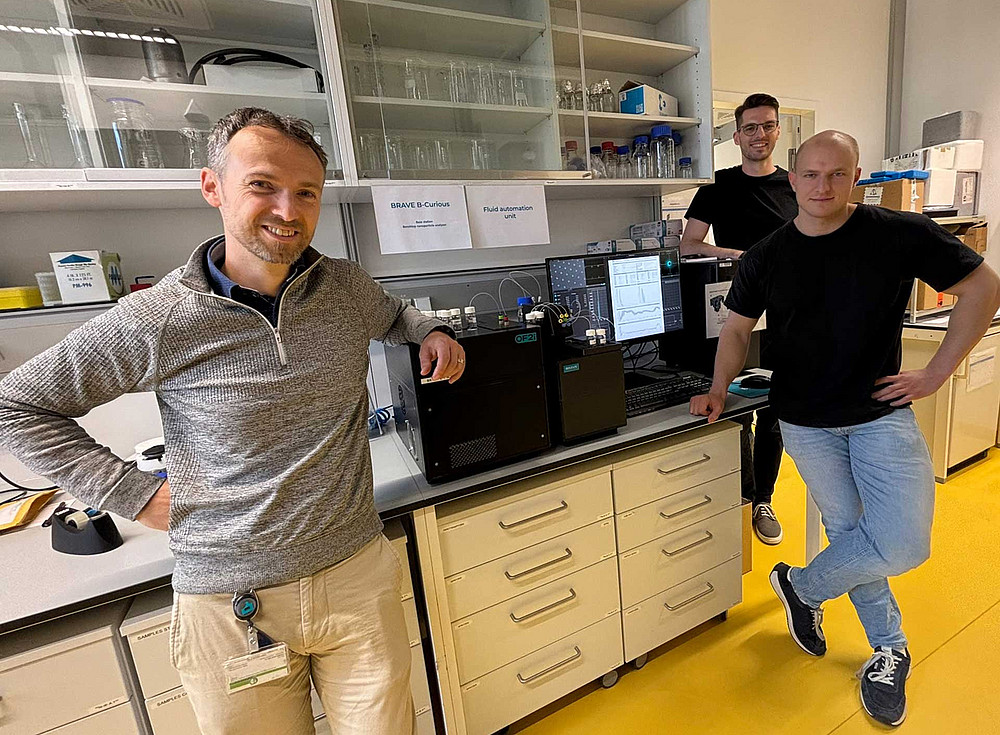
Christian Hill, Marko Šimić and Raphael Hauer (from left)

Have scientifically described the technology: Christian Hill, Marko Šimić and Raphael Hauer (from left) Photo: Uni Graz/Schweiger

They are invisible to the naked eye, but sometimes painful. Even the smallest particles, which are up to 10,000 times thinner than a hair, can cause great damage in medical fluids such as eye drops. Physicists from the University of Graz and Graz University of Technology, in cooperation with the Medical University of Graz, have demonstrated which measuring methods can be used to successfully detect tiny nanoparticles. The researchers' expertise was utilised by a spin-off of the Medical University of Graz to develop the technology to market maturity.

The results of the innovative application are now available in black and white - in the form of a review article in the renowned scientific journal "Nano Letters". In it, a team of physicists from the University of Graz, Med Uni Graz and TU Graz as well as the company BRAVE Analytics summarise their five years of work. "By carrying out simulations and comparing experimental data with samples from industry, we have confirmed the functioning characterisation and analysis of nanoparticles," explains Marko Šimić from the Institute of Physics at the University of Graz.

Against production errors in cosmetics or medicines

The technology is an instrument called "Optofluidic Force Induction (OF2i)", developed by the spin-off company BRAVE Analytics. "It is more of a platform that uses sensors and five different methods to analyse liquids," explains Šimić. Together with the other authors Christian Neuper, Raphael Hauer, Karin Griesmair, Christian Hill and Ulrich Hohenester, Šimić has described how the methods work.
Co-author Hill, biophysicist and CEO of BRAVE Analytics, explains: "All sensors can be read in parallel, which enables simultaneous access to most of the data for the same particle."
Šimić adds that this allows the size, type and composition of tiny particles in the size spectrum between five nanometres and 100 micrometres to be determined in real time. These can creep into cosmetics or medicines due to production errors, for example, and then cause irritation even in very low concentrations, such as in eye sprays.
Christian Hill is convinced of the range of possible applications: "The technology can be used in areas such as infusions, medicines and vaccinations, but also in the semiconductor industry and environmental analysis."

created by Andreas Schweiger

Related news

Record of reported species: Styria wins the global City Nature Challenge

Observers in Styria recorded 4,660 different animals, plants and fungi as part of the international City Nature Challenge between 24 and 27 April 2026. This saw the region take first place in the "species" category. Ostrava in the Czech Republic made the most observations, with just under 140,000, whilst the San Francisco Bay Area had the highest number of participants, namely 3,019.

Studying at the University of Graz: How to enrol

Ready for a new chapter in your life with the start of your studies at the University of Graz in the winter semester 2026/27? Here you will find information on deadlines, admission procedures, registration, and everything else you need to successfully start your studies in the fall.

Europe Day: Strengthening international expertise with Arqus

On 9 May, the spotlight will be on Europe. At the University of Graz, European cooperation is also a tangible part of everyday student life – not least through the Arqus university alliance. Master’s and PhD students can currently register for the Arqus micro-credential in ‘Advanced Creative Thinking and Communication’.

A substantial community: the key role of soil crusts in the earth system

They are often overshadowed by the plant world: lichens, fungi, mosses and bacteria, which form unique communities on rocks and trees or as soil crusts. Bettina Weber from the University of Graz is bringing this biological alliance into the research spotlight. Her research shows that these communities form an essential part of the Earth’s critical zone and play a key role in the interactions between land and atmosphere. Bettina Weber was honoured by the European Geosciences Union for her groundbreaking research at the beginning of May.

Begin of page section:
Additional information:

University of Graz
Universitaetsplatz 3
8010 Graz
Austria
  • Contact
  • Web Editors
  • Moodle
  • UNIGRAZonline
  • Imprint
  • Data Protection Declaration
  • Accessibility Declaration
Weatherstation
Uni Graz

End of this page section. Go to overview of page sections

End of this page section. Go to overview of page sections

Begin of page section:

End of this page section. Go to overview of page sections