Begin of page section:
Page sections:

  • Go to contents (Accesskey 1)
  • Go to position marker (Accesskey 2)
  • Go to main navigation (Accesskey 3)
  • Go to sub navigation (Accesskey 4)
  • Go to additional information (Accesskey 5)
  • Go to page settings (user/language) (Accesskey 8)
  • Go to search (Accesskey 9)

End of this page section. Go to overview of page sections

Begin of page section:
Page settings:

English en
Deutsch de
Search
Login

End of this page section. Go to overview of page sections

Begin of page section:
Search:

Search for details about Uni Graz
Close

End of this page section. Go to overview of page sections


Search

Begin of page section:
Main navigation:

Page navigation:

  • University

    University
    • About the University
    • Organisation
    • Faculties
    • Library
    • Working at University of Graz
    • Campus
    Developing solutions for the world of tomorrow - that is our mission. Our students and our researchers take on the great challenges of society and carry the knowledge out.
  • Research Profile

    Research Profile
    • Our Expertise
    • Research Questions
    • Research Portal
    • Promoting Research
    • Research Transfer
    • Ethics in Research
    Scientific excellence and the courage to break new ground. Research at the University of Graz creates the foundations for making the future worth living.
  • Studies

    Studies
    • Prospective Students
    • Students
  • Community

    Community
    • International
    • Location
    • Research and Business
    • Alumni
    The University of Graz is a hub for international research and brings together scientists and business experts. Moreover, it fosters the exchange and cooperation in study and teaching.
  • Spotlight
Topics
  • Our digital Advent calendar
  • Sustainable University
  • Researchers answer
  • Work for us
Close menu

End of this page section. Go to overview of page sections

Begin of page section:
You are here:

University of Graz News Five in one: physicists are on the trail of nanoparticles in liquids

End of this page section. Go to overview of page sections

Tuesday, 27 May 2025

Five in one: physicists are on the trail of nanoparticles in liquids

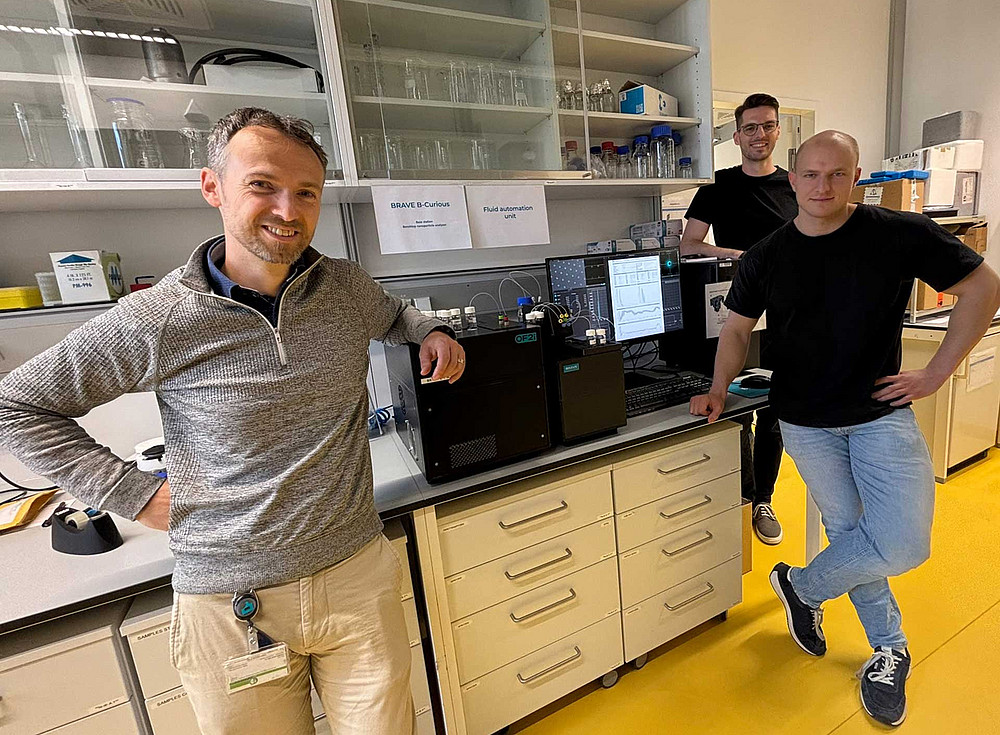
Christian Hill, Marko Šimić and Raphael Hauer (from left)

Have scientifically described the technology: Christian Hill, Marko Šimić and Raphael Hauer (from left) Photo: Uni Graz/Schweiger

They are invisible to the naked eye, but sometimes painful. Even the smallest particles, which are up to 10,000 times thinner than a hair, can cause great damage in medical fluids such as eye drops. Physicists from the University of Graz and Graz University of Technology, in cooperation with the Medical University of Graz, have demonstrated which measuring methods can be used to successfully detect tiny nanoparticles. The researchers' expertise was utilised by a spin-off of the Medical University of Graz to develop the technology to market maturity.

The results of the innovative application are now available in black and white - in the form of a review article in the renowned scientific journal "Nano Letters". In it, a team of physicists from the University of Graz, Med Uni Graz and TU Graz as well as the company BRAVE Analytics summarise their five years of work. "By carrying out simulations and comparing experimental data with samples from industry, we have confirmed the functioning characterisation and analysis of nanoparticles," explains Marko Šimić from the Institute of Physics at the University of Graz.

Against production errors in cosmetics or medicines

The technology is an instrument called "Optofluidic Force Induction (OF2i)", developed by the spin-off company BRAVE Analytics. "It is more of a platform that uses sensors and five different methods to analyse liquids," explains Šimić. Together with the other authors Christian Neuper, Raphael Hauer, Karin Griesmair, Christian Hill and Ulrich Hohenester, Šimić has described how the methods work.
Co-author Hill, biophysicist and CEO of BRAVE Analytics, explains: "All sensors can be read in parallel, which enables simultaneous access to most of the data for the same particle."
Šimić adds that this allows the size, type and composition of tiny particles in the size spectrum between five nanometres and 100 micrometres to be determined in real time. These can creep into cosmetics or medicines due to production errors, for example, and then cause irritation even in very low concentrations, such as in eye sprays.
Christian Hill is convinced of the range of possible applications: "The technology can be used in areas such as infusions, medicines and vaccinations, but also in the semiconductor industry and environmental analysis."

created by Andreas Schweiger

Related news

Chemical Christmas show at the University of Graz: An explosive evening at the Schauspielh

At the beginning of December, the University of Graz transformed the theater into a laboratory: as part of “Chemical Life,” teacher training students staged a chemical Christmas show for Styrian school classes—complete with ethanol rockets, nitrogen snow, and glowing effects. An evening designed to inspire interest in studying chemistry.

Train by train: Koralm railway accelerates exchange between the Universities

Lectures at the University of Klagenfurt in the morning, seminars at the University of Graz in the afternoon: Austria's longest tunnel and a journey time of around 45 minutes make it easy. The Koralm railway increases the speed of networking between the two university locations. The collaboration builds on existing cooperation - for example in the areas of teacher training, Slavic studies and as employers, the universities are well coordinated.

On the trail of the Big Bang: University of Graz receives 1.5 million euros for doctoral programmes

The Austrian Science Fund FWF has selected the Doctoral Programme in Theoretical Particle Physics at the University of Graz for funding from the Doc.funds. Six young scientists will be funded for 3.5 years. They will gain fundamentally new insights into the origins of the world.

From trans women and knee prostheses: sports science prizes awarded

Walking better with a prosthesis, successfully getting rid of excess weight, training more effectively, more fairness for trans people in sport: these were the topics addressed by the students at the University of Graz who were awarded the sports science prizes for their Master's theses on 3 December 2025.

Begin of page section:
Additional information:

University of Graz
Universitaetsplatz 3
8010 Graz
Austria
  • Contact
  • Web Editors
  • Moodle
  • UNIGRAZonline
  • Imprint
  • Data Protection Declaration
  • Accessibility Declaration
Weatherstation
Uni Graz

End of this page section. Go to overview of page sections

End of this page section. Go to overview of page sections

Begin of page section:

End of this page section. Go to overview of page sections