Begin of page section:
Page sections:

  • Go to contents (Accesskey 1)
  • Go to position marker (Accesskey 2)
  • Go to main navigation (Accesskey 3)
  • Go to sub navigation (Accesskey 4)
  • Go to additional information (Accesskey 5)
  • Go to page settings (user/language) (Accesskey 8)
  • Go to search (Accesskey 9)

End of this page section. Go to overview of page sections

Begin of page section:
Page settings:

English en
Deutsch de
Search
Login

End of this page section. Go to overview of page sections

Begin of page section:
Search:

Search for details about Uni Graz
Close

End of this page section. Go to overview of page sections


Search

Begin of page section:
Main navigation:

Page navigation:

  • University

    University
    • About the University
    • Organisation
    • Faculties
    • Library
    • Working at University of Graz
    • Campus
    Developing solutions for the world of tomorrow - that is our mission. Our students and our researchers take on the great challenges of society and carry the knowledge out.
  • Research Profile

    Research Profile
    • Our Expertise
    • Research Questions
    • Research Portal
    • Promoting Research
    • Research Transfer
    • Ethics in Research
    Scientific excellence and the courage to break new ground. Research at the University of Graz creates the foundations for making the future worth living.
  • Studies

    Studies
    • Prospective Students
    • Students
    • Welcome Weeks for First Year Students
  • Community

    Community
    • International
    • Location
    • Research and Business
    • Alumni
    The University of Graz is a hub for international research and brings together scientists and business experts. Moreover, it fosters the exchange and cooperation in study and teaching.
  • Spotlight
Topics
  • Sustainable University
  • Researchers answer
  • Work for us
Close menu

End of this page section. Go to overview of page sections

Begin of page section:
You are here:

University of Graz News Research and fun: digital archaeology puzzle at Buch Wien
End of this page section. Go to overview of page sections

Wednesday, 20 November 2024

Research and fun: digital archaeology puzzle at Buch Wien

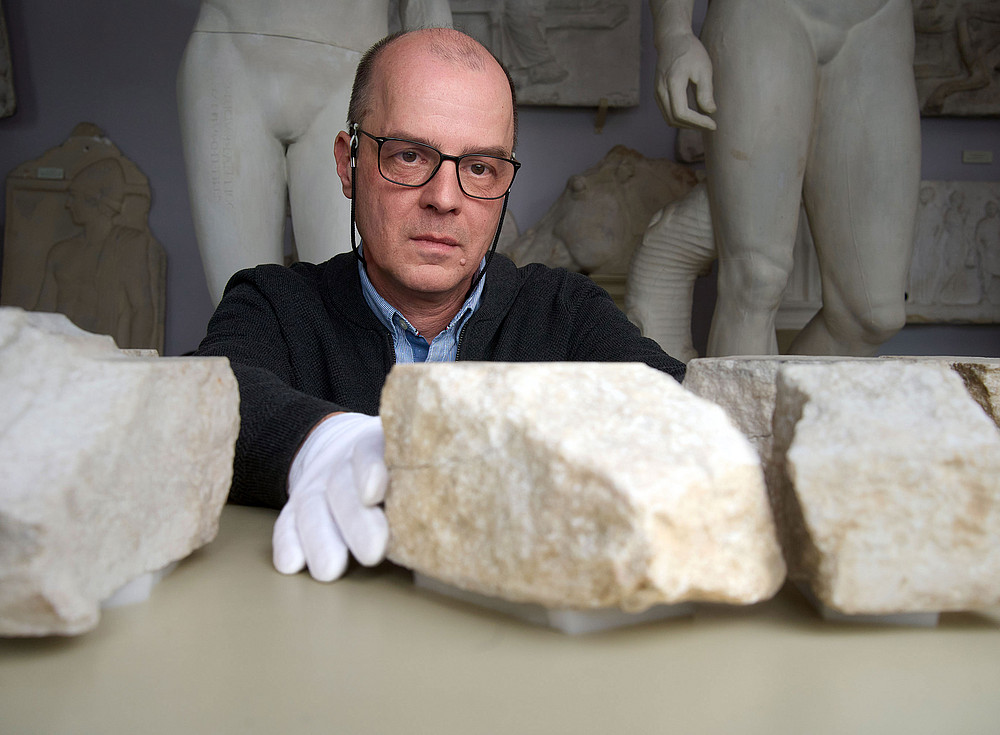
Archaeologist Stephan Karl joins two fragments of an altar slab together

Archaeologist Stephan Karl knows that it takes a lot of dexterity to put historical fragments together to form a whole. Experimenting in virtual space is easier - and more gentle on objects. Photo: University of Graz/wildundwunderbar

Archaeologist Stephan Karl used the natural intelligence of online gamers to reassemble over a hundred fragments of a 1500-year-old altar slab. The game with the virtual pieces can also be tried out at Buch Wien until November 24.

"Crowdsourcing" is intended to help to correctly assemble historical fragments into a whole - in this specific case the (digitised) pieces of an altar slab from East Tyrol. The more eyes and ears that participate, the better. This was the starting point for the research project by Stefan Karl, an archaeologist at the University of Graz, and Reinhold Preiner, a computer scientist at Graz University of Technology. The virtual puzzle game, which actually succeeded in putting the incomplete finds back into their original order, can be tried out at Buch Wien. Details of the research project can be found in UNIZEIT.

created by Dagmar Eklaude

Related news

How Wikipedia and open source are changing the world

From ancient irrigation systems to Wikipedia: common goods have shaped our society for thousands of years. Richard Sturn, professor of economics at the University of Graz, explains why common goods or commons such as open-source software do not work without clear rules and what balance between openness and structure is crucial.

Award for female researchers: University of Graz impresses at the SPIRIT Award

On February 10, 2026, the SPIRIT Award for WOMEN in SCIENCE was presented for the second time—an award for outstanding female researchers in Styria. The winners, including Raquel Gonzalez de Vega from the University of Graz, impressed with innovative projects ranging from the detection of microplastics to revolutionary blood diagnostics.

Electricity consumption reduced: University of Graz well on track

This year, the University of Graz has once again received EMAS certification. Since the introduction of this environmental management system in 2016, the seal of approval has been renewed every three years after successful audits. As an EMAS-certified organisation, the university is committed to systematically improving its environmental performance and contributing to sustainable development at all levels. Progress is documented in the annual environmental statement. The statement for 2024 was recently published. Particularly pleasing: electricity consumption was the lowest since EMAS records began.

Four universities, one degree: first certificates awarded in pioneering Arqus consortium

The European University Alliance Arqus has been in existence since 2018, with the University of Graz collaborating with eight partner institutions at various levels. The first joint master's programme began in 2023. Twenty-one graduates recently celebrated their graduation in Graz.

Begin of page section:
Additional information:

University of Graz
Universitaetsplatz 3
8010 Graz
Austria
  • Contact
  • Web Editors
  • Moodle
  • UNIGRAZonline
  • Imprint
  • Data Protection Declaration
  • Accessibility Declaration
Weatherstation
Uni Graz

End of this page section. Go to overview of page sections

End of this page section. Go to overview of page sections

Begin of page section:

End of this page section. Go to overview of page sections