Begin of page section:
Page sections:

  • Go to contents (Accesskey 1)
  • Go to position marker (Accesskey 2)
  • Go to main navigation (Accesskey 3)
  • Go to sub navigation (Accesskey 4)
  • Go to additional information (Accesskey 5)
  • Go to page settings (user/language) (Accesskey 8)
  • Go to search (Accesskey 9)

End of this page section. Go to overview of page sections

Begin of page section:
Page settings:

English en
Deutsch de
Search
Login

End of this page section. Go to overview of page sections

Begin of page section:
Search:

Search for details about Uni Graz
Close

End of this page section. Go to overview of page sections


Search

Begin of page section:
Main navigation:

Page navigation:

  • University

    University
    • About the University
    • Organisation
    • Faculties
    • Library
    • Working at University of Graz
    • Campus
    Developing solutions for the world of tomorrow - that is our mission. Our students and our researchers take on the great challenges of society and carry the knowledge out.
  • Research Profile

    Research Profile
    • Our Expertise
    • Research Questions
    • Research Portal
    • Promoting Research
    • Research Transfer
    • Ethics in Research
    Scientific excellence and the courage to break new ground. Research at the University of Graz creates the foundations for making the future worth living.
  • Studies

    Studies
    • Prospective Students
    • Students
  • Community

    Community
    • International
    • Location
    • Research and Business
    • Alumni
    The University of Graz is a hub for international research and brings together scientists and business experts. Moreover, it fosters the exchange and cooperation in study and teaching.
  • Spotlight
Topics
  • Our digital Advent calendar
  • Sustainable University
  • Researchers answer
  • Work for us
Close menu

End of this page section. Go to overview of page sections

Begin of page section:
You are here:

University of Graz News A star far away

End of this page section. Go to overview of page sections

Thursday, 22 April 2021

A star far away

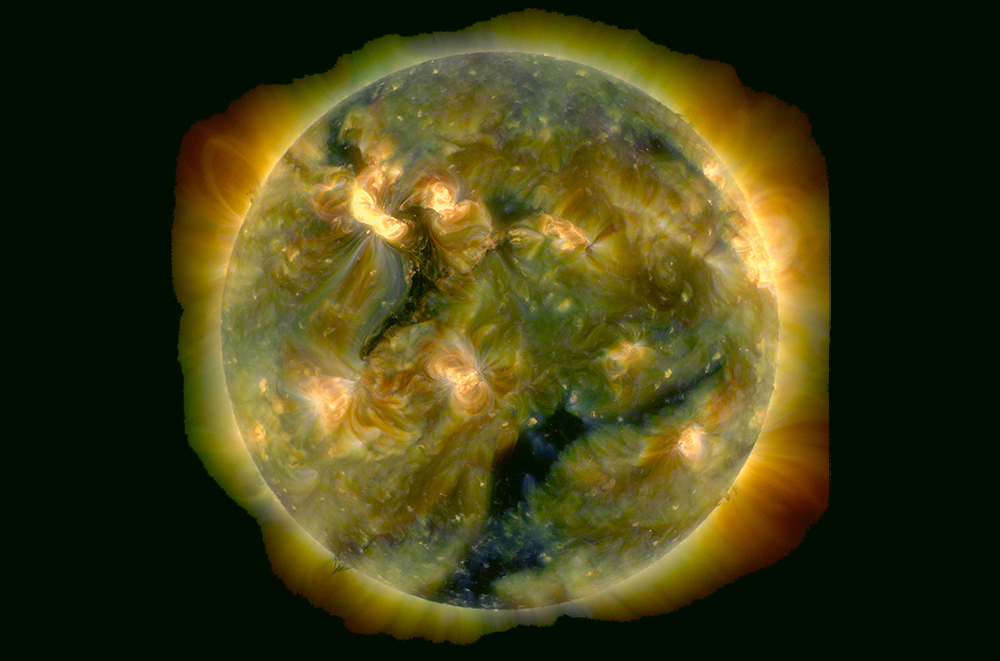
Picture taken from the Atmospheric Imaging Assembly on Board of the Solar Dynamics Observatory of the NASA. Photo: NASA SDO/AIA

Picture taken from the Atmospheric Imaging Assembly on Board of the Solar Dynamics Observatory of the NASA. Photo: NASA SDO/AIA

Astrophysicists from the University of Graz detect coronal mass ejections on neighbouring suns

They are hundreds of light years away. Stars that eject matter into space, just the way our Sun does. Could these eruptions be a threat to distant planets orbiting these stars? A team led by Astrid Veronig, an astrophysicist at the University of Graz, has developed a new method to find this out. As can be read in the renowned professional journal Nature Astronomy, they were able to detect 21 coronal mass ejections on stars and determine their strength.

Our Sun is the source of energetic eruptions in which plasma is ejected into space together with an embedded magnetic field. These coronal mass ejections vary in strength and move through our solar system at speeds of millions of kilometres per hour. The strongest eruptions can even trigger power cuts on Earth and paralyse electronic systems on satellites. However, they are also responsible for spectacular auroras. “The ejections are tracked with the help of coronagraphs, which block out the strong direct sunlight and thereby create a kind of artificial solar eclipse,” explains Astrid Veronig, who uses satellite-based telescopes for this purpose and works together with the space organisations ESA and NASA.

Dimmings in the aureole
While the Sun is a frequent subject of scientific research, so far not many coronal mass ejections have been observed on stars. Veronig: “The spatial resolution is too low and the radiation of the ejections too weak for us to be able to do coronagraphic measurements like those of the Sun.” The researchers therefore turned the tables and studied the Sun like they would study a star. The result was a novel method of detection. “We observe the Sun in the light of ultraviolet and X-ray radiation, where the million-degree hot corona emits the most radiation,” explains the astrophysicist. “When mass ejections occur, i.e. huge clouds of plasma are ejected from the corona, dimmings remain in this aureole and we are able to detect these.”

The scientists have now been able to apply these findings and methodology successfully to other stars. They discovered that such sudden dimmings in X-ray light curves can also be found there. Petra Odert, researcher at the Institute of Physics at the University of Graz and co-author of the study, confirms that “we infer from this that there are also coronal mass ejections on these other stars”. Using this technique, the scientists have discovered a total of 21 coronal mass ejections on other stars. During the CME, considerable parts of the corona can be ejected. Odert: “These high-energy plasma clouds are a threat to exoplanets orbiting the star, as they can erode their atmospheres completely.” However, it depends on the dose, as is so often the case. At the same time, a lower intensity could enable conditions that are just as liveable as those in our planetary system.

This research, supported by the Austrian Space Applications Programme of the Austrian Research Promotion Agency (FFG) and the Austrian Science Fund (FWF), was published in the journal Nature Astronomy.

Astrid M. Veronig, Petra Odert, Martin Leitzinger, Karin Dissauer, Nikolaus C. Fleck, Hugh S. Hudson, Indications of stellar coronal mass ejections through coronal dimmings, >> Nature Astronomy

created by Andreas Schweiger

Related news

Semester abroad without barriers: University of Graz wins award for promoting inclusion

The University of Graz has been awarded the Internationalization Award for its new inclusion initiative. Students with fewer opportunities now also receive financial support for their semester abroad outside Europe.

Fair distribution: Researchers determine just greenhouse gas budgets for all EU regions

Ten years ago, on 12 December 2015, the Paris Climate Agreement was signed at the UN Climate Conference. In order to limit global warming to well below two degrees, only a certain amount of CO2 may be emitted worldwide. While the focus was originally on national emission targets, more than 200 subnational regions and almost 300 cities have now adopted their own targets. But how many emissions are they fairly entitled to? Researchers at the University of Graz have now developed transparent criteria for fair distribution at the subnational level for the first time and determined corresponding greenhouse gas budgets for all European regions. The paper was published today in the scientific journal Nature Communications.

Chemical Christmas show at the University of Graz: An explosive evening at the Schauspielh

At the beginning of December, the University of Graz transformed the theater into a laboratory: as part of “Chemical Life,” teacher training students staged a chemical Christmas show for Styrian school classes—complete with ethanol rockets, nitrogen snow, and glowing effects. An evening designed to inspire interest in studying chemistry.

Train by train: Koralm railway accelerates exchange between the Universities

Lectures at the University of Klagenfurt in the morning, seminars at the University of Graz in the afternoon: Austria's longest tunnel and a journey time of around 45 minutes make it easy. The Koralm railway increases the speed of networking between the two university locations. The collaboration builds on existing cooperation - for example in the areas of teacher training, Slavic studies and as employers, the universities are well coordinated.

Begin of page section:
Additional information:

University of Graz
Universitaetsplatz 3
8010 Graz
Austria
  • Contact
  • Web Editors
  • Moodle
  • UNIGRAZonline
  • Imprint
  • Data Protection Declaration
  • Accessibility Declaration
Weatherstation
Uni Graz

End of this page section. Go to overview of page sections

End of this page section. Go to overview of page sections

Begin of page section:

End of this page section. Go to overview of page sections