Begin of page section:
Page sections:

  • Go to contents (Accesskey 1)
  • Go to position marker (Accesskey 2)
  • Go to main navigation (Accesskey 3)
  • Go to sub navigation (Accesskey 4)
  • Go to additional information (Accesskey 5)
  • Go to page settings (user/language) (Accesskey 8)
  • Go to search (Accesskey 9)

End of this page section. Go to overview of page sections

Begin of page section:
Page settings:

English en
Deutsch de
Search
Login

End of this page section. Go to overview of page sections

Begin of page section:
Search:

Search for details about Uni Graz
Close

End of this page section. Go to overview of page sections


Search

Begin of page section:
Main navigation:

Page navigation:

  • University

    University
    • About the University
    • Organisation
    • Faculties
    • Library
    • Working at University of Graz
    • Campus
    Developing solutions for the world of tomorrow - that is our mission. Our students and our researchers take on the great challenges of society and carry the knowledge out.
  • Research Profile

    Research Profile
    • Our Expertise
    • Research Questions
    • Research Portal
    • Promoting Research
    • Research Transfer
    • Ethics in Research
    Scientific excellence and the courage to break new ground. Research at the University of Graz creates the foundations for making the future worth living.
  • Studies

    Studies
    • Prospective Students
    • Students
  • Community

    Community
    • International
    • Location
    • Research and Business
    • Alumni
    The University of Graz is a hub for international research and brings together scientists and business experts. Moreover, it fosters the exchange and cooperation in study and teaching.
  • Spotlight
Topics
  • Our digital Advent calendar
  • Sustainable University
  • Researchers answer
  • Work for us
Close menu

End of this page section. Go to overview of page sections

Begin of page section:
You are here:

University of Graz News Facettenreich

End of this page section. Go to overview of page sections

Tuesday, 20 April 2021

Facettenreich

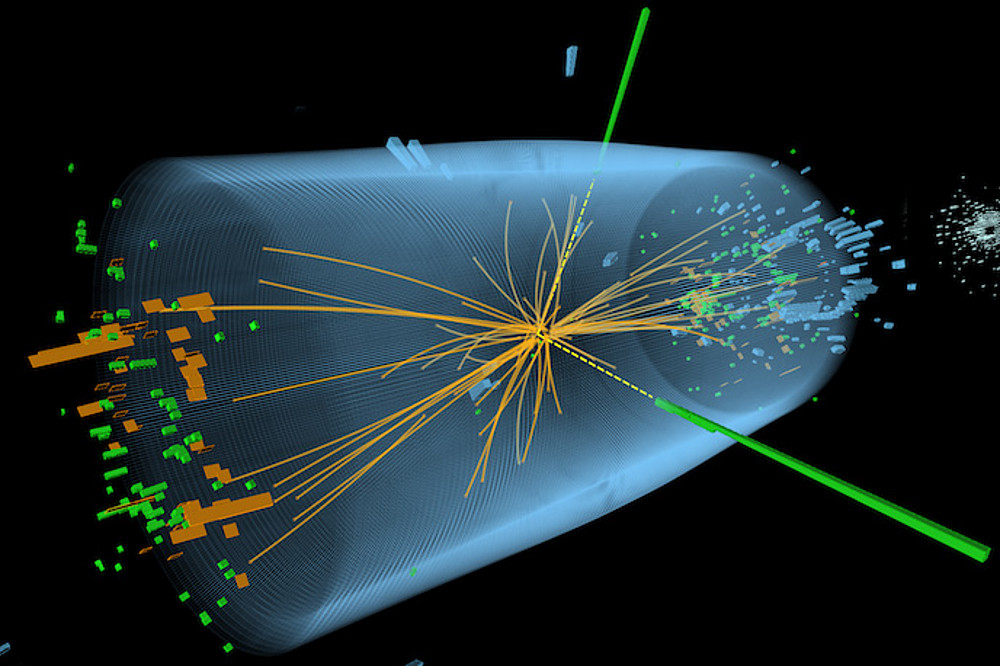
Das Higgs-Teilchen, auch Gottesteilchen genannt. (Bild:CERN/ATLAS and CMS)

Das Higgs-Teilchen, auch Gottesteilchen genannt. (Bild:CERN/ATLAS and CMS)

Von Gottesteilchen bis Sonnensturm: Uni Graz erklärt Rätsel der Physik

Ob Faszinierendes aus dem Kosmos oder zukunftsträchtige Licht-Technologien: In der Reihe „Facetten der Physik“ erklären ForscherInnen der Universität Graz aktuelle Themen leicht verständlich. Die Vorträge sind kostenlos und werden derzeit virtuell abgehalten.

Die nächsten Veranstaltungen der Reihe sind:

28. April 2021, 17.00 Uhr:  Wie das Higgs unser Bild von Elementarteilchen ändert (Axel Maas)
Die Existenz des ominösen Higgs-Teilchens, das auch als „Gottesteilchen“ bezeichnet wird, ist mittlerweile experimentell bestätigt. Doch nach wie vor gibt dieses Elementarteilchen der Forschung Rätsel auf. Welche Eigenschaften es hat, was daran fasziniert, und wie es die Entstehung der Welt erklären könnte, beleuchtet Axel Maas.

12. Mai 2021, 17.00 Uhr:  Photonische Räder, winzige Leuchttürme und Möbiusbänder aus Licht (Peter Banzer)
Wie bringe ich Donuts das Fliegen bei? Was unterscheidet Fahrräder von Flugzeugen? Wie schrumpft man Leuchttürme und warum? Warum macht ein Möbiusband immer doppelt Arbeit? Und was hat das alles nun mit Licht zu tun? In dieser Facette der Physik berichtet Peter Banzer über eben jene und weitere faszinierenden Fragen und Anwendungen aktueller Optik-Forschung.

9. Juni 2021, 17.00 Uhr: Sonne und Weltraumwetter (Astrid Veronig)
Auf der Oberfläche der Sonne, der mit Abstand größten Energielieferantin der Erde, geht es äußerst turbulent zu. Der Auswurf von gewaltigen Mengen Materie kann beispielsweise – nach Ablenkung durch das Magnetfelds der Erde – bei uns als Polarlichter sichtbar werden oder aber bei Auftreffen auf der Erdoberfläche sogar zum Ausfall von Stromnetzen führen können.  Astrid Veronig berichtet über die Physik der Sonne und das von ihr hervorgerufene Weltraumwetter auf der Erde.

Mehr Informationen zur Vortragsreihe auf  https://physik.uni-graz.at/de/facetten/.

created by Joachim Hirtenfellner

Related news

Semester abroad without barriers: University of Graz wins award for promoting inclusion

The University of Graz has been awarded the Internationalization Award for its new inclusion initiative. Students with fewer opportunities now also receive financial support for their semester abroad outside Europe.

Fair distribution: Researchers determine just greenhouse gas budgets for all EU regions

Ten years ago, on 12 December 2015, the Paris Climate Agreement was signed at the UN Climate Conference. In order to limit global warming to well below two degrees, only a certain amount of CO2 may be emitted worldwide. While the focus was originally on national emission targets, more than 200 subnational regions and almost 300 cities have now adopted their own targets. But how many emissions are they fairly entitled to? Researchers at the University of Graz have now developed transparent criteria for fair distribution at the subnational level for the first time and determined corresponding greenhouse gas budgets for all European regions. The paper was published today in the scientific journal Nature Communications.

Chemical Christmas show at the University of Graz: An explosive evening at the Schauspielh

At the beginning of December, the University of Graz transformed the theater into a laboratory: as part of “Chemical Life,” teacher training students staged a chemical Christmas show for Styrian school classes—complete with ethanol rockets, nitrogen snow, and glowing effects. An evening designed to inspire interest in studying chemistry.

Train by train: Koralm railway accelerates exchange between the Universities

Lectures at the University of Klagenfurt in the morning, seminars at the University of Graz in the afternoon: Austria's longest tunnel and a journey time of around 45 minutes make it easy. The Koralm railway increases the speed of networking between the two university locations. The collaboration builds on existing cooperation - for example in the areas of teacher training, Slavic studies and as employers, the universities are well coordinated.

Begin of page section:
Additional information:

University of Graz
Universitaetsplatz 3
8010 Graz
Austria
  • Contact
  • Web Editors
  • Moodle
  • UNIGRAZonline
  • Imprint
  • Data Protection Declaration
  • Accessibility Declaration
Weatherstation
Uni Graz

End of this page section. Go to overview of page sections

End of this page section. Go to overview of page sections

Begin of page section:

End of this page section. Go to overview of page sections