



Begin of page section:
Page sections:

  • Go to contents (Accesskey 1)
  • Go to position marker (Accesskey 2)
  • Go to main navigation (Accesskey 3)
  • Go to sub navigation (Accesskey 4)
  • Go to additional information (Accesskey 5)
  • Go to page settings (user/language) (Accesskey 8)
  • Go to search (Accesskey 9)

End of this page section. Go to overview of page sections

Begin of page section:
Page settings:

English en
Deutsch de
Search
Login

End of this page section. Go to overview of page sections

Begin of page section:
Search:

Search for details about Uni Graz
Close

End of this page section. Go to overview of page sections


Search

Begin of page section:
Main navigation:

Page navigation:

  • University

    University
    • About the University
    • Organisation
    • Faculties
    • Library
    • Working at University of Graz
    • Campus
    Developing solutions for the world of tomorrow - that is our mission. Our students and our researchers take on the great challenges of society and carry the knowledge out.
  • Research Profile

    Research Profile
    • Our Expertise
    • Research Questions
    • Research Portal
    • Promoting Research
    • Research Transfer
    • Ethics in Research
    • Commission for Scientific Integrity
    Scientific excellence and the courage to break new ground. Research at the University of Graz creates the foundations for making the future worth living.
  • Studies

    Studies
    • Prospective Students
    • Students
    • Registration for Study Programme (Winter semester 2026/27)
    • Study Days 22-26 June 2026
  • Community

    Community
    • International
    • Location
    • Research and Business
    • Alumni
    The University of Graz is a hub for international research and brings together scientists and business experts. Moreover, it fosters the exchange and cooperation in study and teaching.
Topics
  • Sustainable University
  • Researchers answer
  • Work for us
Close menu

End of this page section. Go to overview of page sections

Begin of page section:
You are here:

University of Graz News Facettenreich

End of this page section. Go to overview of page sections

Tuesday, 20 April 2021

Facettenreich

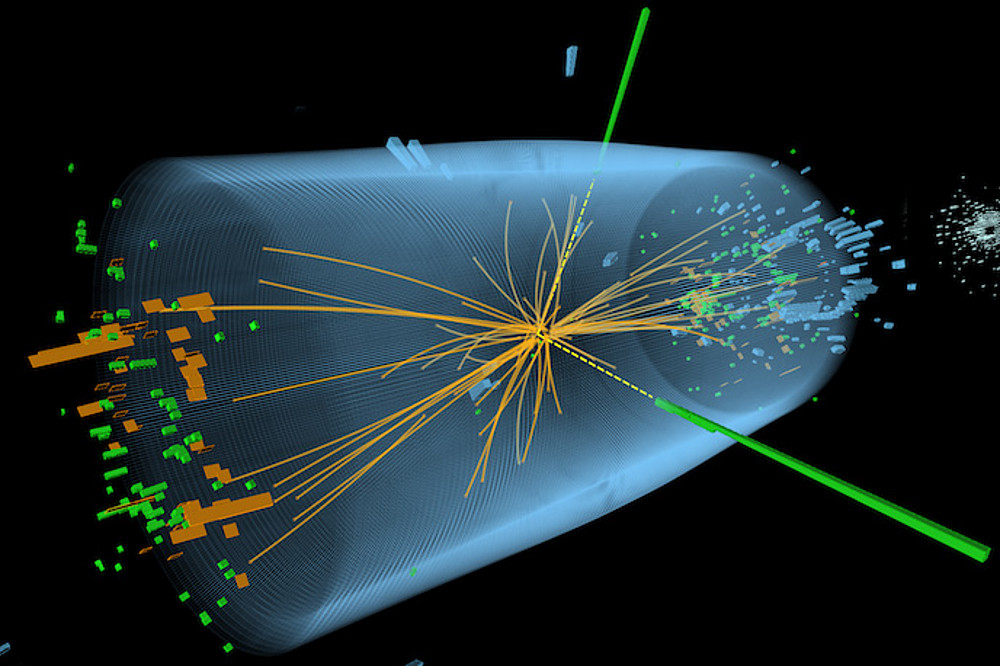
Das Higgs-Teilchen, auch Gottesteilchen genannt. (Bild:CERN/ATLAS and CMS)

Das Higgs-Teilchen, auch Gottesteilchen genannt. (Bild:CERN/ATLAS and CMS)

Von Gottesteilchen bis Sonnensturm: Uni Graz erklärt Rätsel der Physik

Ob Faszinierendes aus dem Kosmos oder zukunftsträchtige Licht-Technologien: In der Reihe „Facetten der Physik“ erklären ForscherInnen der Universität Graz aktuelle Themen leicht verständlich. Die Vorträge sind kostenlos und werden derzeit virtuell abgehalten.

Die nächsten Veranstaltungen der Reihe sind:

28. April 2021, 17.00 Uhr:  Wie das Higgs unser Bild von Elementarteilchen ändert (Axel Maas)
Die Existenz des ominösen Higgs-Teilchens, das auch als „Gottesteilchen“ bezeichnet wird, ist mittlerweile experimentell bestätigt. Doch nach wie vor gibt dieses Elementarteilchen der Forschung Rätsel auf. Welche Eigenschaften es hat, was daran fasziniert, und wie es die Entstehung der Welt erklären könnte, beleuchtet Axel Maas.

12. Mai 2021, 17.00 Uhr:  Photonische Räder, winzige Leuchttürme und Möbiusbänder aus Licht (Peter Banzer)
Wie bringe ich Donuts das Fliegen bei? Was unterscheidet Fahrräder von Flugzeugen? Wie schrumpft man Leuchttürme und warum? Warum macht ein Möbiusband immer doppelt Arbeit? Und was hat das alles nun mit Licht zu tun? In dieser Facette der Physik berichtet Peter Banzer über eben jene und weitere faszinierenden Fragen und Anwendungen aktueller Optik-Forschung.

9. Juni 2021, 17.00 Uhr: Sonne und Weltraumwetter (Astrid Veronig)
Auf der Oberfläche der Sonne, der mit Abstand größten Energielieferantin der Erde, geht es äußerst turbulent zu. Der Auswurf von gewaltigen Mengen Materie kann beispielsweise – nach Ablenkung durch das Magnetfelds der Erde – bei uns als Polarlichter sichtbar werden oder aber bei Auftreffen auf der Erdoberfläche sogar zum Ausfall von Stromnetzen führen können.  Astrid Veronig berichtet über die Physik der Sonne und das von ihr hervorgerufene Weltraumwetter auf der Erde.

Mehr Informationen zur Vortragsreihe auf  https://physik.uni-graz.at/de/facetten/.
created by Joachim Hirtenfellner

Related news

Getting even hotter: Researchers predict global warming of 1.7 degrees by 2027

While Europe is currently sweltering in the heat, global temperatures are also rising towards concerning record levels. In 2026, Earth’s surface air temperature is expected to reach 1.62 degrees, and in 2027 even 1.71 degrees Celsius above pre-industrial levels. The long-term temperature rise – an average over a 20-year period – is predicted to exceed the 1.5-degree threshold of the Paris Agreement as of 2026 already. For the first time, researchers at the University of Graz have been able to make such a forecast so far in advance. The intensifying El Niño climate event favors forecast skill and thereby facilitates a reliable computation.

Forest fire at Rosenhain: Volunteer fire brigade carried out an evacuation drill at the Jesuit refectory

Thick smoke in the stairwell, flames at the edge of the forest, people missing in the Jesuit refectory at the University of Graz: at Rosenhain, the Graz Volunteer Fire Brigade carried out a drill simulating a scenario that is becoming increasingly realistic given the heat and drought

Full effort in the heat: the Sports Centre was in full swing at the Kleeblattlauf

On 19 June 2026, 2,000 runners and hundreds of supporters made their way to the Rosenhain for a sporting end-of-term event.

Save, invest or guarantee: What Austrians expect from the state

Austria needs to make savings. But where? And what should the Republic actually be spending its money on? The answers are provided by the initial findings of a major study involving the University of Graz. 99 per cent of those surveyed are in favour of the state ensuring healthcare provision. Almost three-quarters would like to see more public funding for education, whilst only around three per cent are in favour of cuts in this sector.

Begin of page section:
Additional information:

University of Graz
Universitaetsplatz 3
8010 Graz
Austria
  • Contact
  • Web Editors
  • Moodle
  • UNIGRAZonline
  • Imprint
  • Data Protection Declaration
  • Accessibility Declaration
Weatherstation
Uni Graz

End of this page section. Go to overview of page sections

End of this page section. Go to overview of page sections

Begin of page section:

End of this page section. Go to overview of page sections


