Begin of page section:
Page sections:

  • Go to contents (Accesskey 1)
  • Go to position marker (Accesskey 2)
  • Go to main navigation (Accesskey 3)
  • Go to sub navigation (Accesskey 4)
  • Go to additional information (Accesskey 5)
  • Go to page settings (user/language) (Accesskey 8)
  • Go to search (Accesskey 9)

End of this page section. Go to overview of page sections

Begin of page section:
Page settings:

English en
Deutsch de
Search
Login

End of this page section. Go to overview of page sections

Begin of page section:
Search:

Search for details about Uni Graz
Close

End of this page section. Go to overview of page sections


Search

Begin of page section:
Main navigation:

Page navigation:

  • University

    University
    • About the University
    • Organisation
    • Faculties
    • Library
    • Working at University of Graz
    • Campus
    Developing solutions for the world of tomorrow - that is our mission. Our students and our researchers take on the great challenges of society and carry the knowledge out.
  • Research Profile

    Research Profile
    • Our Expertise
    • Research Questions
    • Research Portal
    • Promoting Research
    • Research Transfer
    • Ethics in Research
    • Commission for Scientific Integrity
    Scientific excellence and the courage to break new ground. Research at the University of Graz creates the foundations for making the future worth living.
  • Studies

    Studies
    • Prospective Students
    • Students
    • Post-registration Law
  • Community

    Community
    • International
    • Location
    • Research and Business
    • Alumni
    The University of Graz is a hub for international research and brings together scientists and business experts. Moreover, it fosters the exchange and cooperation in study and teaching.
Topics
  • Sustainable University
  • Researchers answer
  • Work for us
Close menu

End of this page section. Go to overview of page sections

Begin of page section:
You are here:

University of Graz News Exemplary: Students and staff of the University are committed to climate-friendly mobility

End of this page section. Go to overview of page sections

Monday, 19 May 2025

Exemplary: Students and staff of the University are committed to climate-friendly mobility

Two young women, each with a bicycle, talking to each other, behind them the Resowi Centre of the University of Graz ©Uni Graz/Kanizaj

In 2024, the employees of the University of Graz travelled a total of 34 percent of their commutes by bicycle, while students travelled more than 37 percent by bike. Photo: University of Graz/Kanizaj

Whether by public transport, bicycle or on foot, the majority of students and staff at the University of Graz travel in a climate-friendly manner. If you add up all the journeys between home and university, motorised private transport accounts for only 20 percent of the total for staff. The rest is covered by bus, train, tram, bike or on foot. This makes the university a real role model. The city of Graz has set this distribution of transport modes – known as the modal split – for its residents in its Mobility Plan 2040. Less than five per cent of students use a private car, moped or motorbike.


In 2024, the employees at the University of Graz covered a total of 18 percent of their commutes on foot, 34 percent by bike and 28 percent by public transport. The university promotes active and climate-friendly mobility through numerous measures. These include subsidies for the purchase of bicycles, e-bikes and a Klimaticket or Park&Ride combination ticket. Bicycles and e-cargo bikes can be borrowed during working hours. The ÖBB Business Ticket is available for train journeys. This is widely used. In 2023, university employees saved around 77 tonnes of CO2 on business trips with ÖBB compared to using a car.

Participate and win
By 2030, the University of Graz aims to reduce its emissions by at least two-thirds and achieve climate neutrality by 2040. In order to be able to implement further effective measures along this path, the University is once again asking its students and employees to take part in the annual mobility survey. The participants can win a University of Graz bicycle, a Garmin Forerunner 55 smartwatch with fitness-tracking and a yoga set with a mat and a Blackroll fascia roll.

>> To the survey

Healthy travel
‘In any case, those who cycle or walk are the winners. It's not only good for the environment, but also for your health,’ says Nina Hampl from the Department of Environmental Systems Sciences at the University of Graz. Together with Aglaée Degros from the Institute of Urbanism at Graz University of Technology, she heads the Centre for Active Mobility. Scientists at the centre are working on solutions for establishing muscle-powered transport – walking, cycling, scooters, skateboards and e-bikes – as part of a sustainable society. ‘With our research, we want to help facilitate the transition to climate-friendly and healthy forms of mobility,’ says Hampl.

Long-term studies prove that ‘active mobility on the way to and from work reduces the risk of cardiovascular disease, diabetes and colon cancer, with cycling having the greatest health benefits,’ reports the scientist. Hampl recommends that anyone who wants to take advantage of this potential should consult the health route planner from the ‘klimaaktiv mobil’ initiative.

That alone could actually be motivation for ‘active’ commuting. However, the researcher knows that more is needed to achieve sustainable changes in the population's mobility behaviour: ‘A decisive factor is the transport infrastructure. There must be cycle paths and footpaths that are attractive and safe, even for older people and children.’ In addition, incentives are needed, such as subsidies for e-bikes or the Klimaticket. However, the business economist and social scientist is convinced that bold, less popular measures, such as reducing the number of parking spaces, are also necessary.

 

⇒ If you want to understand the impact of our actions on the environment and are also interested in business management topics, the Bachelor's programme Environmental Systems Sciences / Management is the right choice for you.

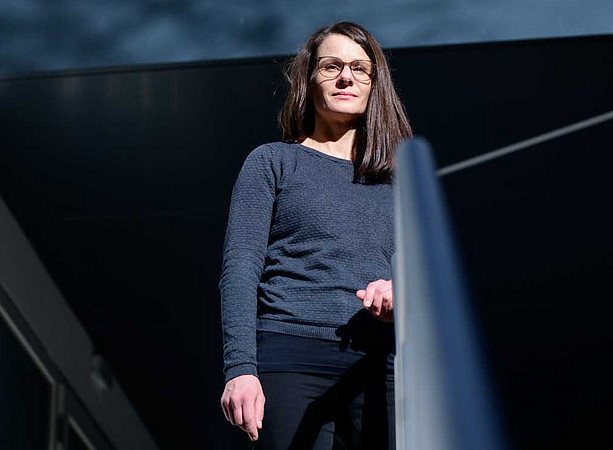
Nina Hampl standing, dark background ©University of Graz/Tzivanopoulos
©University of Graz/Tzivanopoulos
Nina Hampl, business economist and social scientist at the Department of Environmental Systems Sciences at the University of Graz, heads the Centre for Active Mobility together with Aglaée Degros from the Institute of Urbanism at Graz University of Technology. Photo: University of Graz/Tzivanopoulos
white empty picture
white empty picture
created by Gudrun Pichler

Related news

Record of reported species: Styria wins the global City Nature Challenge

Observers in Styria recorded 4,660 different animals, plants and fungi as part of the international City Nature Challenge between 24 and 27 April 2026. This saw the region take first place in the "species" category. Ostrava in the Czech Republic made the most observations, with just under 140,000, whilst the San Francisco Bay Area had the highest number of participants, namely 3,019.

Studying at the University of Graz: How to enrol

Ready for a new chapter in your life with the start of your studies at the University of Graz in the winter semester 2026/27? Here you will find information on deadlines, admission procedures, registration, and everything else you need to successfully start your studies in the fall.

Europe Day: Strengthening international expertise with Arqus

On 9 May, the spotlight will be on Europe. At the University of Graz, European cooperation is also a tangible part of everyday student life – not least through the Arqus university alliance. Master’s and PhD students can currently register for the Arqus micro-credential in ‘Advanced Creative Thinking and Communication’.

A substantial community: the key role of soil crusts in the earth system

They are often overshadowed by the plant world: lichens, fungi, mosses and bacteria, which form unique communities on rocks and trees or as soil crusts. Bettina Weber from the University of Graz is bringing this biological alliance into the research spotlight. Her research shows that these communities form an essential part of the Earth’s critical zone and play a key role in the interactions between land and atmosphere. Bettina Weber was honoured by the European Geosciences Union for her groundbreaking research at the beginning of May.

Begin of page section:
Additional information:

University of Graz
Universitaetsplatz 3
8010 Graz
Austria
  • Contact
  • Web Editors
  • Moodle
  • UNIGRAZonline
  • Imprint
  • Data Protection Declaration
  • Accessibility Declaration
Weatherstation
Uni Graz

End of this page section. Go to overview of page sections

End of this page section. Go to overview of page sections

Begin of page section:

End of this page section. Go to overview of page sections