



Begin of page section:
Page sections:

  • Go to contents (Accesskey 1)
  • Go to position marker (Accesskey 2)
  • Go to main navigation (Accesskey 3)
  • Go to sub navigation (Accesskey 4)
  • Go to additional information (Accesskey 5)
  • Go to page settings (user/language) (Accesskey 8)
  • Go to search (Accesskey 9)

End of this page section. Go to overview of page sections

Begin of page section:
Page settings:

English en
Deutsch de
Search
Login

End of this page section. Go to overview of page sections

Begin of page section:
Search:

Search for details about Uni Graz
Close

End of this page section. Go to overview of page sections


Search

Begin of page section:
Main navigation:

Page navigation:

  • University

    University
    • About the University
    • Organisation
    • Faculties
    • Library
    • Working at University of Graz
    • Campus
    Developing solutions for the world of tomorrow - that is our mission. Our students and our researchers take on the great challenges of society and carry the knowledge out.
  • Research Profile

    Research Profile
    • Our Expertise
    • Research Questions
    • Research Portal
    • Promoting Research
    • Research Transfer
    • Ethics in Research
    • Commission for Scientific Integrity
    Scientific excellence and the courage to break new ground. Research at the University of Graz creates the foundations for making the future worth living.
  • Studies

    Studies
    • Prospective Students
    • Students
  • Community

    Community
    • International
    • Location
    • Research and Business
    • Alumni
    The University of Graz is a hub for international research and brings together scientists and business experts. Moreover, it fosters the exchange and cooperation in study and teaching.
  • Spotlight
Topics
  • Sustainable University
  • Researchers answer
  • Work for us
Close menu

End of this page section. Go to overview of page sections

Begin of page section:
You are here:

University of Graz News Europäische Bienenstudie

End of this page section. Go to overview of page sections

Thursday, 24 July 2014

Europäische Bienenstudie

Die Arbeitsgruppe COLOSS erhebt die Wintersterblichkeit von Honigbienen in Europa. Die Ergebnisse der Saison 2013/14 wurden unter Mitarbeit der Uni Graz soeben publiziert.

Die Arbeitsgruppe COLOSS erhebt die Wintersterblichkeit von Honigbienen in Europa. Die Ergebnisse der Saison 2013/14 wurden unter Mitarbeit der Uni Graz soeben publiziert.

Österreich liegt bei den Winterverlusten im Ländervergleich im Spitzenfeld. Die Daten für die Studie wurden an der Uni Graz gesammelt.

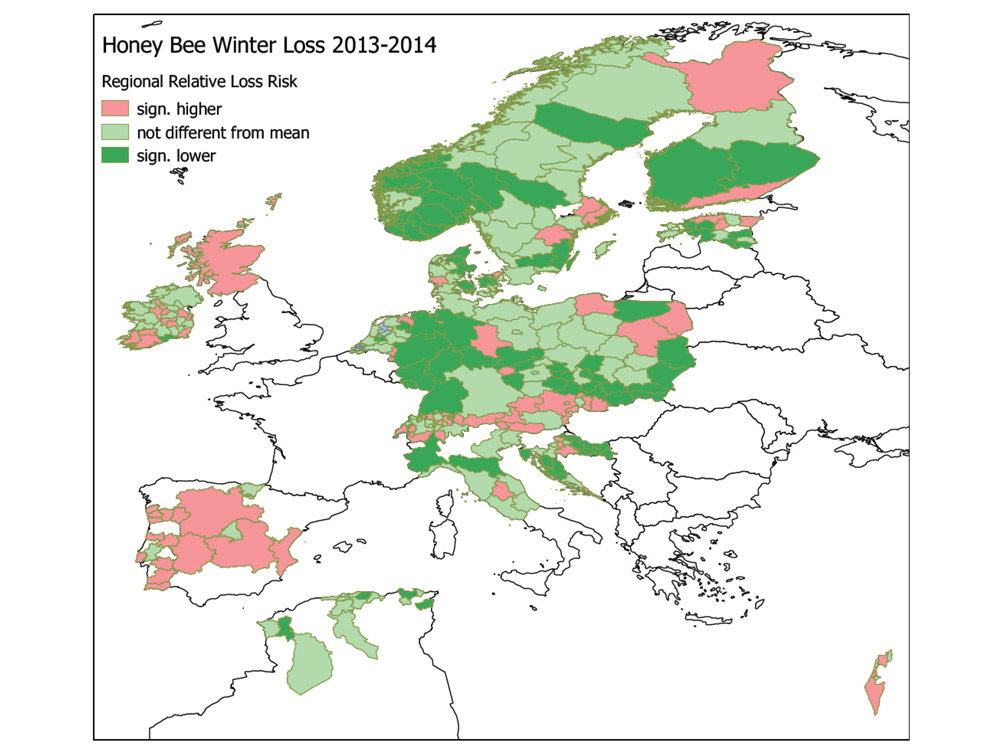
Das Team um Karl Crailsheim und Robert Brodschneider vom Institut für Zoologie der Uni Graz beteiligt sich an der europaweiten Studie COLOSS - kurz für "Prevention of Honeybee COlony LOSSes" -, die die Winterverluste von Honigbienen erhebt und internationale Vergleiche anstellt. Dieser Tage wurden die Ergebnisse für die Saison 2013/14 publiziert. Die Basis bilden Daten aus 19 europäischen Ländern sowie Algerien und Israel. Im Durchschnitt war die Verlustrate mit neun Prozent die niedrigste seit 2007, seit die Vergleichsdaten gesammelt werden. Am besten überlebten die Honigbienen in Norwegen, wo nur sechs Prozent der Völker verendeten, die höchsten Verluste erlitt Portugal mit 14 Prozent. Auch Österreich liegt mit einer durchschnittlichen Sterblichkeitsrate von knapp 13 Prozent im Spitzenfeld. In allen Ländern gibt es regionale Unterschiede. Die genauen Ursachen für die Verluste wird die Arbeitsgruppe noch analysieren, die Witterungsbedingungen dürften eine wesentliche Rolle spielen.

Die an der Karl-Franzens-Universität Graz erhobenen Österreichischen Daten im Detail wurden bereits im Juni veröffentlicht.


created by Dagmar Eklaude

Related news

Higher Education Strategy 2040: Austria’s universities on course for the future

Austria has 77 higher education institutions, which is above the EU average – but does this really make sense? The new Higher Education Strategy 2040 focuses on cooperation rather than mergers. As one of the six largest universities in Austria, the University of Graz plays a central role in this.

Climate research in Greenland: Old data provides new insights

The polar explorer and University of Graz professor Alfred Wegener left behind a unique collection of climate data from Greenland. A research team from the University of Graz is now analysing this 100-year-old treasure trove of data and comparing it with current measurements.

Diversity in nature and science: How we talk about plants and each other

Ginkgo, kiwi, hemp: they exist as male and female plants. Anyone who paid attention in biology class will confirm this. But is this categorisation, established by Carl von Linné almost 300 years ago, still valid today? An interdisciplinary team at the University of Graz is questioning these attributions and using this as a starting point to provide food for thought for gender-sensitive interaction between students, scientific and teaching staff.

Around the world in eight stops: the Long Night of Research at the University of Graz

On 24 April from 5 pm, you can take a short trip around the globe at the University of Graz, discovering pecularities of foreign countries or new local features in the entrance hall of the University Library. The itinerary takes you through introduced animal species, political attitudes and the omnipotence of algorithms. There will also be a programme in the historic reading hall, as well as at the UniGraz@Museum and the University Archive.

Begin of page section:
Additional information:

University of Graz
Universitaetsplatz 3
8010 Graz
Austria
  • Contact
  • Web Editors
  • Moodle
  • UNIGRAZonline
  • Imprint
  • Data Protection Declaration
  • Accessibility Declaration
Weatherstation
Uni Graz

End of this page section. Go to overview of page sections

End of this page section. Go to overview of page sections

Begin of page section:

End of this page section. Go to overview of page sections

