Begin of page section:
Page sections:

  • Go to contents (Accesskey 1)
  • Go to position marker (Accesskey 2)
  • Go to main navigation (Accesskey 3)
  • Go to sub navigation (Accesskey 4)
  • Go to additional information (Accesskey 5)
  • Go to page settings (user/language) (Accesskey 8)
  • Go to search (Accesskey 9)

End of this page section. Go to overview of page sections

Begin of page section:
Page settings:

English en
Deutsch de
Search
Login

End of this page section. Go to overview of page sections

Begin of page section:
Search:

Search for details about Uni Graz
Close

End of this page section. Go to overview of page sections


Search

Begin of page section:
Main navigation:

Page navigation:

  • University

    University
    • About the University
    • Organisation
    • Faculties
    • Library
    • Working at University of Graz
    • Campus
    Developing solutions for the world of tomorrow - that is our mission. Our students and our researchers take on the great challenges of society and carry the knowledge out.
  • Research Profile

    Research Profile
    • Our Expertise
    • Research Questions
    • Research Portal
    • Promoting Research
    • Research Transfer
    • Ethics in Research
    • Commission for Scientific Integrity
    Scientific excellence and the courage to break new ground. Research at the University of Graz creates the foundations for making the future worth living.
  • Studies

    Studies
    • Prospective Students
    • Students
  • Community

    Community
    • International
    • Location
    • Research and Business
    • Alumni
    The University of Graz is a hub for international research and brings together scientists and business experts. Moreover, it fosters the exchange and cooperation in study and teaching.
Topics
  • Sustainable University
  • Researchers answer
  • Work for us
Close menu

End of this page section. Go to overview of page sections

Begin of page section:
You are here:

University of Graz News Es kreucht und fleucht: Biolog:innen wissen, wie es im eigenen Grün Bienen & Co. bunt treiben

End of this page section. Go to overview of page sections

Thursday, 25 May 2023

Es kreucht und fleucht: Biolog:innen wissen, wie es im eigenen Grün Bienen & Co. bunt treiben

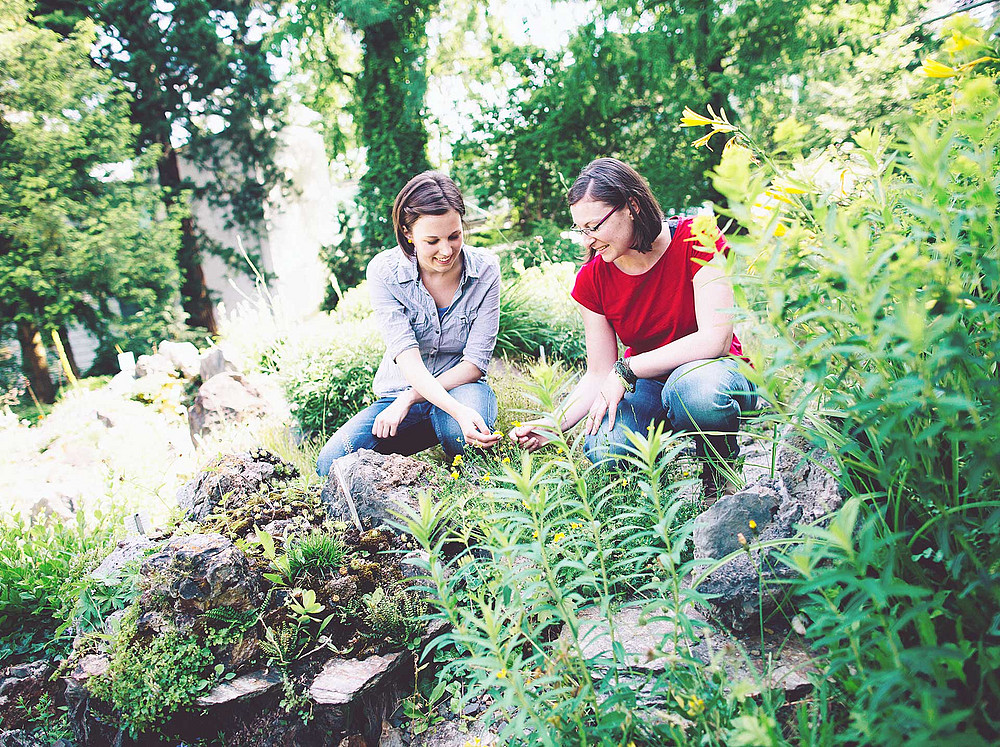
Zwie Frauen beim Pflanzen im Garten ©KANIZAJ MARIJA-M. | 2015

Biodiversität im eigenen Garten fördern: Biolog:innen haben Tipps zusammengestellt. Foto: Uni Graz/Kanizaj

Fauna und Flora bilden ein erfolgreiches Gespann – selbst am Balkon und im Garten. Und dort – und sei er noch so klein – lässt sich daraus eine Oase für Artenvielfalt machen. Die eine oder andere „wilde“ Zone kann zur Rettungsinsel für kaum fortbewegungsfähige Insekten werden, erklärt Gernot Kunz vom Institut für Biologie. Solche sogenannten Trittsteinbiotope sind entscheidende Ersatzlebensräume, wenn ursprüngliche Populationen durch Trockenheit, Regen, Hagel oder einen Traktor zerstört wurden.

  • Eine wilde Ecke höchstens einmal jährlich mähen, Brennnessel und Stängel auch über den Winter stehen lassen. Darin entwickeln sich wieder Tiere.
  • Blumenwiesen mit heimischen Arten anlegen, allerdings keinen Klee oder andere Schmetterlingsblütler. Diese binden nämlich Stickstoff und reichern damit den Boden an.
  • In einer Stadtwohnung kann man mit Nisthilfen, Kräuterkisterln oder Blühpflanzen für ein bisschen Biodiversität sorgen.
  • Heimische Sträucher pflanzen.

Mehr Artenvielfalt am Campus

Die Hinweise greift auch die Uni Graz im aktuellen Biodiversitätsprojekt unter dem Motto „Wir werden klimaneutral“ auf. Insgesamt sieben Standorte am Uni-Gelände werden ab Herbst neu mit Sträuchern und Stauden bepflanzt. Biolog:innen des Botanischen Gartens haben bei der Gestaltung ihre Expertise eingebracht. Es werden klimarobuste, vorrangig heimische und von Insekten bevorzugte Pflanzen wie Vogelbeere, Holunder und Beerensträucher angesiedelt.
Eine weitere Nahrungsquelle für Biene & Co wird eine blumenreiche Blüh-Ecke sein, die in der Nähe des Hauptgebäudes angelegt wird.
Die Bundesimmobiliengesellschaft unterstützt das Biodiversitäts-Projekt mit insgesamt 20 Nisthöhlen, die in Bäumen am Campus angebracht werden.

Noch mehr Tipps hält die aktuelle Ausgabe des Uni-Graz-Magazins UNIZEIT unter dem Titel „Treiben wir es bunt genug“ parat.


created by Dagmar Eklaude & Andreas Schweiger

Related news

What matters in the end: moral theologian takes stock of assisted suicide

Since 1 January 2022, assisted suicide has been legal in Austria under certain conditions. This was made possible by a ruling of the Constitutional Court, which overturned the blanket ban on assisting in suicide. Four years on, it is clear that: “Although the legal framework is in place, many pressing questions remain unanswered when it comes to its practical implementation,” says Johann Platzer, a moral theologian at the University of Graz.

Noise is the signal: new simulation method enables secure communication

Researchers from Graz, Vienna and Munich have developed a new simulation method that makes it possible to calculate quantum light using classical software – a step towards secure quantum communication.

Massacre and Memory: University of Graz addresses the wounds of history

A conference on 12 and 13 June 2026 at the Jesuit Refectory will focus on trauma in Eastern and South-Eastern Europe.

Aufmerksam aufgezeichnet: Silberdistel-Biodiversitätspreis 2023 für Naturschutz-App

Gernot Kunz und das Team des Instituts für Biologie der Universität Graz sind für die Betreuung der Arten-Datenbank iNaturalist mit dem Biodiversitätspreis des Landes Steiermark ausgezeichnet worden.

Begin of page section:
Additional information:

University of Graz
Universitaetsplatz 3
8010 Graz
Austria
  • Contact
  • Web Editors
  • Moodle
  • UNIGRAZonline
  • Imprint
  • Data Protection Declaration
  • Accessibility Declaration
Weatherstation
Uni Graz

End of this page section. Go to overview of page sections

End of this page section. Go to overview of page sections

Begin of page section:

End of this page section. Go to overview of page sections