Begin of page section:
Page sections:

  • Go to contents (Accesskey 1)
  • Go to position marker (Accesskey 2)
  • Go to main navigation (Accesskey 3)
  • Go to sub navigation (Accesskey 4)
  • Go to additional information (Accesskey 5)
  • Go to page settings (user/language) (Accesskey 8)
  • Go to search (Accesskey 9)

End of this page section. Go to overview of page sections

Begin of page section:
Page settings:

English en
Deutsch de
Search
Login

End of this page section. Go to overview of page sections

Begin of page section:
Search:

Search for details about Uni Graz
Close

End of this page section. Go to overview of page sections


Search

Begin of page section:
Main navigation:

Page navigation:

  • University

    University
    • About the University
    • Organisation
    • Faculties
    • Library
    • Working at University of Graz
    • Campus
    Developing solutions for the world of tomorrow - that is our mission. Our students and our researchers take on the great challenges of society and carry the knowledge out.
  • Research Profile

    Research Profile
    • Our Expertise
    • Research Questions
    • Research Portal
    • Promoting Research
    • Research Transfer
    • Ethics in Research
    Scientific excellence and the courage to break new ground. Research at the University of Graz creates the foundations for making the future worth living.
  • Studies

    Studies
    • Prospective Students
    • Students
  • Community

    Community
    • International
    • Location
    • Research and Business
    • Alumni
    The University of Graz is a hub for international research and brings together scientists and business experts. Moreover, it fosters the exchange and cooperation in study and teaching.
  • Spotlight
Topics
  • Our digital Advent calendar
  • Sustainable University
  • Researchers answer
  • Work for us
Close menu

End of this page section. Go to overview of page sections

Begin of page section:
You are here:

University of Graz News Eisen in Karotten

End of this page section. Go to overview of page sections

Wednesday, 17 April 2013

Eisen in Karotten
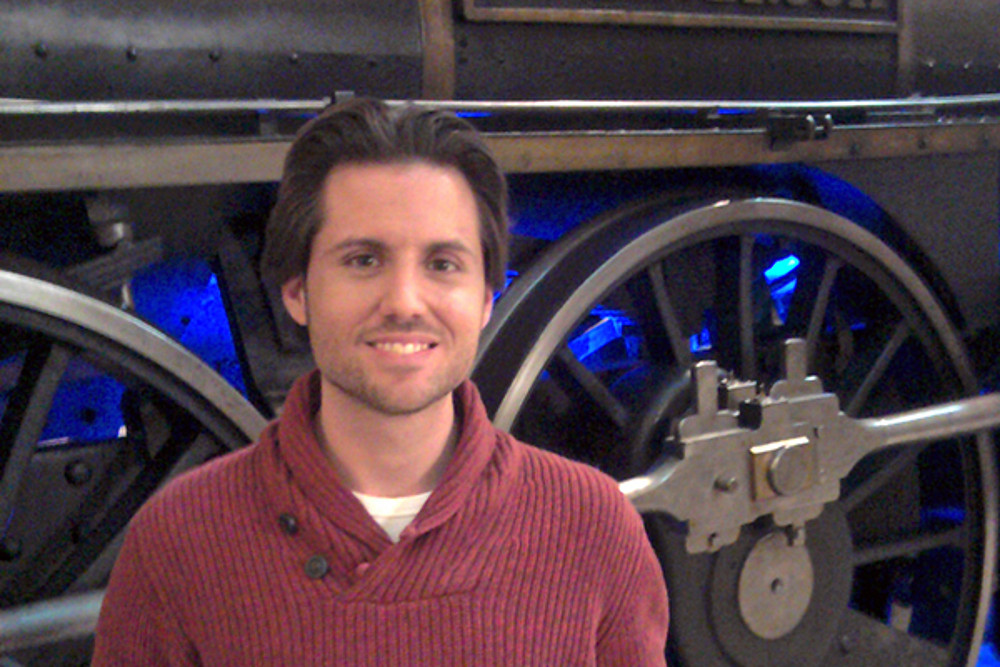
Famelab-Sieger Alexander Schwan erklärt seine Arbeit anhand von Äpfeln und Karotten.

Famelab-Sieger Alexander Schwan erklärt seine Arbeit anhand von Äpfeln und Karotten.

Uni-Graz-Dissertant gewinnt Famelab-Finale

Alexander Schwan, Doktorand am Institut für Chemie der Uni Graz, gewann das heurige Österreich-Finale des Wettbewerbs „Famelab“. Er arbeitet für seine Dissertation mit einem Massenspektrometer, einem Gerät, das Spurenelemente nachweisen kann. „Ich entwickle Methoden, um vor allem Nichtmetalle in sehr geringen Konzentrationen aufzuspüren“, erklärt Schwan. Diese Forschungen können dann beispielsweise für Blutanalysen angewendet werden.
Bei „Famelab“ haben die WissenschafterInnen drei Minuten Zeit, um ihre komplexen Themen allgemein verständlich zu präsentieren. Der Chemiker der Uni Graz verglich für seinen Vortrag Karotten und Äpfel, um zu zeigen, welche Frucht mehr Eisen enthält. Damit konnte er die Jury überzeugen und gewann ein Preisgeld von 2000 Euro. Als Österreich-Sieger vertritt er unser Land auch beim internationalen „Famelab“-Wettbewerb und beim „Times Cheltenham Science Festival“ Anfang Juni in Großbritannien.
„Ich wollte meine Begeisterung für das Gerät einer breiten Öffentlichkeit weitergeben und bin ganz besonders glücklich, dass ich in England noch einmal die Gelegenheit habe, meine Arbeit zu präsentieren“, freut sich der Jungwissenschafter.

created by Dagmar Eklaude

Related news

Chemical Christmas show at the University of Graz: An explosive evening at the Schauspielh

At the beginning of December, the University of Graz transformed the theater into a laboratory: as part of “Chemical Life,” teacher training students staged a chemical Christmas show for Styrian school classes—complete with ethanol rockets, nitrogen snow, and glowing effects. An evening designed to inspire interest in studying chemistry.

Train by train: Koralm railway accelerates exchange between the Universities

Lectures at the University of Klagenfurt in the morning, seminars at the University of Graz in the afternoon: Austria's longest tunnel and a journey time of around 45 minutes make it easy. The Koralm railway increases the speed of networking between the two university locations. The collaboration builds on existing cooperation - for example in the areas of teacher training, Slavic studies and as employers, the universities are well coordinated.

On the trail of the Big Bang: University of Graz receives 1.5 million euros for doctoral programmes

The Austrian Science Fund FWF has selected the Doctoral Programme in Theoretical Particle Physics at the University of Graz for funding from the Doc.funds. Six young scientists will be funded for 3.5 years. They will gain fundamentally new insights into the origins of the world.

From trans women and knee prostheses: sports science prizes awarded

Walking better with a prosthesis, successfully getting rid of excess weight, training more effectively, more fairness for trans people in sport: these were the topics addressed by the students at the University of Graz who were awarded the sports science prizes for their Master's theses on 3 December 2025.

Begin of page section:
Additional information:

University of Graz
Universitaetsplatz 3
8010 Graz
Austria
  • Contact
  • Web Editors
  • Moodle
  • UNIGRAZonline
  • Imprint
  • Data Protection Declaration
  • Accessibility Declaration
Weatherstation
Uni Graz

End of this page section. Go to overview of page sections

End of this page section. Go to overview of page sections

Begin of page section:

End of this page section. Go to overview of page sections