Begin of page section:
Page sections:

  • Go to contents (Accesskey 1)
  • Go to position marker (Accesskey 2)
  • Go to main navigation (Accesskey 3)
  • Go to sub navigation (Accesskey 4)
  • Go to additional information (Accesskey 5)
  • Go to page settings (user/language) (Accesskey 8)
  • Go to search (Accesskey 9)

End of this page section. Go to overview of page sections

Begin of page section:
Page settings:

English en
Deutsch de
Search
Login

End of this page section. Go to overview of page sections

Begin of page section:
Search:

Search for details about Uni Graz
Close

End of this page section. Go to overview of page sections


Search

Begin of page section:
Main navigation:

Page navigation:

  • University

    University
    • About the University
    • Organisation
    • Faculties
    • Library
    • Working at University of Graz
    • Campus
    Developing solutions for the world of tomorrow - that is our mission. Our students and our researchers take on the great challenges of society and carry the knowledge out.
  • Research Profile

    Research Profile
    • Our Expertise
    • Research Questions
    • Research Portal
    • Promoting Research
    • Research Transfer
    • Ethics in Research
    • Commission for Scientific Integrity
    Scientific excellence and the courage to break new ground. Research at the University of Graz creates the foundations for making the future worth living.
  • Studies

    Studies
    • Prospective Students
    • Students
    • Registration for Study Programme (Winter semester 2026/27)
    • Welcome Weeks for First Year Students
  • Community

    Community
    • International
    • Location
    • Research and Business
    • Alumni
    The University of Graz is a hub for international research and brings together scientists and business experts. Moreover, it fosters the exchange and cooperation in study and teaching.
Topics
  • Sustainable University
  • Researchers answer
  • Work for us
Close menu

End of this page section. Go to overview of page sections

Begin of page section:
You are here:

University of Graz News Eisen in Karotten

End of this page section. Go to overview of page sections

Wednesday, 17 April 2013

Eisen in Karotten
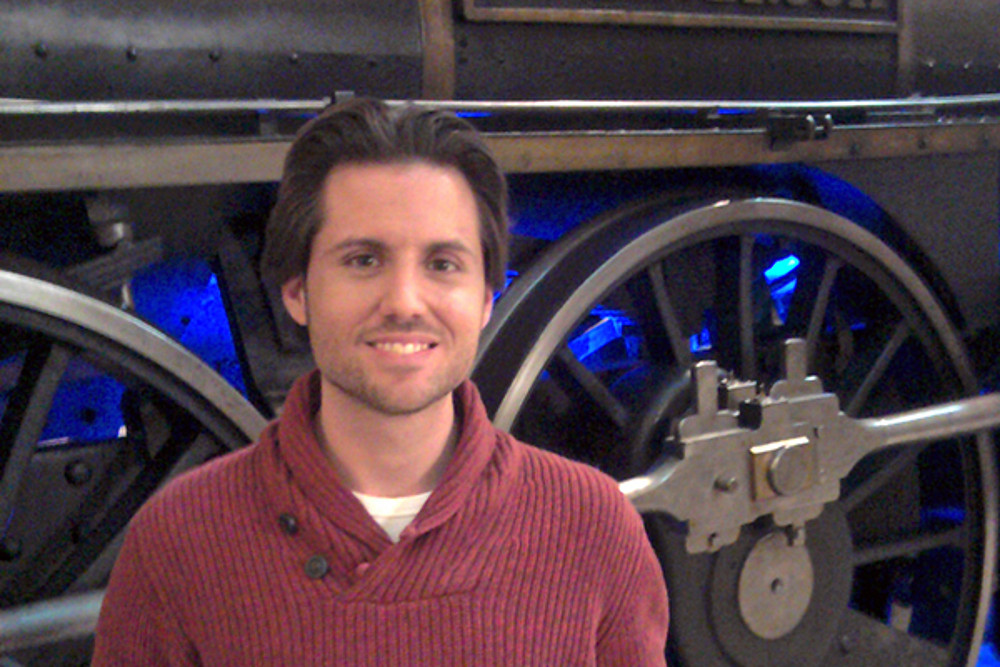
Famelab-Sieger Alexander Schwan erklärt seine Arbeit anhand von Äpfeln und Karotten.

Famelab-Sieger Alexander Schwan erklärt seine Arbeit anhand von Äpfeln und Karotten.

Uni-Graz-Dissertant gewinnt Famelab-Finale

Alexander Schwan, Doktorand am Institut für Chemie der Uni Graz, gewann das heurige Österreich-Finale des Wettbewerbs „Famelab“. Er arbeitet für seine Dissertation mit einem Massenspektrometer, einem Gerät, das Spurenelemente nachweisen kann. „Ich entwickle Methoden, um vor allem Nichtmetalle in sehr geringen Konzentrationen aufzuspüren“, erklärt Schwan. Diese Forschungen können dann beispielsweise für Blutanalysen angewendet werden.
Bei „Famelab“ haben die WissenschafterInnen drei Minuten Zeit, um ihre komplexen Themen allgemein verständlich zu präsentieren. Der Chemiker der Uni Graz verglich für seinen Vortrag Karotten und Äpfel, um zu zeigen, welche Frucht mehr Eisen enthält. Damit konnte er die Jury überzeugen und gewann ein Preisgeld von 2000 Euro. Als Österreich-Sieger vertritt er unser Land auch beim internationalen „Famelab“-Wettbewerb und beim „Times Cheltenham Science Festival“ Anfang Juni in Großbritannien.
„Ich wollte meine Begeisterung für das Gerät einer breiten Öffentlichkeit weitergeben und bin ganz besonders glücklich, dass ich in England noch einmal die Gelegenheit habe, meine Arbeit zu präsentieren“, freut sich der Jungwissenschafter.

created by Dagmar Eklaude

Related news

Surprise, spectacle, science: Astrophysicists observed a partial solar eclipse

The star of the show was the sun, and the programme featured a natural spectacle: the partial solar eclipse on the evening of 12 August 2026 drew crowds to Graz’s Schloßberg. The ‘sun-downer’ was accompanied by a dash of science from astrophysicists at the University of Graz.

Discussions on Europe’s digital future are taking place in Graz

Exactly three months before the event, the Technology Impact Summit (TIS) team is unveiling the programme for this year’s think tank event.

Preserving cultural heritage: Graz researchers make Roman inscriptions legible again

Researchers from the University of Graz and Graz University of Technology are working to save inscriptions carved in stone in Styria during Roman times from disappearing. They have developed a simple and cost-effective method to make inscriptions on tombs and votive altars – which have been weathered or damaged – legible again. They are currently testing the method on Roman stones at several sites across Styria. The aim is to provide other historians with a tool to preserve cultural heritage when expensive research equipment is not available. The method was recently published in the research journal Heritage Science.

When the sun goes dark: Enlightening for science and the people of Graz

When the moon partially passes in front of the sun in Graz on 12 August 2026, the event will once again captivate many people. This includes Manuela Temmer, an astrophysicist at the University of Graz. The scientist confirms that this celestial phenomenon offers significant value for research: “During a solar eclipse, the corona can be observed more clearly than with any instrument.”

Begin of page section:
Additional information:

University of Graz
Universitaetsplatz 3
8010 Graz
Austria
  • Contact
  • Web Editors
  • Moodle
  • UNIGRAZonline
  • Imprint
  • Data Protection Declaration
  • Accessibility Declaration
Weatherstation
Uni Graz

End of this page section. Go to overview of page sections

End of this page section. Go to overview of page sections

Begin of page section:

End of this page section. Go to overview of page sections