



Begin of page section:
Page sections:

  • Go to contents (Accesskey 1)
  • Go to position marker (Accesskey 2)
  • Go to main navigation (Accesskey 3)
  • Go to sub navigation (Accesskey 4)
  • Go to additional information (Accesskey 5)
  • Go to page settings (user/language) (Accesskey 8)
  • Go to search (Accesskey 9)

End of this page section. Go to overview of page sections

Begin of page section:
Page settings:

English en
Deutsch de
Search
Login

End of this page section. Go to overview of page sections

Begin of page section:
Search:

Search for details about Uni Graz
Close

End of this page section. Go to overview of page sections


Search

Begin of page section:
Main navigation:

Page navigation:

  • University

    University
    • About the University
    • Organisation
    • Faculties
    • Library
    • Working at University of Graz
    • Campus
    Developing solutions for the world of tomorrow - that is our mission. Our students and our researchers take on the great challenges of society and carry the knowledge out.
  • Research Profile

    Research Profile
    • Our Expertise
    • Research Questions
    • Research Portal
    • Promoting Research
    • Research Transfer
    • Ethics in Research
    • Commission for Scientific Integrity
    Scientific excellence and the courage to break new ground. Research at the University of Graz creates the foundations for making the future worth living.
  • Studies

    Studies
    • Prospective Students
    • Students
    • Registration for Study Programme (Winter semester 2026/27)
    • Study Days 22-26 June 2026
  • Community

    Community
    • International
    • Location
    • Research and Business
    • Alumni
    The University of Graz is a hub for international research and brings together scientists and business experts. Moreover, it fosters the exchange and cooperation in study and teaching.
Topics
  • Sustainable University
  • Researchers answer
  • Work for us
Close menu

End of this page section. Go to overview of page sections

Begin of page section:
You are here:

University of Graz News Einfach und Genial

End of this page section. Go to overview of page sections

Wednesday, 20 December 2017

Einfach und Genial

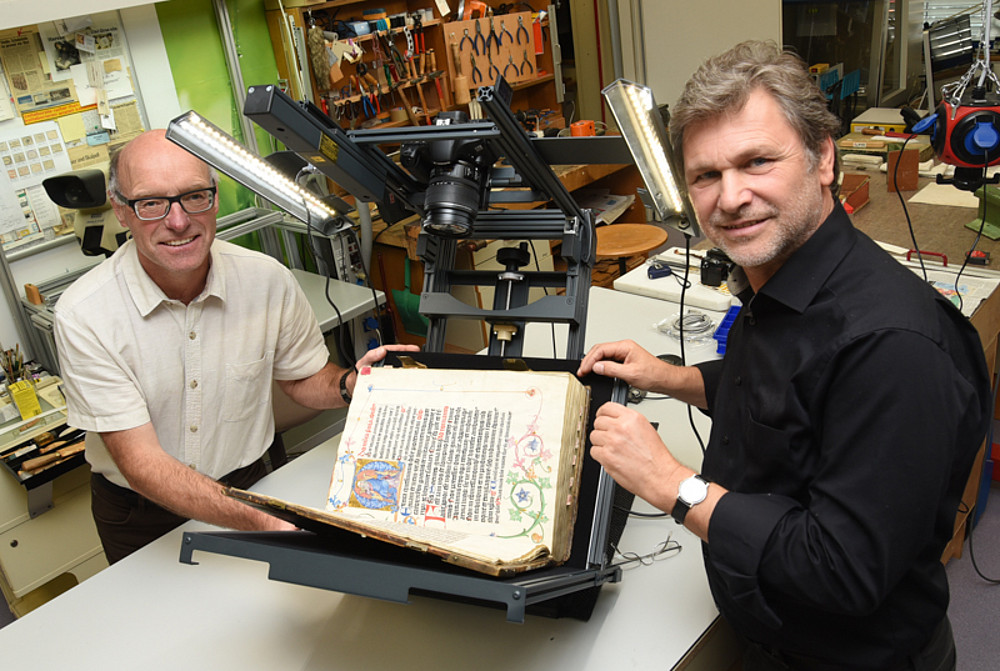
VESTIGIA-Leiter Erich Renhart gab den Anstoß, Manfred Mayer (r.) entwickelte den Traveller. Kürzlich wurde das 100. Gerät verkauft. Foto: Uni Graz/Tzivanopoulos ©Uni Graz/Tzivanopoulos

VESTIGIA-Leiter Erich Renhart gab den Anstoß, Manfred Mayer (r.) entwickelte den Traveller. Kürzlich wurde das 100. Gerät verkauft. Foto: Uni Graz/Tzivanopoulos

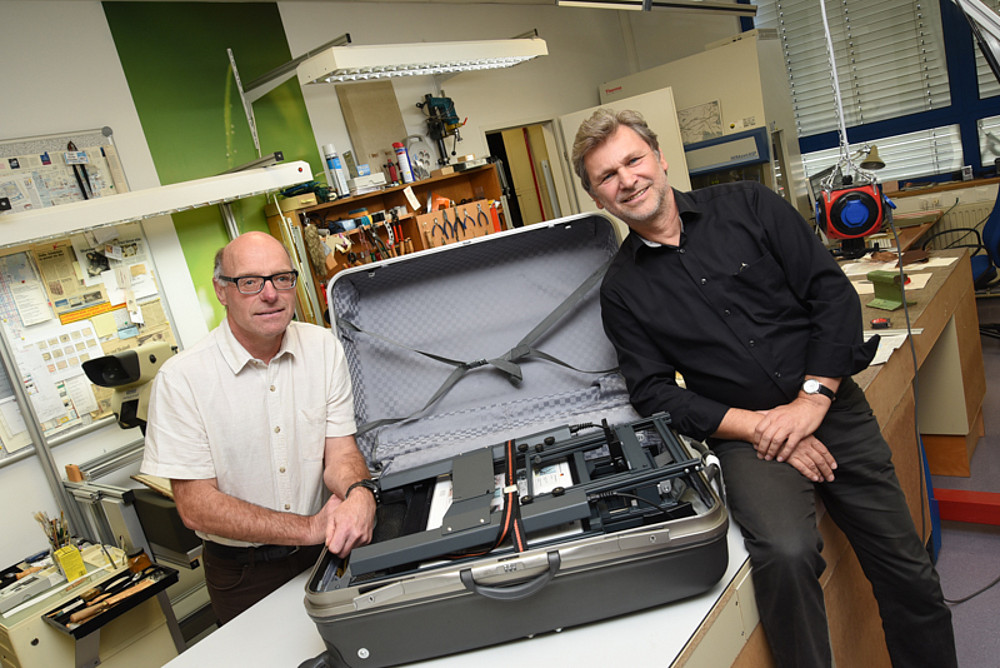
Das Gerät passt in einen handelslüblichen Schalenkoffer, der bei Flugreisen problemlos aufgegeben werden kann ©Uni Graz/Tzivanopoulos

Das Gerät passt in einen handelslüblichen Schalenkoffer, der bei Flugreisen problemlos aufgegeben werden kann

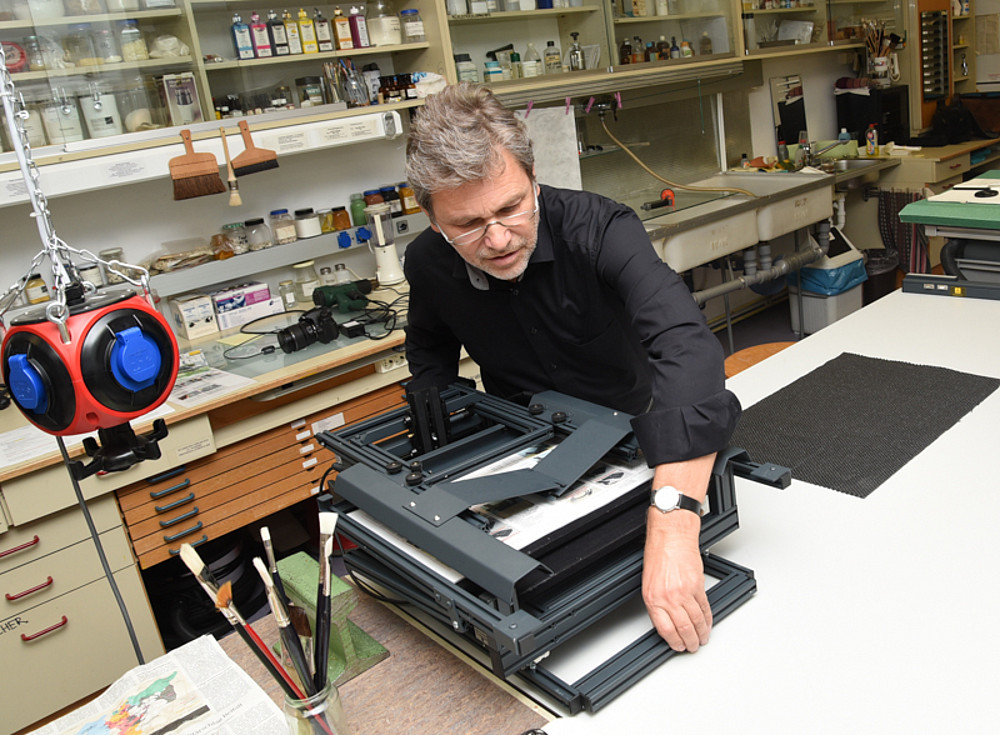
Der Traveller ist so konzipiert, dass er von einer Person aufgebaut werden kann ©Uni Graz/Tzivanopoulos

Der Traveller ist so konzipiert, dass er von einer Person aufgebaut werden kann

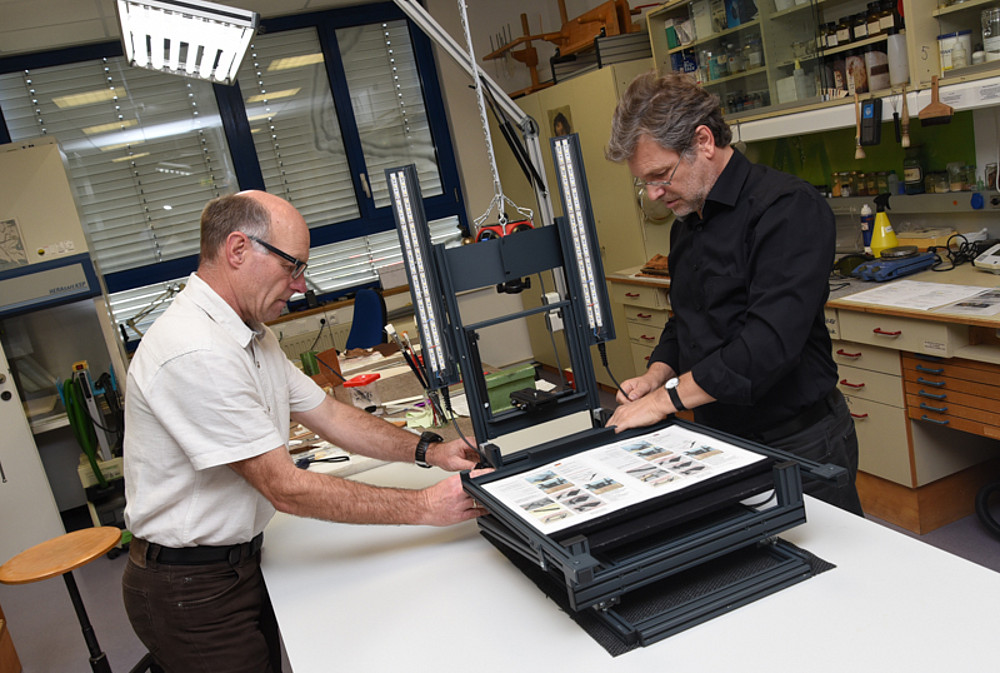
Der Traveller ist so konzipiert, dass er von einer Person aufgebaut werden kann ©Uni Graz/Tzivanopoulos

Eingesetzt wird er zur Digitalisierung wertvoller Schriften und Bücher, die nicht nach Graz an die UB gebracht werden können

Der Traveller, eine Erfindung zur mobilen Digitalisierung aus dem Hause Uni Graz, ist weltweit begehrt

Der „Traveller’s Conservation Copy Stand – TCCS 4232“ ist eine Erfindung von Weltformat. Die mobile Version des Grazer Büchertisches, der eigens für die schonende Digitalisierung von alten Schriften an der Universitätsbibliothek Graz (UB) und am VESTIGIA-Zentrum für die Erforschung des Buch- und Schrifterbe entwickelt wurde, feiert heuer sein zehnjähriges Jubiläum. „Ursprünglich war der Traveller für den Feldeinsatz von Uni-Graz-WissenschafterInnen gedacht, die an Handschriften in Armenien und Bulgarien forschen“, erinnert sich Manfred Mayer. Der Restaurator, der sich an der UB unter anderem mit Digitalisierung beschäftigt, ist der Erfinder des praktischen Geräts, das in einen handelsüblichen Koffer passt und mittlerweile in die ganze Welt verkauft wird. Und genau das ist das Erfolgskonzept des einzigartigen Travellers: „Wir haben damals mit der Serienreife des Prototyps eine Marktlücke geschlossen“, führt Mayer aus. Der mobile Büchertisch ist nämlich in nur zehn Minuten an jedem beliebigen Ort – vor allem in schwer zugänglichen Klosterbibliotheken – einsatzbereit. Er ist so konzipiert, dass ihn eine Person aufbauen und bedienen kann. Kernstück des rund 7 200 Euro teuren Geräts ist eine ausgeklügelte Laseroptik (Fokal Point Assistent), die es erlaubt, mit einer konstanten Schärfe der Kameralinse zu fotografieren. Und das stets im richtigen Maßstab. LEDs sorgen für eine einwandfreie und energiesparende Ausleuchtung des Objekts; optional kann auch UV-Licht eingesetzt werden. Damit lassen sich die Struktur der Oberfläche oder sogar verborgene Texte besser erkennen. Der Traveller funktioniert mit jeder Digitalkamera. In der Bücherwiege finden Objekte mit einer maximalen Größe von 42 mal 32 Zentimeter Platz.

Gefertigt wird der Traveller von einer steirischen Firma. Er besteht aus pulverbeschichtetem Aluminium und ist somit leicht und unverwüstlich. 100 Stück sind weltweit im Umlauf, das 101. Exemplar wird gerade gefertigt. Stationiert ist er von Algerien über Indonesien bis in die Vereinigten Staaten von Amerika. „Besonders stolz sind wir, dass er an der Library of Congress benutzt wird“, sagt Mayer. Ausgeliefert wird er in einem Schalenkoffer mit Zubehör und einer ausführlichen Gebrauchsanweisung. Das Paket hat ein Gesamtgewicht von 22,8 Kilogramm. Mit Absicht: Denn genauso viel beträgt üblicherweise die Freigepäcksgrenze bei Economy-Class-Flügen.  

created by Konstantinos Tzivanopoulos

Related news

Full effort in the heat: the Sports Centre was in full swing at the Kleeblattlauf

On 19 June 2026, 2,000 runners and hundreds of supporters made their way to the Rosenhain for a sporting end-of-term event.

Save, invest or guarantee: What Austrians expect from the state

Austria needs to make savings. But where? And what should the Republic actually be spending its money on? The answers are provided by the initial findings of a major study involving the University of Graz. 99 per cent of those surveyed are in favour of the state ensuring healthcare provision. Almost three-quarters would like to see more public funding for education, whilst only around three per cent are in favour of cuts in this sector.

Complying with the norm: Why Do Standards Shape Our Lives, Elisabeth Staudegger?

Standards determine whether a sheet of paper fits in a printer or whether a charging plug can power multiple devices. These standards shape our everyday lives. But who actually sets these standards? Where are the weaknesses, and how could science help to improve them? Elisabeth Staudegger, Head of the ‘Law and IT’ Department at the Institute for Legal Foundations at the University of Graz, host the Academic Standards Day on 16 June. Here she relays how sciences can contribute to the topic of standardisation and reveals her personal favourite standard.

More body awareness than a culture war

In Italy, sex education lessons will in future only be permitted with parental consent, and will be banned entirely in nurseries and primary schools. At the same time, Pride Month highlights why knowledge about the body, relationships, boundaries and diversity is important for young people. A study by the University of Graz shows how important knowledge about the body, contraception, relationship skills and protection against violence is

Begin of page section:
Additional information:

University of Graz
Universitaetsplatz 3
8010 Graz
Austria
  • Contact
  • Web Editors
  • Moodle
  • UNIGRAZonline
  • Imprint
  • Data Protection Declaration
  • Accessibility Declaration
Weatherstation
Uni Graz

End of this page section. Go to overview of page sections

End of this page section. Go to overview of page sections

Begin of page section:

End of this page section. Go to overview of page sections


