




Begin of page section:
Page sections:

  • Go to contents (Accesskey 1)
  • Go to position marker (Accesskey 2)
  • Go to main navigation (Accesskey 3)
  • Go to sub navigation (Accesskey 4)
  • Go to additional information (Accesskey 5)
  • Go to page settings (user/language) (Accesskey 8)
  • Go to search (Accesskey 9)

End of this page section. Go to overview of page sections

Begin of page section:
Page settings:

English en
Deutsch de
Search
Login

End of this page section. Go to overview of page sections

Begin of page section:
Search:

Search for details about Uni Graz
Close

End of this page section. Go to overview of page sections


Search

Begin of page section:
Main navigation:

Page navigation:

  • University

    University
    • About the University
    • Organisation
    • Faculties
    • Library
    • Working at University of Graz
    • Campus
    Developing solutions for the world of tomorrow - that is our mission. Our students and our researchers take on the great challenges of society and carry the knowledge out.
  • Research Profile

    Research Profile
    • Our Expertise
    • Research Questions
    • Research Portal
    • Promoting Research
    • Research Transfer
    • Ethics in Research
    • Commission for Scientific Integrity
    Scientific excellence and the courage to break new ground. Research at the University of Graz creates the foundations for making the future worth living.
  • Studies

    Studies
    • Prospective Students
    • Students
    • Welcome Weeks for First Year Students
  • Community

    Community
    • International
    • Location
    • Research and Business
    • Alumni
    The University of Graz is a hub for international research and brings together scientists and business experts. Moreover, it fosters the exchange and cooperation in study and teaching.
Topics
  • Sustainable University
  • Researchers answer
  • Work for us
Close menu

End of this page section. Go to overview of page sections

Begin of page section:
You are here:

University of Graz News One for all

End of this page section. Go to overview of page sections

Tuesday, 16 November 2021

One for all

Two newly renovated toilets in the main building of the University of Graz welcome all people without separate facilities for ladies and men. Photo: Uni Graz/Pichler

Two newly renovated toilets in the main building of the University of Graz welcome all people without separate facilities for ladies and men. Photo: Uni Graz/Pichler

In all gender toilets, every person is welcome

In the main building of the University of Graz two WC facilities on the ground floor and first floor were completely refurbished during the summer. Since mid-October, they have been open to staff, students and visitors to the university – with a special feature: "All genders welcome" can be read on the milky white sliding glass doors. These lavatories are the first publicly accessible toilets at the University of Graz without separate areas for men and women.

"All genders welcome" – an invitation that some have been waiting for, while others may be, at first, a little hesitant to enter, although the modern lavatories, whose doors open without being touched, look very attractive already from the outside.

In any case, the all-gender-welcome toilets are a great relief for people who do not or cannot clearly assign themselves to the female or male gender. The feeling of being out of place is a stressful or at least unpleasant experience, especially at the WC.

People who need assistance at the lavatory and are accompanied by a person of the opposite sex know this, as do mums with a son or dads with a daughter, when they enter a WC. "Going to the toilet is a need common to all people, and no person should be afraid of wry looks or even of being verbally or physically attacked there," says Barbara Hey, head of the Coordination Centre for Gender Studies and Equal Opportunities. With her team, she suggested the realisation of the all-gender-welcome toilets, among other measures to promote diversity.

"At the university, where many people with different needs are on site – students, staff and visitors to events – it is particularly important for us to appreciate diversity. We have used the necessary renovation of the toilet facilities to create more spacious neutral areas," emphasises Peter Riedler, Vice-Rector for Financial Affairs, Resources and Location Development. With its facilities, the University of Graz has implemented what is already standard practice at many universities internationally. Apart from that, in some places there has always been "one for all", as passengers of trains and planes know.

Nevertheless, some people still feel more comfortable when they only encounter members of their own sex at the lavatory. Therefore, there will continue to be ladies' and men's toilets at the University of Graz. To ensure that everyone can find the appropriate WC, all facilities are clearly identified accordingly.
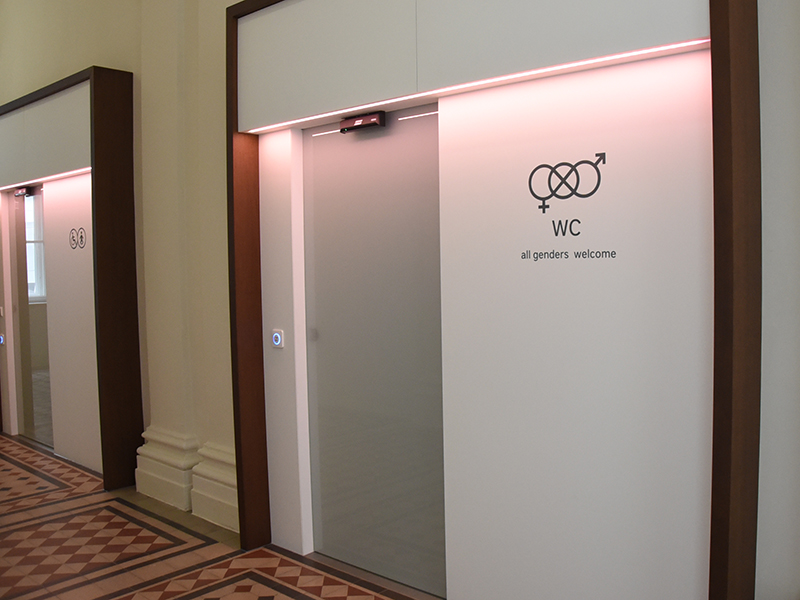
The new toilet facilities also include a barrier-free lavatory and a changing table. Photo: Uni Graz/Pichler
created by Gudrun Pichler

Related news

Electrifying: Researchers film the first moments on the way from light to electricity

Physicists at the University of Graz (Austria), in collaboration with colleagues from Marburg University and Forschungszentrum Jülich (Germany), have achieved a scientific breakthrough. For the first time, the generation of electrical energy from light has been filmed and described theoretically. This work is of far-reaching significance, not least for optimising sustainable energy production from photovoltaics. This is because it provides fundamental building blocks for understanding the physical processes that take place, for example, in organic solar cells. The paper was published in the journal Physical Review X, one of the world’s most prestigious physics journals.

University of Graz: Working together to make Styria a sustainable centre of learning

Round table calls for sustainable funding for the 2028–2030 performance agreement period between the five Styrian universities and the federal government.

How can we teach using YouTube and AI? The University of Graz is strengthening media education in schools

A journey through the blood vessels using VR headsets brings biology lessons to life. An interactive quiz brings physics to life. The YouTube video explains the First World War. Whilst mobile phones are increasingly being banned from the classroom, social media platforms, apps and AI are playing an ever-greater role in knowledge transfer at school. But how can teaching with media be made even more effective? What are the challenges in media-based teaching? At the University of Graz, researchers are discussing these issues at a conference being held in Austria for the first time.

Jurassic Sounds: Biologist reconstructs insect songs from 165 million years ago

It was apparently not just the roars of the dinosaurs that made up the soundscape of the animal world during the Jurassic period. Crickets and grasshoppers communicated through a variety of songs and high-pitched sounds, as Thorin Jonsson from the Institute of Biology at the University of Graz discovered together with colleagues from the universities of Lincoln, Bristol (UK), Beijing (China) and Tempe (USA). The findings on what are so far the oldest traces of sound on Earth have just been published in the journal PNAS.

Begin of page section:
Additional information:

University of Graz
Universitaetsplatz 3
8010 Graz
Austria
  • Contact
  • Web Editors
  • Moodle
  • UNIGRAZonline
  • Imprint
  • Data Protection Declaration
  • Accessibility Declaration
Weatherstation
Uni Graz

End of this page section. Go to overview of page sections

End of this page section. Go to overview of page sections

Begin of page section:

End of this page section. Go to overview of page sections


