Begin of page section:
Page sections:

  • Go to contents (Accesskey 1)
  • Go to position marker (Accesskey 2)
  • Go to main navigation (Accesskey 3)
  • Go to sub navigation (Accesskey 4)
  • Go to additional information (Accesskey 5)
  • Go to page settings (user/language) (Accesskey 8)
  • Go to search (Accesskey 9)

End of this page section. Go to overview of page sections

Begin of page section:
Page settings:

English en
Deutsch de
Search
Login

End of this page section. Go to overview of page sections

Begin of page section:
Search:

Search for details about Uni Graz
Close

End of this page section. Go to overview of page sections


Search

Begin of page section:
Main navigation:

Page navigation:

  • University

    University
    • About the University
    • Organisation
    • Faculties
    • Library
    • Working at University of Graz
    • Campus
    Developing solutions for the world of tomorrow - that is our mission. Our students and our researchers take on the great challenges of society and carry the knowledge out.
  • Research Profile

    Research Profile
    • Our Expertise
    • Research Questions
    • Research Portal
    • Promoting Research
    • Research Transfer
    • Ethics in Research
    Scientific excellence and the courage to break new ground. Research at the University of Graz creates the foundations for making the future worth living.
  • Studies

    Studies
    • Prospective Students
    • Students
  • Community

    Community
    • International
    • Location
    • Research and Business
    • Alumni
    The University of Graz is a hub for international research and brings together scientists and business experts. Moreover, it fosters the exchange and cooperation in study and teaching.
  • Spotlight
Topics
  • Our digital Advent calendar
  • Sustainable University
  • Researchers answer
  • Work for us
Close menu

End of this page section. Go to overview of page sections

Begin of page section:
You are here:

University of Graz News Dynamics in the gut

End of this page section. Go to overview of page sections

Wednesday, 13 July 2022

Dynamics in the gut

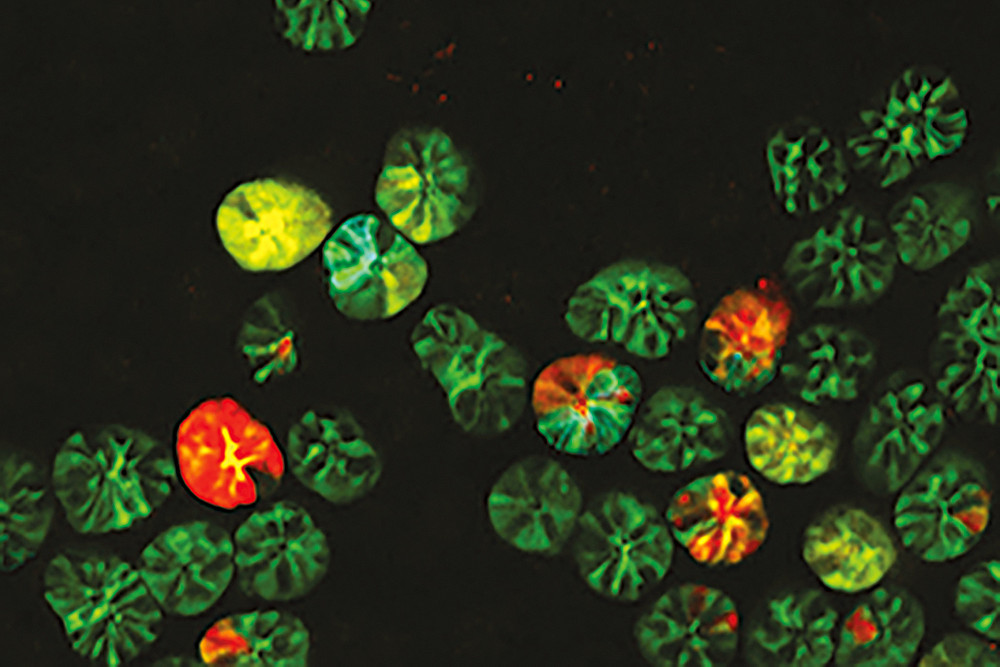
Frontal detail of the intestine crypts with its associated stem cells. Photo: Jacco Van Rheenen "Intravital microscopy of cancer" NKI Lab

Frontal detail of the intestine crypts with its associated stem cells. Photo: Jacco Van Rheenen "Intravital microscopy of cancer" NKI Lab

Researchers discover previously unknown mechanism of cell renewal

In a healthy body, millions of new cells are produced every day to replace the old ones. The so-called stem cells are responsible for this by dividing. Some of their offspring take over certain functions in the tissue, while others, as stem cells, ensure continuous renewal. This process takes place particularly quickly in the intestine. Its epithelium, the wafer-thin layer of cells that covers the intestinal wall, renews itself every four to seven days. If this process is disturbed, it can lead to serious diseases such as cancer. A prerequisite for possible therapeutic approaches is to understand exactly how the renewal process works. A team of scientists from European universities and research centres with participation from the University of Graz has now discovered a previously unknown mechanism of stem cell regulation in the intestine, which was published in the renowned scientific journal Nature.

Only a few make the grade
Stem cells can normally be recognised by their genetic profile and biochemical properties. "In our research, we discovered that there are many cells in the gut that would have the potential to function as stem cells based on these characteristics. At the same time, however, we observed that only a few of them actually fulfil this task and drive the renewal process. The rest are lost," reports Bernat Corominas Murtra from the Institute of Biology at the University of Graz, one of the first authors of the current study. The scientists were able to determine differences between the small and large intestine: "Although approximately the same number of potential stem cells is produced in both sections, many more are lost in the large intestine than in the small intestine," adds the researcher.

Movement makes the difference
In addition, the potential stem cells move differently depending on the section. "While they seem to move back and forth chaotically in the small intestine, the process in the large intestine is comparatively orderly," says Corominas Murtra. Responsible for the respective movement patterns is a biochemical signal that occurs much more frequently in the small intestine, the authors of the study found.

To answer the question of which factors influence stem cell regulation, the entire process was simulated on the computer using mathematical modelling methods. In the process, the researchers discovered a previously unknown mechanism: "From the movement pattern in combination with the geometry of the organ, it is possible to predict which cells are lost and which or how many remain as effective stem cells," Corominas Murtra summarises. This is the first time it has been demonstrated that the function of stem cells is not only dependent on their genetic profile.

These findings open up new insights into possible causes for malfunctions in one of the key organs of our body and provide a basis for further research into innovative therapeutic approaches.

Bernat Corominas Murtra was appointed professor for Complex Adaptive Systems in the Field of Excellence COLIBRI (Complexity of LIfe in Basic Research and Innovation) at the University of Graz in 2021.

Publication
Retrograde movements determine effective stem cell numbers in the intestine
M. Azkanaz, B. Corominas-Murtra et al.
Nature, DOI: 10.1038/s41586-022-04962-0

created by Gudrun Pichler

Related news

Semester abroad without barriers: University of Graz wins award for promoting inclusion

The University of Graz has been awarded the Internationalization Award for its new inclusion initiative. Students with fewer opportunities now also receive financial support for their semester abroad outside Europe.

Fair distribution: Researchers determine just greenhouse gas budgets for all EU regions

Ten years ago, on 12 December 2015, the Paris Climate Agreement was signed at the UN Climate Conference. In order to limit global warming to well below two degrees, only a certain amount of CO2 may be emitted worldwide. While the focus was originally on national emission targets, more than 200 subnational regions and almost 300 cities have now adopted their own targets. But how many emissions are they fairly entitled to? Researchers at the University of Graz have now developed transparent criteria for fair distribution at the subnational level for the first time and determined corresponding greenhouse gas budgets for all European regions. The paper was published today in the scientific journal Nature Communications.

Chemical Christmas show at the University of Graz: An explosive evening at the Schauspielh

At the beginning of December, the University of Graz transformed the theater into a laboratory: as part of “Chemical Life,” teacher training students staged a chemical Christmas show for Styrian school classes—complete with ethanol rockets, nitrogen snow, and glowing effects. An evening designed to inspire interest in studying chemistry.

Train by train: Koralm railway accelerates exchange between the Universities

Lectures at the University of Klagenfurt in the morning, seminars at the University of Graz in the afternoon: Austria's longest tunnel and a journey time of around 45 minutes make it easy. The Koralm railway increases the speed of networking between the two university locations. The collaboration builds on existing cooperation - for example in the areas of teacher training, Slavic studies and as employers, the universities are well coordinated.

Begin of page section:
Additional information:

University of Graz
Universitaetsplatz 3
8010 Graz
Austria
  • Contact
  • Web Editors
  • Moodle
  • UNIGRAZonline
  • Imprint
  • Data Protection Declaration
  • Accessibility Declaration
Weatherstation
Uni Graz

End of this page section. Go to overview of page sections

End of this page section. Go to overview of page sections

Begin of page section:

End of this page section. Go to overview of page sections