



Begin of page section:
Page sections:

  • Go to contents (Accesskey 1)
  • Go to position marker (Accesskey 2)
  • Go to main navigation (Accesskey 3)
  • Go to sub navigation (Accesskey 4)
  • Go to additional information (Accesskey 5)
  • Go to page settings (user/language) (Accesskey 8)
  • Go to search (Accesskey 9)

End of this page section. Go to overview of page sections

Begin of page section:
Page settings:

English en
Deutsch de
Search
Login

End of this page section. Go to overview of page sections

Begin of page section:
Search:

Search for details about Uni Graz
Close

End of this page section. Go to overview of page sections


Search

Begin of page section:
Main navigation:

Page navigation:

  • University

    University
    • About the University
    • Organisation
    • Faculties
    • Library
    • Working at University of Graz
    • Campus
    Developing solutions for the world of tomorrow - that is our mission. Our students and our researchers take on the great challenges of society and carry the knowledge out.
  • Research Profile

    Research Profile
    • Our Expertise
    • Research Questions
    • Research Portal
    • Promoting Research
    • Research Transfer
    • Ethics in Research
    • Commission for Scientific Integrity
    Scientific excellence and the courage to break new ground. Research at the University of Graz creates the foundations for making the future worth living.
  • Studies

    Studies
    • Prospective Students
    • Students
    • Registration for Study Programme (Winter semester 2026/27)
    • Study Days 22-26 June 2026
  • Community

    Community
    • International
    • Location
    • Research and Business
    • Alumni
    The University of Graz is a hub for international research and brings together scientists and business experts. Moreover, it fosters the exchange and cooperation in study and teaching.
Topics
  • Sustainable University
  • Researchers answer
  • Work for us
Close menu

End of this page section. Go to overview of page sections

Begin of page section:
You are here:

University of Graz News Dynamics in the gut

End of this page section. Go to overview of page sections

Wednesday, 13 July 2022

Dynamics in the gut

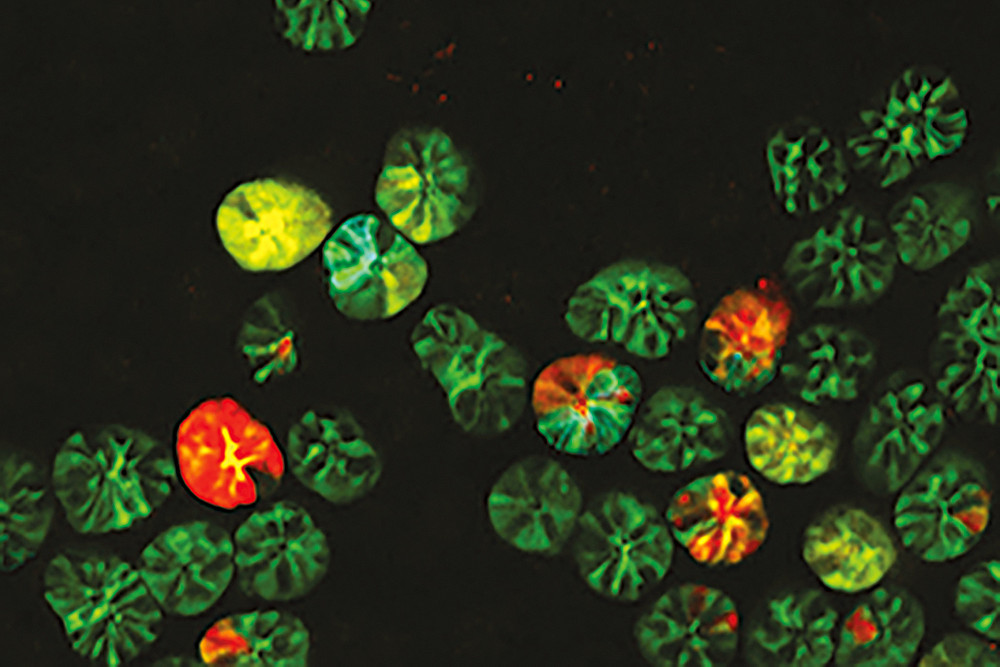
Frontal detail of the intestine crypts with its associated stem cells. Photo: Jacco Van Rheenen "Intravital microscopy of cancer" NKI Lab

Frontal detail of the intestine crypts with its associated stem cells. Photo: Jacco Van Rheenen "Intravital microscopy of cancer" NKI Lab

Researchers discover previously unknown mechanism of cell renewal

In a healthy body, millions of new cells are produced every day to replace the old ones. The so-called stem cells are responsible for this by dividing. Some of their offspring take over certain functions in the tissue, while others, as stem cells, ensure continuous renewal. This process takes place particularly quickly in the intestine. Its epithelium, the wafer-thin layer of cells that covers the intestinal wall, renews itself every four to seven days. If this process is disturbed, it can lead to serious diseases such as cancer. A prerequisite for possible therapeutic approaches is to understand exactly how the renewal process works. A team of scientists from European universities and research centres with participation from the University of Graz has now discovered a previously unknown mechanism of stem cell regulation in the intestine, which was published in the renowned scientific journal Nature.

Only a few make the grade
Stem cells can normally be recognised by their genetic profile and biochemical properties. "In our research, we discovered that there are many cells in the gut that would have the potential to function as stem cells based on these characteristics. At the same time, however, we observed that only a few of them actually fulfil this task and drive the renewal process. The rest are lost," reports Bernat Corominas Murtra from the Institute of Biology at the University of Graz, one of the first authors of the current study. The scientists were able to determine differences between the small and large intestine: "Although approximately the same number of potential stem cells is produced in both sections, many more are lost in the large intestine than in the small intestine," adds the researcher.

Movement makes the difference
In addition, the potential stem cells move differently depending on the section. "While they seem to move back and forth chaotically in the small intestine, the process in the large intestine is comparatively orderly," says Corominas Murtra. Responsible for the respective movement patterns is a biochemical signal that occurs much more frequently in the small intestine, the authors of the study found.

To answer the question of which factors influence stem cell regulation, the entire process was simulated on the computer using mathematical modelling methods. In the process, the researchers discovered a previously unknown mechanism: "From the movement pattern in combination with the geometry of the organ, it is possible to predict which cells are lost and which or how many remain as effective stem cells," Corominas Murtra summarises. This is the first time it has been demonstrated that the function of stem cells is not only dependent on their genetic profile.

These findings open up new insights into possible causes for malfunctions in one of the key organs of our body and provide a basis for further research into innovative therapeutic approaches.

Bernat Corominas Murtra was appointed professor for Complex Adaptive Systems in the Field of Excellence COLIBRI (Complexity of LIfe in Basic Research and Innovation) at the University of Graz in 2021.

Publication
Retrograde movements determine effective stem cell numbers in the intestine
M. Azkanaz, B. Corominas-Murtra et al.
Nature, DOI: 10.1038/s41586-022-04962-0

created by Gudrun Pichler

Related news

Full effort in the heat: the Sports Centre was in full swing at the Kleeblattlauf

On 19 June 2026, 2,000 runners and hundreds of supporters made their way to the Rosenhain for a sporting end-of-term event.

Save, invest or guarantee: What Austrians expect from the state

Austria needs to make savings. But where? And what should the Republic actually be spending its money on? The answers are provided by the initial findings of a major study involving the University of Graz. 99 per cent of those surveyed are in favour of the state ensuring healthcare provision. Almost three-quarters would like to see more public funding for education, whilst only around three per cent are in favour of cuts in this sector.

Complying with the norm: Why Do Standards Shape Our Lives, Elisabeth Staudegger?

Standards determine whether a sheet of paper fits in a printer or whether a charging plug can power multiple devices. These standards shape our everyday lives. But who actually sets these standards? Where are the weaknesses, and how could science help to improve them? Elisabeth Staudegger, Head of the ‘Law and IT’ Department at the Institute for Legal Foundations at the University of Graz, host the Academic Standards Day on 16 June. Here she relays how sciences can contribute to the topic of standardisation and reveals her personal favourite standard.

More body awareness than a culture war

In Italy, sex education lessons will in future only be permitted with parental consent, and will be banned entirely in nurseries and primary schools. At the same time, Pride Month highlights why knowledge about the body, relationships, boundaries and diversity is important for young people. A study by the University of Graz shows how important knowledge about the body, contraception, relationship skills and protection against violence is

Begin of page section:
Additional information:

University of Graz
Universitaetsplatz 3
8010 Graz
Austria
  • Contact
  • Web Editors
  • Moodle
  • UNIGRAZonline
  • Imprint
  • Data Protection Declaration
  • Accessibility Declaration
Weatherstation
Uni Graz

End of this page section. Go to overview of page sections

End of this page section. Go to overview of page sections

Begin of page section:

End of this page section. Go to overview of page sections

