Begin of page section:
Page sections:

  • Go to contents (Accesskey 1)
  • Go to position marker (Accesskey 2)
  • Go to main navigation (Accesskey 3)
  • Go to sub navigation (Accesskey 4)
  • Go to additional information (Accesskey 5)
  • Go to page settings (user/language) (Accesskey 8)
  • Go to search (Accesskey 9)

End of this page section. Go to overview of page sections

Begin of page section:
Page settings:

English en
Deutsch de
Search
Login

End of this page section. Go to overview of page sections

Begin of page section:
Search:

Search for details about Uni Graz
Close

End of this page section. Go to overview of page sections


Search

Begin of page section:
Main navigation:

Page navigation:

  • University

    University
    • About the University
    • Organisation
    • Faculties
    • Library
    • Working at University of Graz
    • Campus
    Developing solutions for the world of tomorrow - that is our mission. Our students and our researchers take on the great challenges of society and carry the knowledge out.
  • Research Profile

    Research Profile
    • Our Expertise
    • Research Questions
    • Research Portal
    • Promoting Research
    • Research Transfer
    • Ethics in Research
    • Commission for Scientific Integrity
    Scientific excellence and the courage to break new ground. Research at the University of Graz creates the foundations for making the future worth living.
  • Studies

    Studies
    • Prospective Students
    • Students
    • Welcome Weeks for First Year Students
  • Community

    Community
    • International
    • Location
    • Research and Business
    • Alumni
    The University of Graz is a hub for international research and brings together scientists and business experts. Moreover, it fosters the exchange and cooperation in study and teaching.
Topics
  • Sustainable University
  • Researchers answer
  • Work for us
Close menu

End of this page section. Go to overview of page sections

Begin of page section:
You are here:

University of Graz News Digitale Spuren

End of this page section. Go to overview of page sections

Friday, 05 November 2021

Digitale Spuren

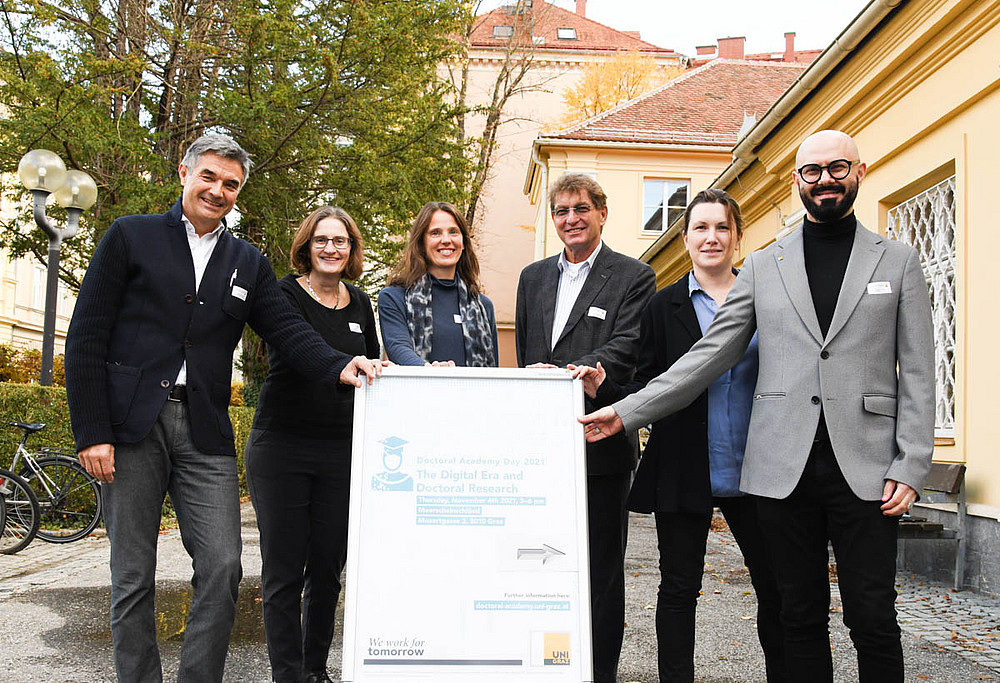
Sie luden wieder zum Doctoral Academy Day: Joachim Reidl, Corinne von der Hellen, Gudrun Salmhofer, Peter Scherrer, Stefanie Lerch-Pesendorfer und Gerald Lind (v.l.). Foto: Uni Graz/Tzivanopoulos

Sie luden wieder zum Doctoral Academy Day: Joachim Reidl, Corinne von der Hellen, Gudrun Salmhofer, Peter Scherrer, Stefanie Lerch-Pesendorfer und Gerald Lind (v.l.). Foto: Uni Graz/Tzivanopoulos

Doctoral Academy Day 2021 zum Thema „Digitale Transformation“ mit Blick auf Nachwuchsforschende

DoktorandInnen kommunizieren, kooperieren und forschen mit digitalen Tools in virtuellen Umgebungen. Der Doctoral Academy Day 2021 nahm unter dem Titel „The Digital Era and Doctoral Research” eine Bestandsaufnahme der sich dadurch eröffnenden Handlungsfelder und Möglichkeiten vor. Der thematischen Ausrichtung entsprechend fand die Veranstaltung am 4. November 2021 in hybrider Form – im Meerscheinschlössl und via uniMeet – statt.

Im Eröffnungsgespräch mit Gudrun Salmhofer skizzierten Joachim Reidl, Vizerektor für Forschung und Nachwuchsförderung, und Peter Scherrer, Professor für Archäologie und langjähriger Direktor der Doctoral Academy, die außergewöhnlichen Auswirkungen der Digitalisierung auf alle Aspekte des akademischen Lebens. Im Anschluss arbeitete Paul Spencer vom Doctoral College der University of Bristol in seiner Keynote „The Digitally Agile Researcher“ drei Eckpfeiler erfolgreicher wissenschaftlicher Karrieren in digitalen Kontexten heraus: die Sichtbarmachung wissenschaftlicher Expertise im Internet, die aktive Nutzung von Online-Vernetzungsmöglichkeiten und einen ethisch reflektierten Umgang mit gängigen Praktiken bei der digitalen Zugänglichmachung wissenschaftlicher Publikationen.

Die im Rahmen des Doctoral Academy Days bereits traditionelle Vorstellung neuer Academy-Mitgliedskonsortien durch DoktorandInnen erfolgte in diesem Jahr durch Nathalie Frieß bei „Complexity of Life“ und Tamara Berger bei „Biomolecular Structures and Interactions“.

Forschung mit Potenzial
Beispiele für State-of-the-Art-Forschung auf digitaler Basis lieferten die Vorträge dreier weiterer DoktorandInnen. Stefan Herdy sprach über den Einsatz von Machine-Learning-Tools zur Untersuchung biologischer Bodenkrusten, Amit Singh erklärte Computer-gestützte Zugänge zur Erforschung enzymatischer Prozesse, und Hristina Veljanova präsentierte ihre Arbeit zur Erstellung eines Kriterienkatalogs für vertrauenswürdige automatische Fahrzeuge und Fahrassistenzsysteme. Den Blickwinkel außeruniversitärer ArbeitgeberInnen vermittelte Mario Mitter, Doktoratsabsolvent mit erfolgreicher Karriere als Data Scientist. Wichtig bei der Auswahl von Job-BewerberInnen sei weniger die Kenntnis konkreter digitaler Werkzeuge, sondern vor allem die im Laufe der Doktoratsausbildung erworbene Fähigkeit zur selbstständigen Problemlösung.
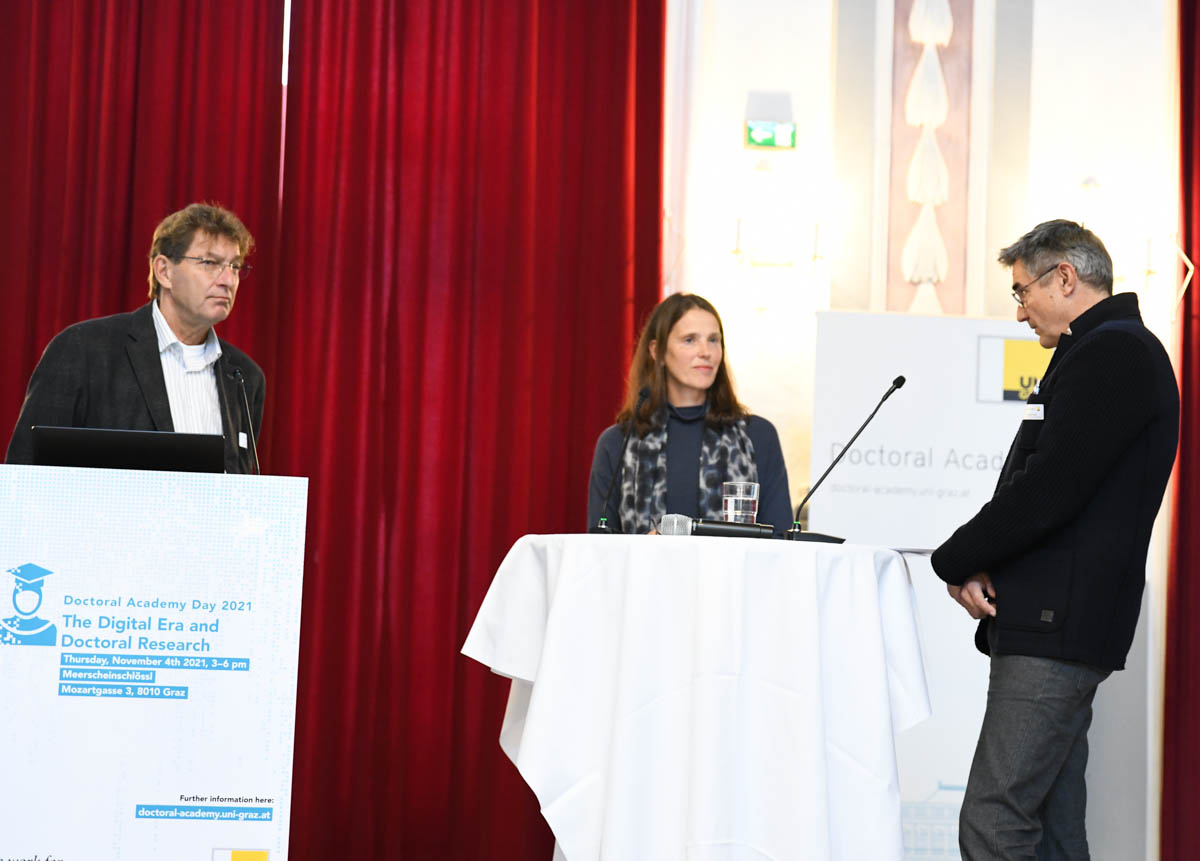
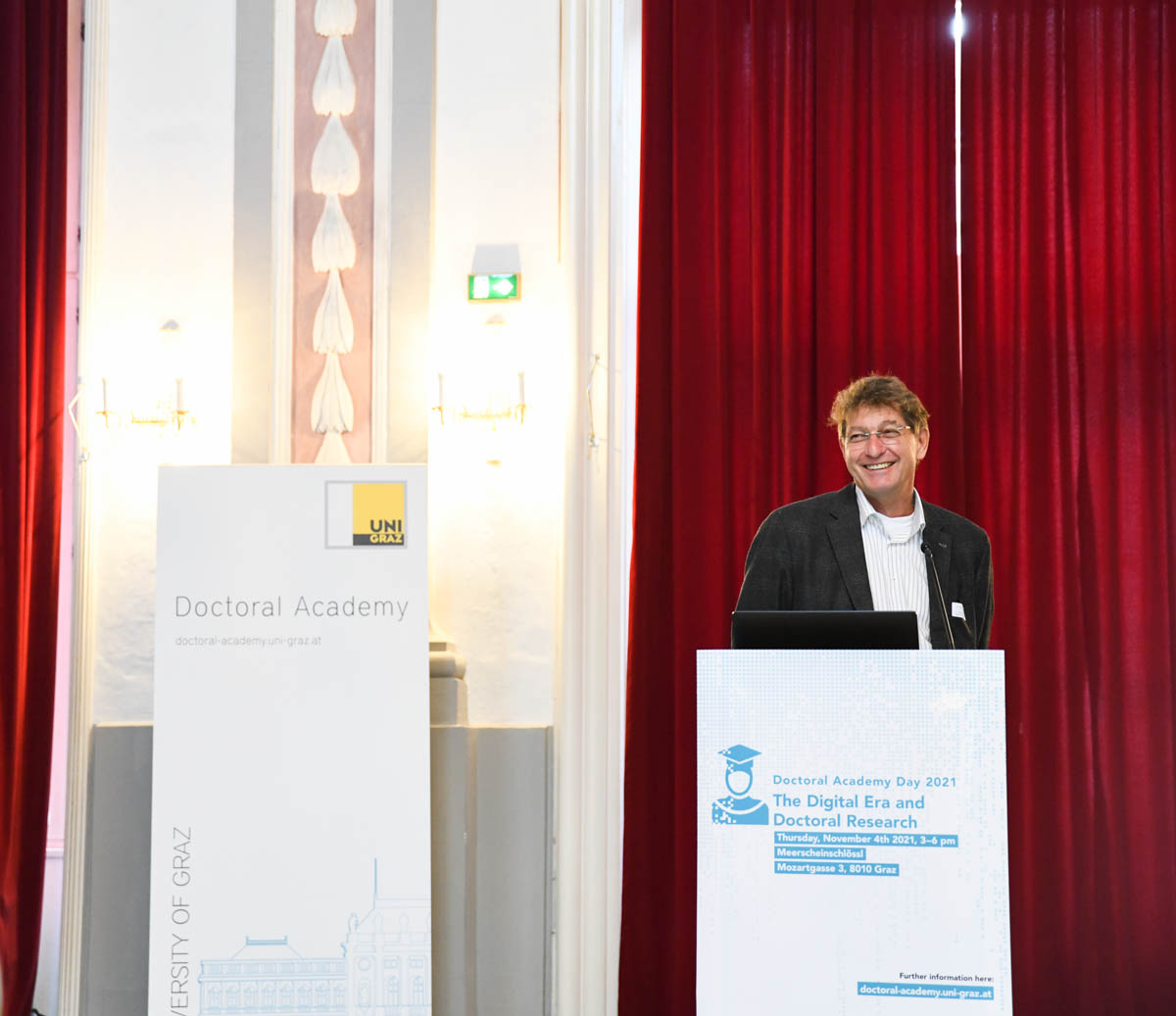
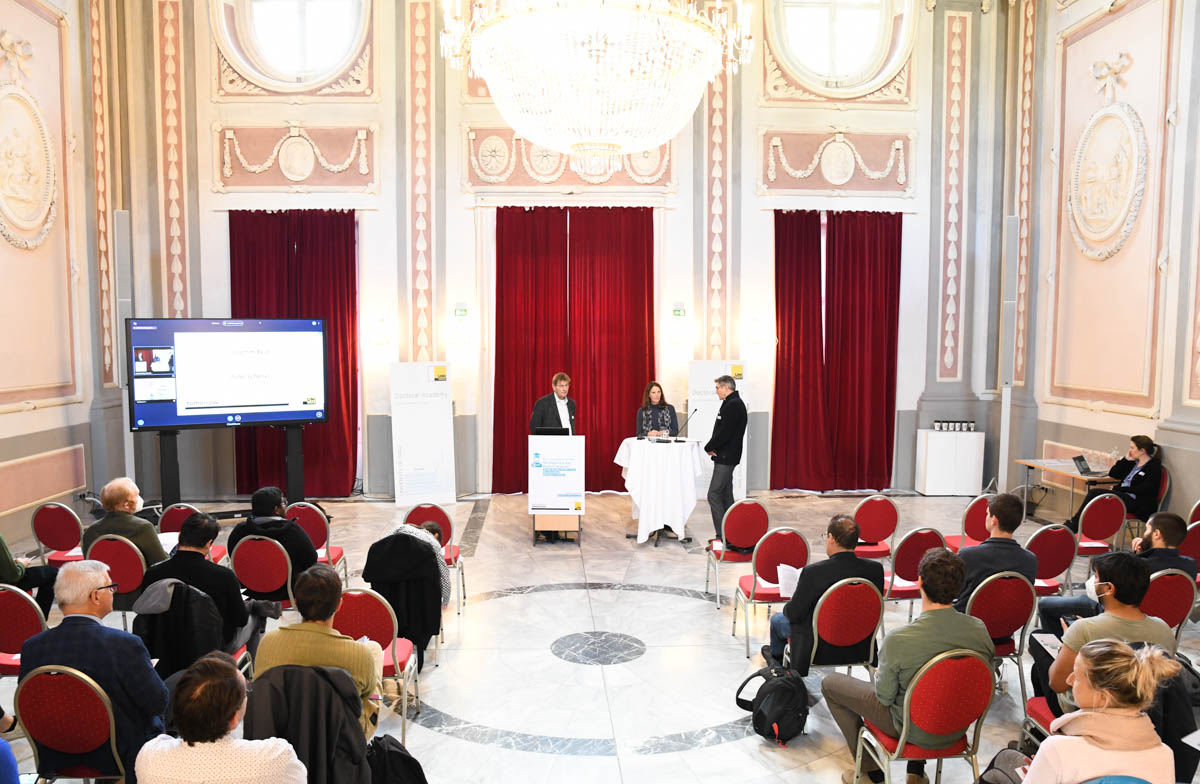
Peter Scherrer (links) und Joachim Reidl im Gespräch mit Gudrun Salmhofer. Foto: Uni Graz/Tzivanopoulos
Das Event fand im Meerscheinschlössl an der Uni Graz statt, wurde aber auch online übertragen.
created by Gerald Lind & Konstantin Tzivanopoulos

Related news

Electrifying: Researchers film the first moments on the way from light to electricity

Physicists at the University of Graz (Austria), in collaboration with colleagues from Marburg University and Forschungszentrum Jülich (Germany), have achieved a scientific breakthrough. For the first time, the generation of electrical energy from light has been filmed and described theoretically. This work is of far-reaching significance, not least for optimising sustainable energy production from photovoltaics. This is because it provides fundamental building blocks for understanding the physical processes that take place, for example, in organic solar cells. The paper was published in the journal Physical Review X, one of the world’s most prestigious physics journals.

University of Graz: Working together to make Styria a sustainable centre of learning

Round table calls for sustainable funding for the 2028–2030 performance agreement period between the five Styrian universities and the federal government.

How can we teach using YouTube and AI? The University of Graz is strengthening media education in schools

A journey through the blood vessels using VR headsets brings biology lessons to life. An interactive quiz brings physics to life. The YouTube video explains the First World War. Whilst mobile phones are increasingly being banned from the classroom, social media platforms, apps and AI are playing an ever-greater role in knowledge transfer at school. But how can teaching with media be made even more effective? What are the challenges in media-based teaching? At the University of Graz, researchers are discussing these issues at a conference being held in Austria for the first time.

Jurassic Sounds: Biologist reconstructs insect songs from 165 million years ago

It was apparently not just the roars of the dinosaurs that made up the soundscape of the animal world during the Jurassic period. Crickets and grasshoppers communicated through a variety of songs and high-pitched sounds, as Thorin Jonsson from the Institute of Biology at the University of Graz discovered together with colleagues from the universities of Lincoln, Bristol (UK), Beijing (China) and Tempe (USA). The findings on what are so far the oldest traces of sound on Earth have just been published in the journal PNAS.

Begin of page section:
Additional information:

University of Graz
Universitaetsplatz 3
8010 Graz
Austria
  • Contact
  • Web Editors
  • Moodle
  • UNIGRAZonline
  • Imprint
  • Data Protection Declaration
  • Accessibility Declaration
Weatherstation
Uni Graz

End of this page section. Go to overview of page sections

End of this page section. Go to overview of page sections

Begin of page section:

End of this page section. Go to overview of page sections