Begin of page section:
Page sections:

  • Go to contents (Accesskey 1)
  • Go to position marker (Accesskey 2)
  • Go to main navigation (Accesskey 3)
  • Go to sub navigation (Accesskey 4)
  • Go to additional information (Accesskey 5)
  • Go to page settings (user/language) (Accesskey 8)
  • Go to search (Accesskey 9)

End of this page section. Go to overview of page sections

Begin of page section:
Page settings:

English en
Deutsch de
Search
Login

End of this page section. Go to overview of page sections

Begin of page section:
Search:

Search for details about Uni Graz
Close

End of this page section. Go to overview of page sections


Search

Begin of page section:
Main navigation:

Page navigation:

  • University

    University
    • About the University
    • Organisation
    • Faculties
    • Library
    • Working at University of Graz
    • Campus
    Developing solutions for the world of tomorrow - that is our mission. Our students and our researchers take on the great challenges of society and carry the knowledge out.
  • Research Profile

    Research Profile
    • Our Expertise
    • Research Questions
    • Research Portal
    • Promoting Research
    • Research Transfer
    • Ethics in Research
    Scientific excellence and the courage to break new ground. Research at the University of Graz creates the foundations for making the future worth living.
  • Studies

    Studies
    • Prospective Students
    • Students
  • Community

    Community
    • International
    • Location
    • Research and Business
    • Alumni
    The University of Graz is a hub for international research and brings together scientists and business experts. Moreover, it fosters the exchange and cooperation in study and teaching.
  • Spotlight
Topics
  • Our digital Advent calendar
  • Sustainable University
  • Researchers answer
  • Work for us
Close menu

End of this page section. Go to overview of page sections

Begin of page section:
You are here:

University of Graz News Die Schizophrenie der Kunststoffe

End of this page section. Go to overview of page sections

Wednesday, 12 July 2017

Die Schizophrenie der Kunststoffe
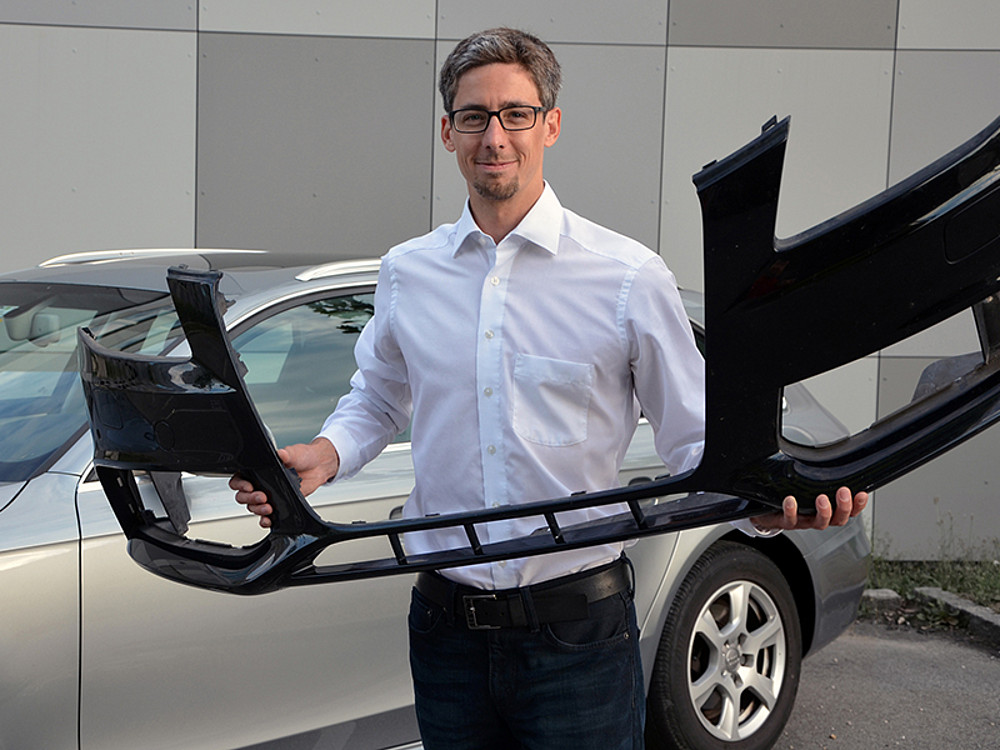
David Schönmayr analysiert das System der automotiven Kunststoffproduktion und -Verwertung. Foto: Stefanie H. Fotografie

David Schönmayr analysiert das System der automotiven Kunststoffproduktion und -Verwertung. Foto: Stefanie H. Fotografie

Absolvent der Uni Graz entwickelte Fahrplan für Recyclingherausforderungen der Automobilindustrie

Rohölproduktion und Plastikmüll auf der einen Seite, CO2-Einsparungen und rekordverdächtige Sicherheit auf der anderen Seite. Das ist die Schizophrenie des High-Tech Materials Kunststoff im Automobil, wie es David Schönmayr, PhD, bezeichnet. Schönmayr analysierte dieses Paradoxon in seinem Doktoratsstudium an der Karl-Franzens-Universität Graz und hat nun nach seinem Promotion ein Buch bei Springer veröffentlicht: „Automotive Recycling, Plastics, and Sustainability“.
„Die Nutzungsphase von Autos wird ökologisch betrachtet immer weniger relevant, da der CO2-Verbrauch pro Kilometer durch Kunststoff-Leichtbau, effiziente Antriebe und Elektromobilität stetig sinkt“, erklärt der Absolvent der Uni Graz „Der Nachteil ist, dass die Produktion und die Verwertung nach der Nutzung immer komplexer werden. Dort verstecken sich nun einige der vermeintlich eingesparten Umweltauswirkungen.“ Deshalb, so Schönmayr, müssten jetzt genau neue Lösungen entwickelt werden.
In seinem Buch analysiert der Forscher dazu das System der automotiven Kunststoffproduktion und -Verwertung, liefert praktische Tools, Prognosen, Szenarien und die Ergebnisse einer europaweiten Expertenumfrage. Dabei zeigt er beispielsweise, dass der Einsatz recycelter Kunststoffe aktuell noch bei weniger sicherheitskritischen Bauteilen – wie Radläufen, Abdeckungen, Gehäusen und Wasserabweisern – sowie EcoDesign die zwei wichtigsten Schritte sind, um Automotivkunststoffe nachhaltiger zu gestalten. „Selbst Verbundwerkstoffe und Biokunststoffe schneiden deutlich schlechter ab“, weiß Schönmayr, der auch eine „Roadmap für Kunststoffkreisläufe in Unternehmen“ erarbeitet hat.

Der Autor ist Fachmann der unternehmerischen Nachhaltigkeit. Er hat sein Doktorat am Institut für Geographie und Raumforschung sowie am Institut für Systemwissenschaften, Innovations- und Nachhaltigkeitsforschung der Karl-Franzens-Universität Graz absolviert. Aktuell ist er im Cleantech-Cluster der Business Upper Austria – OÖ Wirtschaftsagentur GmbH aktiv und setzt nachhaltige Projekte mit Industrie und Forschung um. Eines der Projekte, Kunststoff-CSI, wurde kürzlich mit dem Energy Globe Award Austria ausgezeichnet.

>> Infos zum Buch

created by Andreas Schweiger

Related news

Chemical Christmas show at the University of Graz: An explosive evening at the Schauspielh

At the beginning of December, the University of Graz transformed the theater into a laboratory: as part of “Chemical Life,” teacher training students staged a chemical Christmas show for Styrian school classes—complete with ethanol rockets, nitrogen snow, and glowing effects. An evening designed to inspire interest in studying chemistry.

Train by train: Koralm railway accelerates exchange between the Universities

Lectures at the University of Klagenfurt in the morning, seminars at the University of Graz in the afternoon: Austria's longest tunnel and a journey time of around 45 minutes make it easy. The Koralm railway increases the speed of networking between the two university locations. The collaboration builds on existing cooperation - for example in the areas of teacher training, Slavic studies and as employers, the universities are well coordinated.

On the trail of the Big Bang: University of Graz receives 1.5 million euros for doctoral programmes

The Austrian Science Fund FWF has selected the Doctoral Programme in Theoretical Particle Physics at the University of Graz for funding from the Doc.funds. Six young scientists will be funded for 3.5 years. They will gain fundamentally new insights into the origins of the world.

From trans women and knee prostheses: sports science prizes awarded

Walking better with a prosthesis, successfully getting rid of excess weight, training more effectively, more fairness for trans people in sport: these were the topics addressed by the students at the University of Graz who were awarded the sports science prizes for their Master's theses on 3 December 2025.

Begin of page section:
Additional information:

University of Graz
Universitaetsplatz 3
8010 Graz
Austria
  • Contact
  • Web Editors
  • Moodle
  • UNIGRAZonline
  • Imprint
  • Data Protection Declaration
  • Accessibility Declaration
Weatherstation
Uni Graz

End of this page section. Go to overview of page sections

End of this page section. Go to overview of page sections

Begin of page section:

End of this page section. Go to overview of page sections