Begin of page section:
Page sections:

  • Go to contents (Accesskey 1)
  • Go to position marker (Accesskey 2)
  • Go to main navigation (Accesskey 3)
  • Go to sub navigation (Accesskey 4)
  • Go to additional information (Accesskey 5)
  • Go to page settings (user/language) (Accesskey 8)
  • Go to search (Accesskey 9)

End of this page section. Go to overview of page sections

Begin of page section:
Page settings:

English en
Deutsch de
Search
Login

End of this page section. Go to overview of page sections

Begin of page section:
Search:

Search for details about Uni Graz
Close

End of this page section. Go to overview of page sections


Search

Begin of page section:
Main navigation:

Page navigation:

  • University

    University
    • About the University
    • Organisation
    • Faculties
    • Library
    • Working at University of Graz
    • Campus
    Developing solutions for the world of tomorrow - that is our mission. Our students and our researchers take on the great challenges of society and carry the knowledge out.
  • Research Profile

    Research Profile
    • Our Expertise
    • Research Questions
    • Research Portal
    • Promoting Research
    • Research Transfer
    • Ethics in Research
    Scientific excellence and the courage to break new ground. Research at the University of Graz creates the foundations for making the future worth living.
  • Studies

    Studies
    • Prospective Students
    • Students
  • Community

    Community
    • International
    • Location
    • Research and Business
    • Alumni
    The University of Graz is a hub for international research and brings together scientists and business experts. Moreover, it fosters the exchange and cooperation in study and teaching.
  • Spotlight
Topics
  • Sustainable University
  • Researchers answer
  • Work for us
Close menu

End of this page section. Go to overview of page sections

Begin of page section:
You are here:

University of Graz News Clear & Simple

End of this page section. Go to overview of page sections

Wednesday, 17 February 2021

Clear & Simple

Even after the pandemic. "Some of the digital methods will stay with us,” according to Elke Höfler, an expert in teaching methodology at the Institute of Romance Studies.

Even after the pandemic. "Some of the digital methods will stay with us,” according to Elke Höfler, an expert in teaching methodology at the Institute of Romance Studies.

Education expert at the University of Graz: “Online learning in the classroom is here to stay”

Pupils and teachers are back in their classrooms. With face-to-face teaching and no more home schooling. “But some of the digital methods will stay with us,” according to Elke Höfler, an expert in teaching methodology at the Institute of Romance Studies. The concept of “blended learning” combines online learning with face-to-face teaching.

“Teaching plans would need to be swiftly adapted, and new materials created,” explains Höfler, who researches digital learning and teaching at the University of Graz. She is campaigning for a long-overdue analysis of home schooling. “This is the only way we can learn from the current situation, think about lasting changes, and most importantly, put these into practice.”
In the post-COVID era it will be vital to have the right combination of methods, and to use whatever works best. Höfler suggests that 60 per cent face-to-face teaching and 40 per cent online might be a sensible balance for blended learning. It depends on the subject and the type of teaching required. “Languages are certainly more demanding.”

“Teaching and learning using digital media is already an integral component of the teacher training programme,” confirms Catherine Walter-Laager, Vice Rector for Studies and Teaching. Teacher training has included subject specialist requirements in this area for a long time already, she points out. Some aspects of the course content emphasise this:
for example, in introductory seminars, language teaching students develop specific materials and scenarios in both digital and analogue formats, so that they can be used for both face-to-face teaching and distance learning.
The University of Graz has also worked in collaboration with other higher education institutions in the South-East Development Network to design and implement two MOOCs (Massive Open Online Courses) for the new teacher training programme (“PädagogInnenbildung NEU”).

Clip (German only)


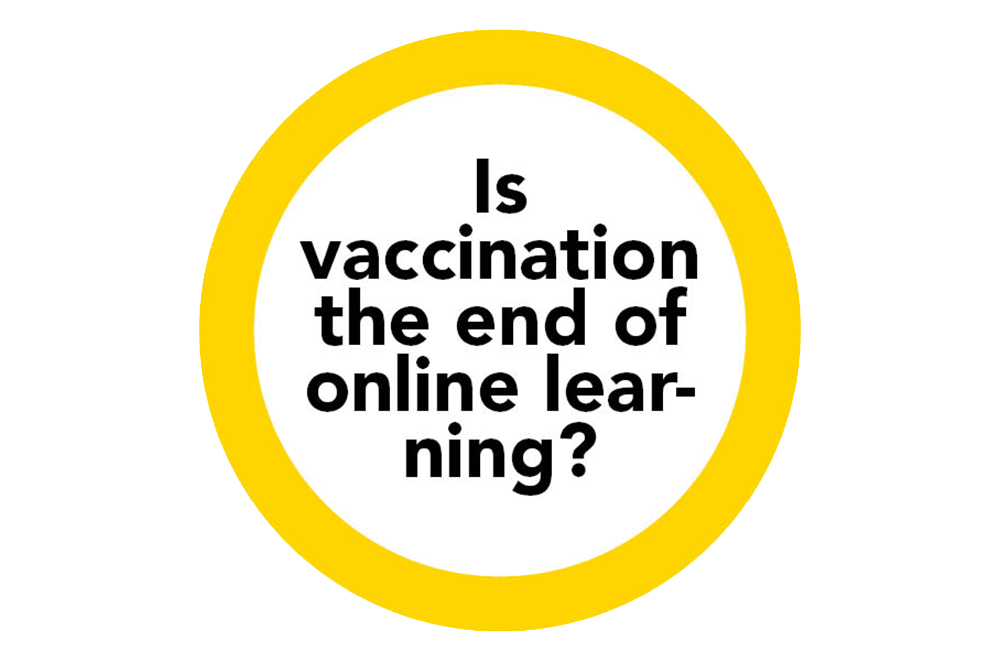
Elke Höfler: "I hope online teaching doesn’t disappear completely once people have been vaccinated.
Online teaching actually has some advantages, particularly if it is not just in the form of video-conferencing. Online teaching also includes interactive exercises, and one-to-one training, where learners receive individual tuition, for example in pronunciation.
After we are vaccinated, we will once again have complete freedom to choose the way we operate. We can select the method and format that is best suited to achieving the learning objective, and ultimately ensuring the best outcome for our pupils.
We have contact, we have face-to-face teaching. We also have individual phases of learning – both online and in the classroom – whichever is the best option in each case."

created by Andreas Schweiger

Related news

Cosmetics in the environment: University of Graz proves danger to ants

Titanium dioxide, which is found in cosmetics, for example, is increasingly entering the environment in the form of nanoparticles. This could also put insects at risk. If ants ingest the substance in combination with the pesticide glyphosate, it disturbs the development of their offspring. Scientists at the University of Graz are drawing attention to the negative consequences of this toxic cocktail.

How are tech companies changing democracy? Uni Graz designs exhibition for schools

Filtered information, conspiracy theories, fake news – certain groups and corporations are using social media and algorithms to try to influence public opinion in their favour. Their goal: to weaken fundamental rights and diversity of opinion and seize power. In a new exhibition, researchers at the University of Graz are working with pupils to explore the impact of social media and AI on democracy. In accompanying workshops, the scientists want to encourage young people to develop their own ideas for a socially and ecologically viable future and to actively help shape it. The exhibition, designed as a travelling exhibition for schools, will open on 9 March 2026 at the Dreihackengasse Gymnasium in Graz.

Step by step: What motivates Mireille van Poppel as a scientist and vice-rector

Improving people's health and eliminating inequalities: Mireille van Poppel pursues these goals both as a public health researcher and as vice-rector for Internationalisation and Equality. In both roles, she pays particular attention to individual needs.

Master's degree in psychotherapy in Graz: registration opens in March

Graz is becoming a hotspot for psychotherapy: from 2026, the University of Graz and the Medical University of Graz will jointly offer the new master's programme. Registration for the admission procedure for the 140 study places will start in March.

Begin of page section:
Additional information:

University of Graz
Universitaetsplatz 3
8010 Graz
Austria
  • Contact
  • Web Editors
  • Moodle
  • UNIGRAZonline
  • Imprint
  • Data Protection Declaration
  • Accessibility Declaration
Weatherstation
Uni Graz

End of this page section. Go to overview of page sections

End of this page section. Go to overview of page sections

Begin of page section:

End of this page section. Go to overview of page sections