Begin of page section:
Page sections:

  • Go to contents (Accesskey 1)
  • Go to position marker (Accesskey 2)
  • Go to main navigation (Accesskey 3)
  • Go to sub navigation (Accesskey 4)
  • Go to additional information (Accesskey 5)
  • Go to page settings (user/language) (Accesskey 8)
  • Go to search (Accesskey 9)

End of this page section. Go to overview of page sections

Begin of page section:
Page settings:

English en
Deutsch de
Search
Login

End of this page section. Go to overview of page sections

Begin of page section:
Search:

Search for details about Uni Graz
Close

End of this page section. Go to overview of page sections


Search

Begin of page section:
Main navigation:

Page navigation:

  • University

    University
    • About the University
    • Organisation
    • Faculties
    • Library
    • Working at University of Graz
    • Campus
    Developing solutions for the world of tomorrow - that is our mission. Our students and our researchers take on the great challenges of society and carry the knowledge out.
  • Research Profile

    Research Profile
    • Our Expertise
    • Research Questions
    • Research Portal
    • Promoting Research
    • Research Transfer
    • Ethics in Research
    Scientific excellence and the courage to break new ground. Research at the University of Graz creates the foundations for making the future worth living.
  • Studies

    Studies
    • Prospective Students
    • Students
  • Community

    Community
    • International
    • Location
    • Research and Business
    • Alumni
    The University of Graz is a hub for international research and brings together scientists and business experts. Moreover, it fosters the exchange and cooperation in study and teaching.
  • Spotlight
Topics
  • Our digital Advent calendar
  • Sustainable University
  • Researchers answer
  • Work for us
Close menu

End of this page section. Go to overview of page sections

Begin of page section:
You are here:

University of Graz News China hautnah

End of this page section. Go to overview of page sections

Friday, 23 September 2016

China hautnah

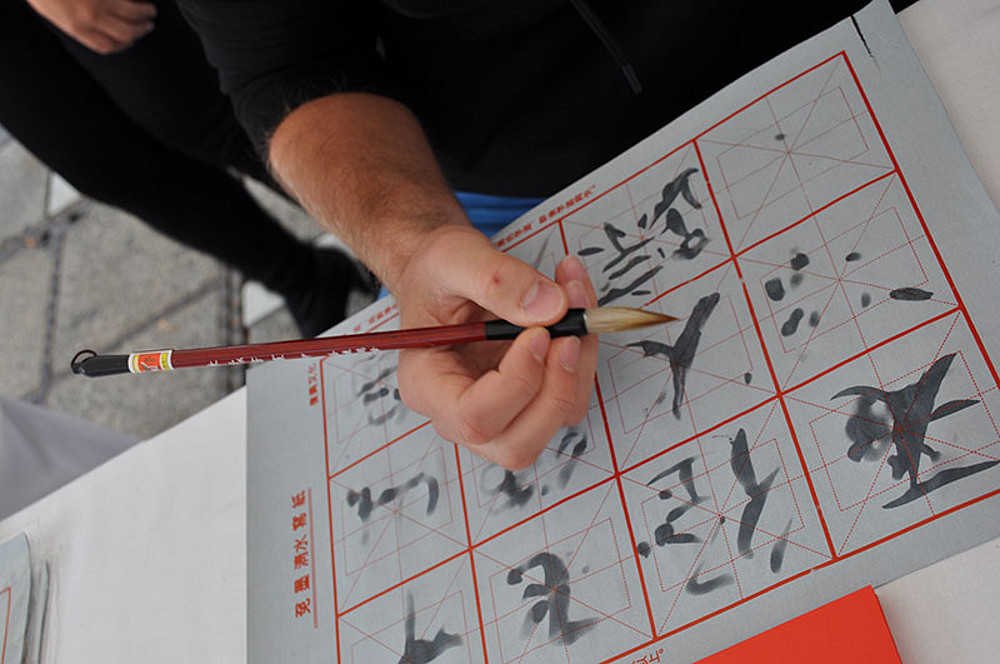
BesucherInnen können sich in Kalligraphie und Scherenschnitt versuchen.

BesucherInnen können sich in Kalligraphie und Scherenschnitt versuchen.

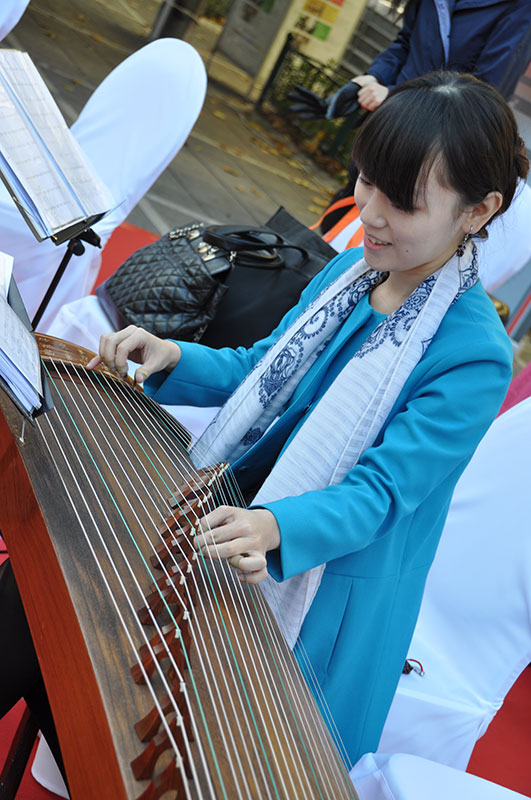
Ausgesuchte chinesische Musikstücke werden am Konfuzius-Tag auf traditionellen Instrumenten dargeboten. Alle Fotos: Konfuzius-Institut Uni Graz.

Ausgesuchte chinesische Musikstücke werden am Konfuzius-Tag auf traditionellen Instrumenten dargeboten. Alle Fotos: Konfuzius-Institut Uni Graz.

Uni Graz feiert am 29. September den Tag der Konfuzius-Institute

Am Donnerstag, 29. September 2016, feiert das Konfuzius-Institut der Karl-Franzens-Universität am Grazer Hauptplatz den jährlich weltweit zelebrierten Tag der Konfuzius-Institute. Ein buntes und vielfältiges Programm bietet BesucherInnen von 11 bis 18 Uhr die Möglichkeit, China hautnah zu erleben und auch selbst aktiv zu werden. Vorgeführt werden unter anderem chinesische Kampf- und Schnitzkunst, dazu wird als kulinarische Spezialität Mondkuchen und Tee gereicht. Wer möchte, kann sich selbst in Kalligraphie und Scherenschnitt versuchen, oder bereits die ersten chinesischen Wörter üben. Umrahmt wird das Programm durch Live-Performance ausgesuchter chinesischer Musikstücke, dargebracht auf traditionellen Instrumenten.


Einen Höhepunkt dieses besonderen Tages stellt eine gemeinsame Pop-up-Fotoausstellung der Städte Zhenjiang und Graz dar. BewohnerInnen von Zhenjiang werden anwesend sein, um den BesucherInnen Einblicke in „ihre“ Stadt zu geben. Ergänzt wird die Ausstellung durch Fotos von SchülerInnen der BHAK/BHAS-Grazbachgasse, die im Sommer zwei Wochen China bereist hatten. Die Reise war mit Unterstützung des Grazer Konfuzius-Institutes zustande gekommen.

Über das Konfuzius-Institut
Das seit 2010 an der Karl-Franzens-Universität Graz bestehende Konfuzius-Institut versteht sich als regionales Zentrum für die chinesische Sprache, Fenster für die chinesische Kultur und Brücke zwischen der chinesischen und österreichischen Bevölkerung. Weltweit bestehen bereits rund 500 Institute, etwa 160 davon in Europa. Die Grazer Einrichtung ist – neben einem Pendant in Wien – die zweite in Österreich, und bündelt die China-Expertise in der Steiermark. Das universitäre Institut ist schwerpunktmäßig in den Bereichen Lehre, Forschung und Kulturaustausch aktiv. Seit 2015 fungiert Dr. Wan Jie Chen, B.A. als Direktor.

created by Gerhild Kastrun

Related news

Preserving knowledge: Book sponsorship success story cracks the 100,000 euro mark

The special collections of Graz University Library comprise around 300,000 valuable objects from 25 centuries: Papyri, manuscripts, incunabula, maps and printed books. The sensational find from 2023 is also kept here: the Graz Mummy Book, the world's oldest known book fragment in codex form.

Semester abroad without barriers: University of Graz wins award for promoting inclusion

The University of Graz has been awarded the Internationalization Award for its new inclusion initiative. Students with fewer opportunities now also receive financial support for their semester abroad outside Europe.

Fair distribution: Researchers determine just greenhouse gas budgets for all EU regions

Ten years ago, on 12 December 2015, the Paris Climate Agreement was signed at the UN Climate Conference. In order to limit global warming to well below two degrees, only a certain amount of CO2 may be emitted worldwide. While the focus was originally on national emission targets, more than 200 subnational regions and almost 300 cities have now adopted their own targets. But how many emissions are they fairly entitled to? Researchers at the University of Graz have now developed transparent criteria for fair distribution at the subnational level for the first time and determined corresponding greenhouse gas budgets for all European regions. The paper was published today in the scientific journal Nature Communications.

Chemical Christmas show at the University of Graz: An explosive evening at the Schauspielh

At the beginning of December, the University of Graz transformed the theater into a laboratory: as part of “Chemical Life,” teacher training students staged a chemical Christmas show for Styrian school classes—complete with ethanol rockets, nitrogen snow, and glowing effects. An evening designed to inspire interest in studying chemistry.

Begin of page section:
Additional information:

University of Graz
Universitaetsplatz 3
8010 Graz
Austria
  • Contact
  • Web Editors
  • Moodle
  • UNIGRAZonline
  • Imprint
  • Data Protection Declaration
  • Accessibility Declaration
Weatherstation
Uni Graz

End of this page section. Go to overview of page sections

End of this page section. Go to overview of page sections

Begin of page section:

End of this page section. Go to overview of page sections