



Begin of page section:
Page sections:

  • Go to contents (Accesskey 1)
  • Go to position marker (Accesskey 2)
  • Go to main navigation (Accesskey 3)
  • Go to sub navigation (Accesskey 4)
  • Go to additional information (Accesskey 5)
  • Go to page settings (user/language) (Accesskey 8)
  • Go to search (Accesskey 9)

End of this page section. Go to overview of page sections

Begin of page section:
Page settings:

English en
Deutsch de
Search
Login

End of this page section. Go to overview of page sections

Begin of page section:
Search:

Search for details about Uni Graz
Close

End of this page section. Go to overview of page sections


Search

Begin of page section:
Main navigation:

Page navigation:

  • University

    University
    • About the University
    • Organisation
    • Faculties
    • Library
    • Working at University of Graz
    • Campus
    Developing solutions for the world of tomorrow - that is our mission. Our students and our researchers take on the great challenges of society and carry the knowledge out.
  • Research Profile

    Research Profile
    • Our Expertise
    • Research Questions
    • Research Portal
    • Promoting Research
    • Research Transfer
    • Ethics in Research
    • Commission for Scientific Integrity
    Scientific excellence and the courage to break new ground. Research at the University of Graz creates the foundations for making the future worth living.
  • Studies

    Studies
    • Prospective Students
    • Students
    • Welcome Weeks for First Year Students
  • Community

    Community
    • International
    • Location
    • Research and Business
    • Alumni
    The University of Graz is a hub for international research and brings together scientists and business experts. Moreover, it fosters the exchange and cooperation in study and teaching.
Topics
  • Sustainable University
  • Researchers answer
  • Work for us
Close menu

End of this page section. Go to overview of page sections

Begin of page section:
You are here:

University of Graz News Preserving knowledge: Book sponsorship success story cracks the 100,000 euro mark

End of this page section. Go to overview of page sections

Tuesday, 16 December 2025

Preserving knowledge: Book sponsorship success story cracks the 100,000 euro mark

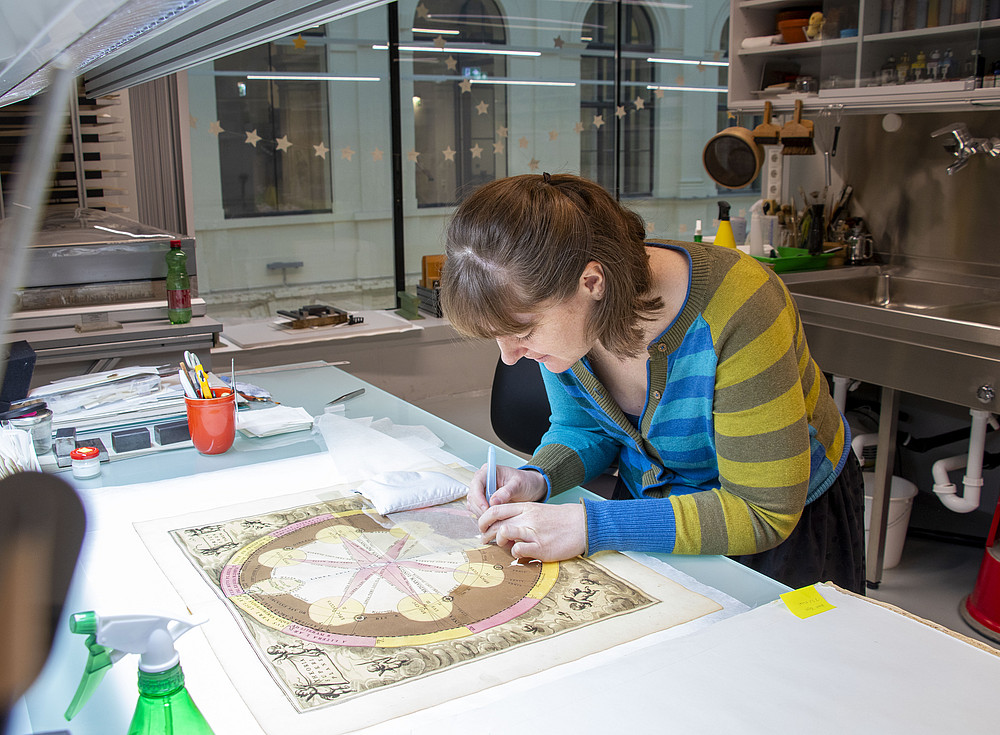
A woman is restoring a book.

Some pages of the 18th-century atlas Harmonica Macrocosmica have become brittle due to verdigris. Restorer Lena Krämer shows how the fragile areas need to be reinforced with fine Japanese paper in order to preserve them. Photo: University of Graz/Reif-Teubenbacher.

The special collections of Graz University Library comprise around 300,000 valuable objects from 25 centuries: Papyri, manuscripts, incunabula, maps and printed books. The sensational find from 2023 is also kept here: the Graz Mummy Book, the world's oldest known book fragment in codex form.

Preserving this knowledge is a challenge. Because the ravages of time are gnawing away at these unique collections. This is why the University of Graz has launched a fundraising project that allows you to sponsor the preservation of a particular book. This is unique in Austria's universities, as Graz University Library is the only one to carry out restoration work.

"Our special collections harbour impressive treasures that are part of our cultural memory. With the book sponsorships, we make it possible for this knowledge to remain academically usable and also reach future generations," emphasises Rector Peter Riedler.

What does the book need?

Preserving a historical book for posterity requires a great deal of effort. "Each work requires different measures, such as dry cleaning, paper repairs, pigment or ink consolidation. The stitching also often needs to be reinforced and bindings repaired," says Theresa Zammit Lupi, Head Conservator in the Special Collections. Only high-quality materials that have been tested for chemical stability and durability are used. However, Zammit Lupi explains that it is not just a matter of restoration. "We take a holistic view of the book and research its contents as well as the history of the materials," she explains.

Magic mark cracked

The donation project "2500 years of knowledge - book sponsorships at Graz University Library", which was launched almost two years ago, is proving successful. "There are currently 62 sponsorships. Half of these books have already been repaired," says Beatrice Weinelt from the fundraising team at the University of Graz. Vice Rector Markus Fallenböck confirms that every financial contribution counts: "Together we are showing how much fundraising can achieve for science, culture and access to historical knowledge." He is particularly pleased that the "magic mark" of 100,000 euros was recently broken.

Support is possible from as little as 50 euros, while a sponsorship for professional restoration starts at 350 euros. Donations are tax-deductible. Supporters will be named on a plaque in the library, sponsors additionally receive a documentation report and a certificate as a thank you. They are also invited to a special guided tour of Graz University Library.

Last minute Christmas present

Some valuable treasures are still waiting to be restored. For example, the atlas "Harmonica Macrocosmica" from 1708, which illustrates with magnificent, hand-coloured copperplate engravings how the relationship between the earth and the universe was imagined before Newton. Or the atlas "Theatrum Orbis Terrarum" from 1575, which offers an important insight into many medieval European cities by means of hand-coloured maps and illustrations. So if you are still looking for a gift for Christmas, you could consider giving the gift of a book sponsorship. The corresponding certificate will be under the Christmas tree if the fundraising team is informed by 18 December at the latest.

More information: https://buchpatenschaften.uni-graz.at


>> Video: How do you restore a historical book?


created by Gerhild Leljak

Related news

A fresh start, a calling, holidays: what draws people from other career paths to teaching

They used to develop software; now they teach maths in the classroom. Career changers are expected to help address the shortage of qualified teachers in Austria’s schools. In their doctoral theses at the Institute for Educational Research and Teacher Training at the University of Graz, Melanie Gürentz and Claudia Mair examined how these new teachers perceive their new professional roles.

Talent Talks bridge the gap in career guidance

The Styrian Chamber of Commerce (WKO Steiermark), the Styrian Chamber of Labour (AK Steiermark) and the AMS are joining forces when it comes to training young people and, through the “Talent Talks”, are creating a seamless pathway to career guidance. This takes preparation and follow-up support – just in time for the start of the term and the scheme’s tenth anniversary – to a whole new level. A new survey conducted by the Talent Centre among 2,687 former participants to mark the anniversary shows just how important this development is. Of the young people who received follow-up support from the Talent Report, 74.6 per cent stated that they had a good understanding of their own strengths and talents following the Talent Check. Without follow-up support, the figure was 66.5 per cent – a significant difference of 8.1 percentage points.

ERC Starting Grants: three million euros for two researchers at the University of Graz

Two researchers from the University of Graz have secured prestigious and generously funded grants from the EU. Starting Grants from the European Research Council (ERC), each worth 1.5 million euros, have been awarded to the human geographer Heide Bruckner and the social scientist Silvana Weiss.

Austria’s emissions rose in 2025: University of Graz researchers analyse the causes

The Environment Agency Austria has today published the figures for the country’s greenhouse gas emissions in 2025. While emissions fell sharply year on year from 2022 to 2024, they rose again by just under 0.7 per cent in 2025. Researchers at the University of Graz have analysed how much of this increase was due to structural changes in the economy and how much was attributable to external factors over which there is little control. “In 2025, the colder winter compared with 2024 increased emissions by 0.81 per cent, while the weak economy reduced them by 0.38 per cent. If we factor out these influences, we find an underlying increase of 0.26 per cent compared with the previous year,” reports economist Karl Steininger. “This clearly means that Austria is not on track to meet its climate targets, which require a substantial reduction in emissions by 2030.”

Begin of page section:
Additional information:

University of Graz
Universitaetsplatz 3
8010 Graz
Austria
  • Contact
  • Web Editors
  • Moodle
  • UNIGRAZonline
  • Imprint
  • Data Protection Declaration
  • Accessibility Declaration
Weatherstation
Uni Graz

End of this page section. Go to overview of page sections

End of this page section. Go to overview of page sections

Begin of page section:

End of this page section. Go to overview of page sections