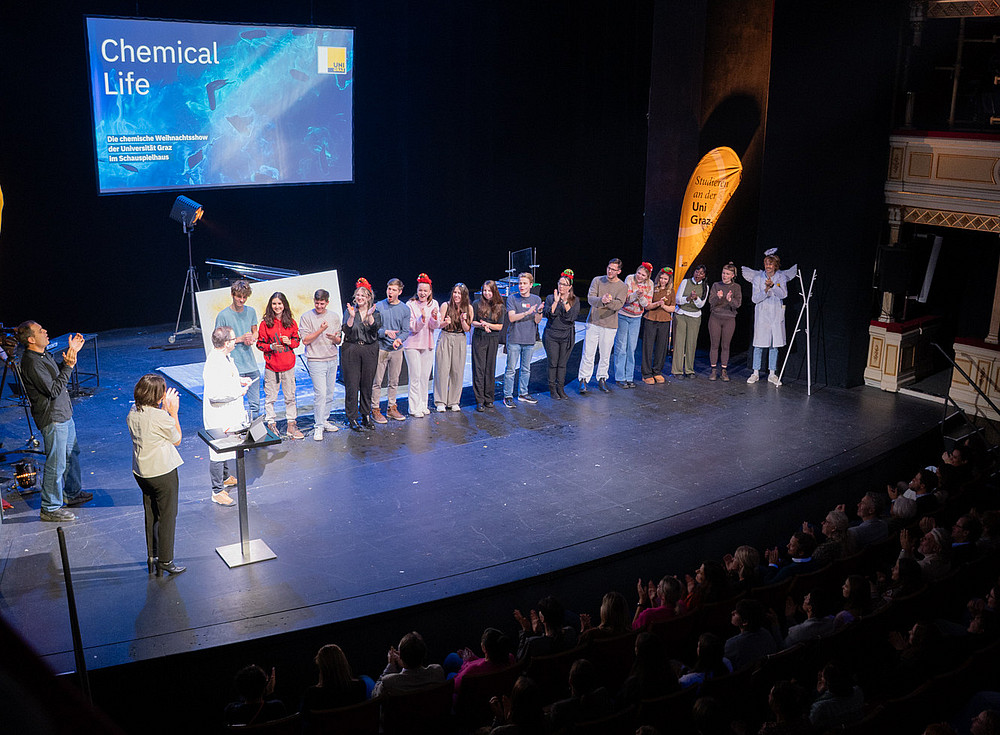
Advent is a peaceful and contemplative time, but there was no sign of a silent night at the Schauspielhaus theater on December 4, 2025. The atmosphere on stage was explosive, in the truest sense of the word. Under the motto “Chemical Life,” the University of Graz invited Styrian school classes to a chemical Christmas show, where chemistry teacher training students showed what they were capable of. Their experiments demonstrated how hot and cold nature can be.
Cathrine Walter-Laager, Vice Rector for Studies and Teaching, welcomed the school classes and thanked the Schauspielhaus theater for its cooperation. “This is a successful example of how we can bring our research to the public. And who knows, maybe we'll see one of the students back at the University of Graz soon.” Andrea Vilter, director of the Schauspielhaus theater, was unfortunately unable to attend in person. Her message of greeting was delivered by presenter Eva Pölzl. Finally, Philipp Spitzer, Professor of Chemistry Education and organizer of the Christmas chemistry show, thanked the many employees of the Schauspielhaus who made this performance possible and, above all, the theater's fire department, for whom this performance is always a particularly precarious experience.
PET rockets
Because chemical components were used as rocket propellants on several occasions. For example, the show demonstrated how aluminum foil can be used to build small launch pads. Ethanol was also used. To produce a loud “whoosh” sound, students mixed the alcohol with air in a large water canister and ignited the mixture. For the next stage of the experiment, Professor Spitzer himself had to step in. Using this alcohol-air mixture as propellant, he catapulted a PET bottle several meters through the air.
This was surpassed by physicist Bernhard Weingartner, who is also known from the ORF show “Fakt oder Fake” (Fact or Fake). His PET “rocket” was powered by a mixture of ice-cold liquid butane (-0.5 degrees Celsius!) and normal water. With a bang, the bottle disappeared somewhere behind the stage.
With so much heat and explosions, a cool-down is needed in between. How about -200 degrees, or rather, liquid nitrogen? When this element comes into contact with normal water, a thick fog with light snowfall immediately forms. When the students poured the remaining nitrogen onto the stage, there was a moment of shock in the front row, but the drops evaporated before they even reached the floor.
But it's not just chemistry that offers exciting experiments, as sports scientists Gerhard Tschakert and Othmar Moser demonstrated. On stage, they performed a sports performance test. Numerous vital signs were recorded live, from heart rate and respiratory rate to blood sugar and lactate levels. This allowed the researchers to show how performance gradually declines as the resistance on the ergometer increases.
Christ Child
There was also a reunion with a participant from the 2023 Christmas show. Doctoral student Jan Kriegl once again took on the role of the Christ Child, who had lost his way after the theater suddenly fell into darkness. With bright fire from magnesium and red flames from strontium nitrate, he was finally able to find his way onto the stage.
The finale was a science hack that anyone can replicate at home. It involves the bark of the horse chestnut tree, which contains the element aesculin. So if you peel a branch of the tree and put the bark in a container of water, this substance disperses. If you then illuminate the container with a UV lamp, the result is an almost magical scene. But as with all the experiments of the evening, this was pure science.
Ethanol rockets, nitrogen snow, glowing liquids, and burning metals: you can learn all this and much more by studying chemistry or teaching chemistry.