Begin of page section:
Page sections:

  • Go to contents (Accesskey 1)
  • Go to position marker (Accesskey 2)
  • Go to main navigation (Accesskey 3)
  • Go to sub navigation (Accesskey 4)
  • Go to additional information (Accesskey 5)
  • Go to page settings (user/language) (Accesskey 8)
  • Go to search (Accesskey 9)

End of this page section. Go to overview of page sections

Begin of page section:
Page settings:

English en
Deutsch de
Search
Login

End of this page section. Go to overview of page sections

Begin of page section:
Search:

Search for details about Uni Graz
Close

End of this page section. Go to overview of page sections


Search

Begin of page section:
Main navigation:

Page navigation:

  • University

    University
    • About the University
    • Organisation
    • Faculties
    • Library
    • Working at University of Graz
    • Campus
    Developing solutions for the world of tomorrow - that is our mission. Our students and our researchers take on the great challenges of society and carry the knowledge out.
  • Research Profile

    Research Profile
    • Our Expertise
    • Research Questions
    • Research Portal
    • Promoting Research
    • Research Transfer
    • Ethics in Research
    Scientific excellence and the courage to break new ground. Research at the University of Graz creates the foundations for making the future worth living.
  • Studies

    Studies
    • Prospective Students
    • Students
  • Community

    Community
    • International
    • Location
    • Research and Business
    • Alumni
    The University of Graz is a hub for international research and brings together scientists and business experts. Moreover, it fosters the exchange and cooperation in study and teaching.
  • Spotlight
Topics
  • Our digital Advent calendar
  • Sustainable University
  • Researchers answer
  • Work for us
Close menu

End of this page section. Go to overview of page sections

Begin of page section:
You are here:

University of Graz News Chemie und Umwelt

End of this page section. Go to overview of page sections

Wednesday, 12 November 2014

Chemie und Umwelt

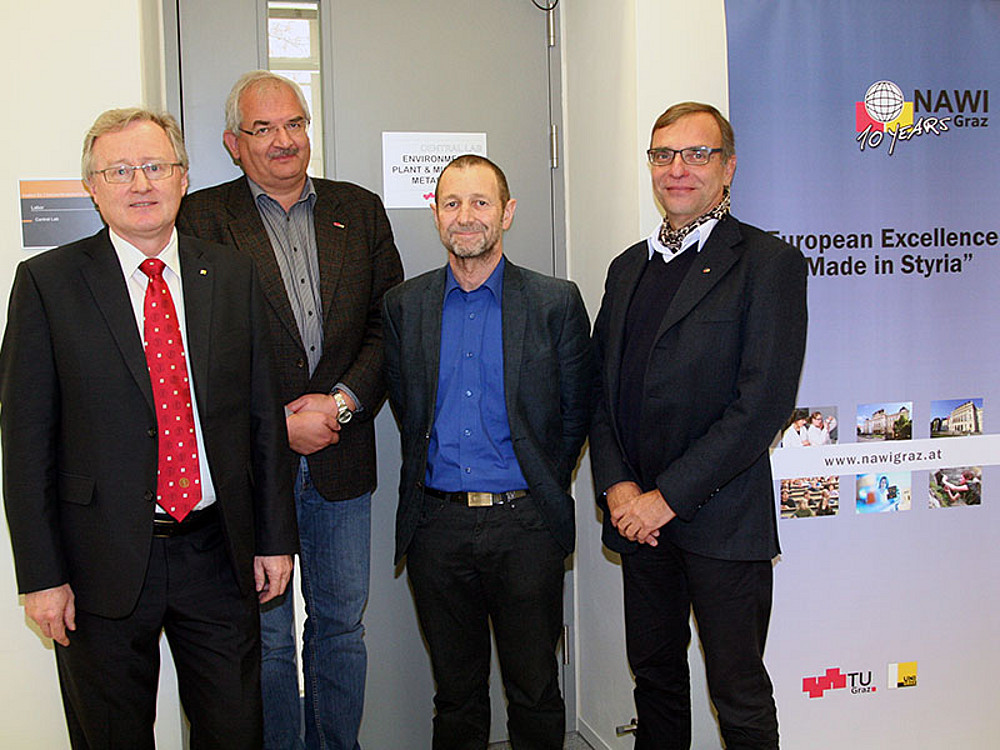
Rudolf Bauer, Leiter des Instituts für Pharmazeutische Wissenschaften, NAWI-Graz-Dekan Frank Uhlig, Kevin Francesconi, Leiter des Instituts für Chemie, und NAWI-Graz-Dekan Martin Mittelbach (v.l.). Foto: Uni Graz/Pichler

Rudolf Bauer, Leiter des Instituts für Pharmazeutische Wissenschaften, NAWI-Graz-Dekan Frank Uhlig, Kevin Francesconi, Leiter des Instituts für Chemie, und NAWI-Graz-Dekan Martin Mittelbach (v.l.). Foto: Uni Graz/Pichler

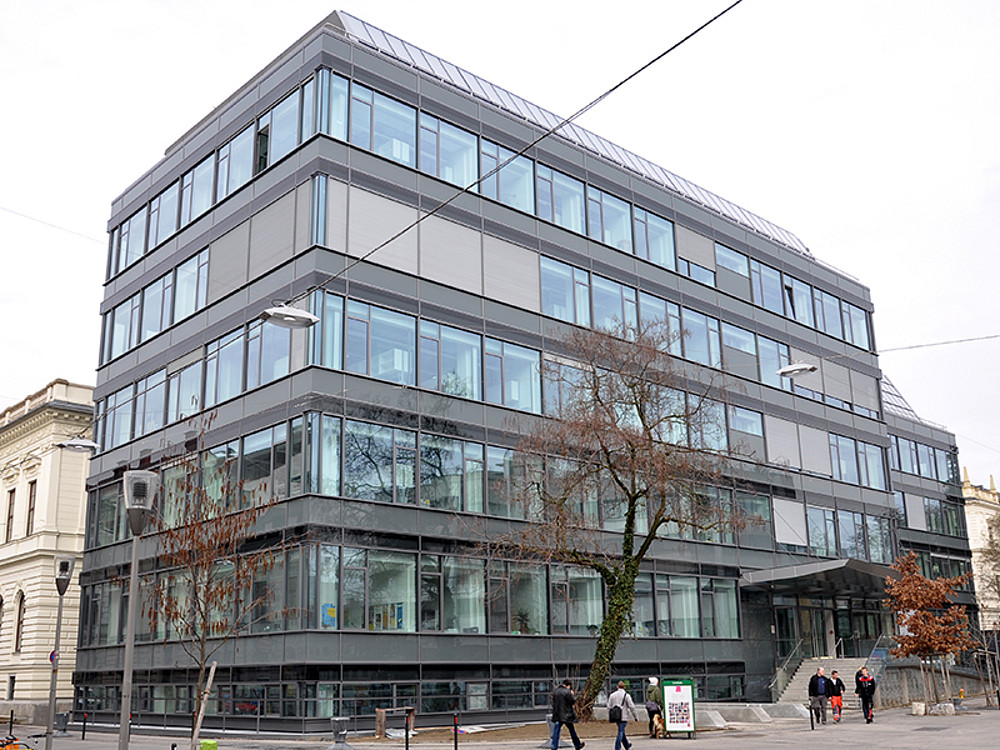
Das top-moderne Laborgebäude am Universitätsplatz 1 bietet optimale Rahmenbedingungen für Forschung und Lehre. Foto: Uni Graz/Tzivanopoulos

Das top-moderne Laborgebäude am Universitätsplatz 1 bietet optimale Rahmenbedingungen für Forschung und Lehre. Foto: Uni Graz/Tzivanopoulos

NAWI Graz Central Lab for Metabolomics bündelt Forschung von Uni Graz und TU Graz

Die Erforschung der chemischen Strukturen von pflanzlichen und mikrobiellen Inhaltsstoffen sowie deren biologische Wirkung und Auswirkung auf die Umwelt stehen im Mittelpunkt der wissenschaftlichen Arbeit des „NAWI Graz Central Lab for Environmental, Plant & Microbial Metabolomics“, das heute, am 12. November 2014, am Universitätsplatz 1 feierlich eröffnet wurde. Unter der Leitung von Univ.-Prof. Dr. Gabriele Berg (Institut für Umweltbiotechnologie der TU Graz) und Univ.-Prof. Dr. Kevin Francesconi (Institut für Chemie der Karl-Franzens-Universität) schafft die neue Einrichtung optimale Voraussetzungen für eine enge Zusammenarbeit zwischen ForscherInnen beider Universitäten. Herzstück der Infrastruktur ist ein hochauflösendes Massenspektrometer auf dem aktuellsten Stand der Technik. Damit sollen noch unbekannte, in der Natur vorkommende Moleküle untersucht und identifiziert werden. Das Gerät ist am Institut für Chemie der Uni Graz, am Universitätsplatz 1, aufgestellt und steht allen kooperierenden Arbeitsgruppen zur Verfügung.


„NAWI Graz macht es möglich, dass wir so ein Gerät anschaffen und betreiben können“, unterstrich Vizerektorin Renate Dworczak anlässlich der Eröffnung des Central Lab for Metabolomics die Bedeutung der strategischen Kooperation von Karl-Franzens-Universität und TU Graz in den Naturwissenschaften. „NAWI Graz zeigt vor, wie man an einem Standort zukunftsfähige Forschung betreiben kann“, so Dworczak.

Univ.-Prof. Dr. Nadia Mösch-Zanetti, die während der Generalsanierung des Gebäudes am Universitätsplatz 1 (2012–2014) Leiterin des dort ansässigen Instituts für Chemie gewesen war, ließ die Geschichte des Hauses Revue passieren. Von Prof. Leopold von Pebal (1826–1887) geplant und 1877/78 fertiggestellt, befand es sich damals auf dem aktuellsten Stand der Technik. Nach den jüngsten Umbauten präsentiert es sich heute erneut als top-modernes Laborgebäude, das beste Rahmenbedingungen für Forschung und Lehre bietet.

Univ.-Prof. Dr. Kevin Francesconi, Leiter des Instituts für Chemie, und Univ.-Prof. Dr. Rudolf Bauer, Leiter des Instituts für Pharmazeutische Wissenschaften der Uni Graz, gaben Einblicke in Forschungsbereiche des Central Lab for Metabolomics. Es ist eines von derzeit vier NAWI Graz Central Labs, die Forschungsinitiativen am Standort bündeln.

created by Gudrun Pichler

Related news

Chemical Christmas show at the University of Graz: An explosive evening at the Schauspielh

At the beginning of December, the University of Graz transformed the theater into a laboratory: as part of “Chemical Life,” teacher training students staged a chemical Christmas show for Styrian school classes—complete with ethanol rockets, nitrogen snow, and glowing effects. An evening designed to inspire interest in studying chemistry.

Train by train: Koralm railway accelerates exchange between the Universities

Lectures at the University of Klagenfurt in the morning, seminars at the University of Graz in the afternoon: Austria's longest tunnel and a journey time of around 45 minutes make it easy. The Koralm railway increases the speed of networking between the two university locations. The collaboration builds on existing cooperation - for example in the areas of teacher training, Slavic studies and as employers, the universities are well coordinated.

On the trail of the Big Bang: University of Graz receives 1.5 million euros for doctoral programmes

The Austrian Science Fund FWF has selected the Doctoral Programme in Theoretical Particle Physics at the University of Graz for funding from the Doc.funds. Six young scientists will be funded for 3.5 years. They will gain fundamentally new insights into the origins of the world.

From trans women and knee prostheses: sports science prizes awarded

Walking better with a prosthesis, successfully getting rid of excess weight, training more effectively, more fairness for trans people in sport: these were the topics addressed by the students at the University of Graz who were awarded the sports science prizes for their Master's theses on 3 December 2025.

Begin of page section:
Additional information:

University of Graz
Universitaetsplatz 3
8010 Graz
Austria
  • Contact
  • Web Editors
  • Moodle
  • UNIGRAZonline
  • Imprint
  • Data Protection Declaration
  • Accessibility Declaration
Weatherstation
Uni Graz

End of this page section. Go to overview of page sections

End of this page section. Go to overview of page sections

Begin of page section:

End of this page section. Go to overview of page sections