Begin of page section:
Page sections:

  • Go to contents (Accesskey 1)
  • Go to position marker (Accesskey 2)
  • Go to main navigation (Accesskey 3)
  • Go to sub navigation (Accesskey 4)
  • Go to additional information (Accesskey 5)
  • Go to page settings (user/language) (Accesskey 8)
  • Go to search (Accesskey 9)

End of this page section. Go to overview of page sections

Begin of page section:
Page settings:

English en
Deutsch de
Search
Login

End of this page section. Go to overview of page sections

Begin of page section:
Search:

Search for details about Uni Graz
Close

End of this page section. Go to overview of page sections


Search

Begin of page section:
Main navigation:

Page navigation:

  • University

    University
    • About the University
    • Organisation
    • Faculties
    • Library
    • Working at University of Graz
    • Campus
    Developing solutions for the world of tomorrow - that is our mission. Our students and our researchers take on the great challenges of society and carry the knowledge out.
  • Research Profile

    Research Profile
    • Our Expertise
    • Research Questions
    • Research Portal
    • Promoting Research
    • Research Transfer
    • Ethics in Research
    • Commission for Scientific Integrity
    Scientific excellence and the courage to break new ground. Research at the University of Graz creates the foundations for making the future worth living.
  • Studies

    Studies
    • Prospective Students
    • Students
    • Welcome Weeks for First Year Students
  • Community

    Community
    • International
    • Location
    • Research and Business
    • Alumni
    The University of Graz is a hub for international research and brings together scientists and business experts. Moreover, it fosters the exchange and cooperation in study and teaching.
Topics
  • Sustainable University
  • Researchers answer
  • Work for us
Close menu

End of this page section. Go to overview of page sections

Begin of page section:
You are here:

University of Graz News Chemie und Umwelt

End of this page section. Go to overview of page sections

Wednesday, 12 November 2014

Chemie und Umwelt

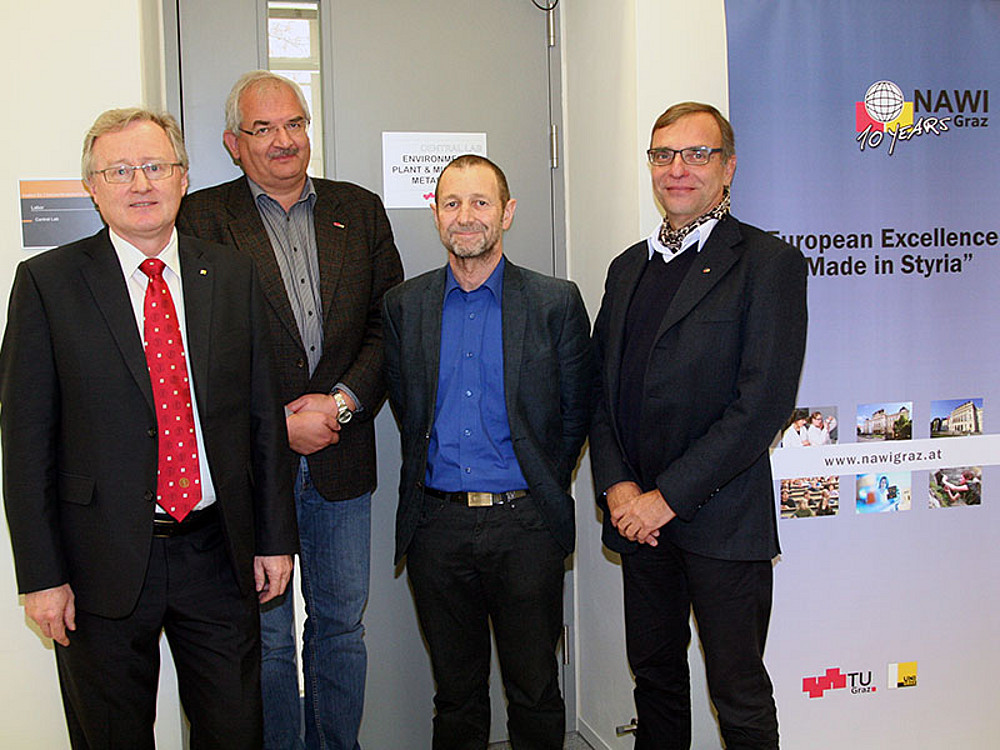
Rudolf Bauer, Leiter des Instituts für Pharmazeutische Wissenschaften, NAWI-Graz-Dekan Frank Uhlig, Kevin Francesconi, Leiter des Instituts für Chemie, und NAWI-Graz-Dekan Martin Mittelbach (v.l.). Foto: Uni Graz/Pichler

Rudolf Bauer, Leiter des Instituts für Pharmazeutische Wissenschaften, NAWI-Graz-Dekan Frank Uhlig, Kevin Francesconi, Leiter des Instituts für Chemie, und NAWI-Graz-Dekan Martin Mittelbach (v.l.). Foto: Uni Graz/Pichler

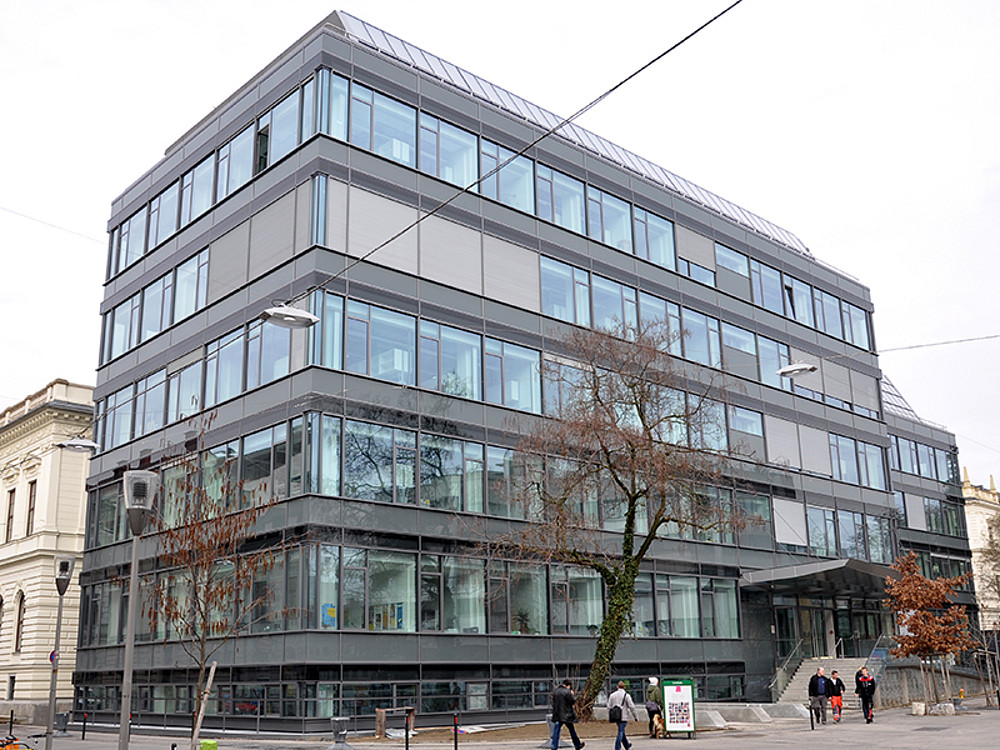
Das top-moderne Laborgebäude am Universitätsplatz 1 bietet optimale Rahmenbedingungen für Forschung und Lehre. Foto: Uni Graz/Tzivanopoulos

Das top-moderne Laborgebäude am Universitätsplatz 1 bietet optimale Rahmenbedingungen für Forschung und Lehre. Foto: Uni Graz/Tzivanopoulos

NAWI Graz Central Lab for Metabolomics bündelt Forschung von Uni Graz und TU Graz

Die Erforschung der chemischen Strukturen von pflanzlichen und mikrobiellen Inhaltsstoffen sowie deren biologische Wirkung und Auswirkung auf die Umwelt stehen im Mittelpunkt der wissenschaftlichen Arbeit des „NAWI Graz Central Lab for Environmental, Plant & Microbial Metabolomics“, das heute, am 12. November 2014, am Universitätsplatz 1 feierlich eröffnet wurde. Unter der Leitung von Univ.-Prof. Dr. Gabriele Berg (Institut für Umweltbiotechnologie der TU Graz) und Univ.-Prof. Dr. Kevin Francesconi (Institut für Chemie der Karl-Franzens-Universität) schafft die neue Einrichtung optimale Voraussetzungen für eine enge Zusammenarbeit zwischen ForscherInnen beider Universitäten. Herzstück der Infrastruktur ist ein hochauflösendes Massenspektrometer auf dem aktuellsten Stand der Technik. Damit sollen noch unbekannte, in der Natur vorkommende Moleküle untersucht und identifiziert werden. Das Gerät ist am Institut für Chemie der Uni Graz, am Universitätsplatz 1, aufgestellt und steht allen kooperierenden Arbeitsgruppen zur Verfügung.


„NAWI Graz macht es möglich, dass wir so ein Gerät anschaffen und betreiben können“, unterstrich Vizerektorin Renate Dworczak anlässlich der Eröffnung des Central Lab for Metabolomics die Bedeutung der strategischen Kooperation von Karl-Franzens-Universität und TU Graz in den Naturwissenschaften. „NAWI Graz zeigt vor, wie man an einem Standort zukunftsfähige Forschung betreiben kann“, so Dworczak.

Univ.-Prof. Dr. Nadia Mösch-Zanetti, die während der Generalsanierung des Gebäudes am Universitätsplatz 1 (2012–2014) Leiterin des dort ansässigen Instituts für Chemie gewesen war, ließ die Geschichte des Hauses Revue passieren. Von Prof. Leopold von Pebal (1826–1887) geplant und 1877/78 fertiggestellt, befand es sich damals auf dem aktuellsten Stand der Technik. Nach den jüngsten Umbauten präsentiert es sich heute erneut als top-modernes Laborgebäude, das beste Rahmenbedingungen für Forschung und Lehre bietet.

Univ.-Prof. Dr. Kevin Francesconi, Leiter des Instituts für Chemie, und Univ.-Prof. Dr. Rudolf Bauer, Leiter des Instituts für Pharmazeutische Wissenschaften der Uni Graz, gaben Einblicke in Forschungsbereiche des Central Lab for Metabolomics. Es ist eines von derzeit vier NAWI Graz Central Labs, die Forschungsinitiativen am Standort bündeln.


created by Gudrun Pichler

Related news

Jurassic Sounds: Biologist reconstructs insect songs from 165 million years ago

It was apparently not just the roars of the dinosaurs that made up the soundscape of the animal world during the Jurassic period. Crickets and grasshoppers communicated through a variety of songs and high-pitched sounds, as Thorin Jonsson from the Institute of Biology at the University of Graz discovered together with colleagues from the universities of Lincoln, Bristol (UK), Beijing (China) and Tempe (USA). The findings on what are so far the oldest traces of sound on Earth have just been published in the journal PNAS.

EU funding boosts international exchange between universities

The University of Graz is further expanding its international study opportunities through the European university alliance Arqus and is taking the lead in two key projects. In future, students will benefit from even more joint degree programmes and from simplified recognition of academic achievements through the Joint European Degree Label.

Rescue and risks: Researchers have surveyed public perceptions of AI

The use of artificial intelligence has had to be made transparent since 2 August 2026. The EU’s AI Act, which has been in force since then, also sets out how risky an application is and which security measures apply as a result. However, the assessment of risks by the legislation differs in some cases significantly from the perceptions of the Austrian public. This is the finding of a representative study carried out by data scientist Stefan Thalmann from the University of Graz and his team.

The Healing Sea: Researchers discover new approaches to treating chronic inflammation in sponges

Chronic inflammation plays a key role in many diseases, ranging from metabolic disorders and cardiovascular diseases to tissue damage following injuries or infections. “Normally, the body is able to resolve inflammation on its own. If this process becomes unbalanced, immune cells remain permanently active and continue to drive negative changes in the tissue,” explains Andreas Koeberle, a pharmacist at the University of Graz.

Begin of page section:
Additional information:

University of Graz
Universitaetsplatz 3
8010 Graz
Austria
  • Contact
  • Web Editors
  • Moodle
  • UNIGRAZonline
  • Imprint
  • Data Protection Declaration
  • Accessibility Declaration
Weatherstation
Uni Graz

End of this page section. Go to overview of page sections

End of this page section. Go to overview of page sections

Begin of page section:

End of this page section. Go to overview of page sections