Begin of page section:
Page sections:

  • Go to contents (Accesskey 1)
  • Go to position marker (Accesskey 2)
  • Go to main navigation (Accesskey 3)
  • Go to sub navigation (Accesskey 4)
  • Go to additional information (Accesskey 5)
  • Go to page settings (user/language) (Accesskey 8)
  • Go to search (Accesskey 9)

End of this page section. Go to overview of page sections

Begin of page section:
Page settings:

English en
Deutsch de
Search
Login

End of this page section. Go to overview of page sections

Begin of page section:
Search:

Search for details about Uni Graz
Close

End of this page section. Go to overview of page sections


Search

Begin of page section:
Main navigation:

Page navigation:

  • University

    University
    • About the University
    • Organisation
    • Faculties
    • Library
    • Working at University of Graz
    • Campus
    Developing solutions for the world of tomorrow - that is our mission. Our students and our researchers take on the great challenges of society and carry the knowledge out.
  • Research Profile

    Research Profile
    • Our Expertise
    • Research Questions
    • Research Portal
    • Promoting Research
    • Research Transfer
    • Ethics in Research
    Scientific excellence and the courage to break new ground. Research at the University of Graz creates the foundations for making the future worth living.
  • Studies

    Studies
    • Prospective Students
    • Students
  • Community

    Community
    • International
    • Location
    • Research and Business
    • Alumni
    The University of Graz is a hub for international research and brings together scientists and business experts. Moreover, it fosters the exchange and cooperation in study and teaching.
  • Spotlight
Topics
  • Our digital Advent calendar
  • Sustainable University
  • Researchers answer
  • Work for us
Close menu

End of this page section. Go to overview of page sections

Begin of page section:
You are here:

University of Graz News Cell division as a Rubik's Cube: how a viable organism emerges from random disorder

End of this page section. Go to overview of page sections

Friday, 11 October 2024

Cell division as a Rubik's Cube: how a viable organism emerges from random disorder

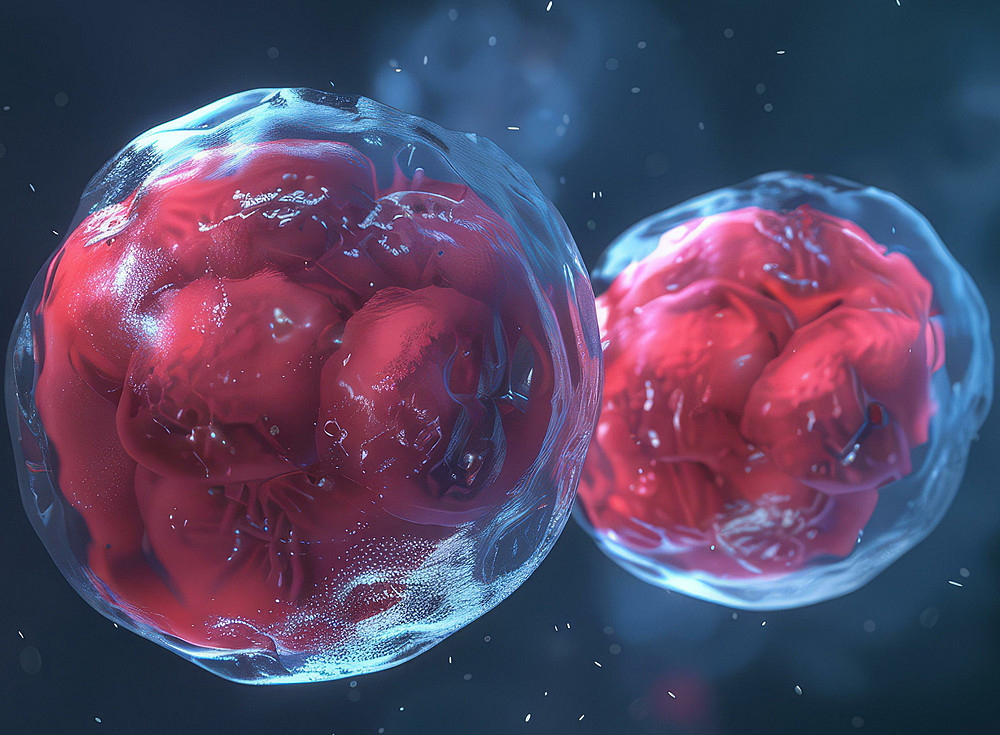
Division of human cells in the early stages ©Rostislav – stock.adobe.com

The first stages of cell division are characterised by random disorder. Only at the end of the 8-cell stage does a very specific configuration dominate, offering optimal conditions for further development. Photo: Rostislav - stock.adobe.com

Whether fly, mouse or human: the development of an organism from a single cell is one of the most astonishing phenomena in nature. Many different processes overlap, some of which are chaotic. A research team led by scientists from the Hubrecht Institute in the Netherlands, the Institute of Science and Technology Austria and the University of Graz investigated the early stages of cell division in mammals. They were able to show that – like a Rubik's cube – a precisely assembled complex emerges from random disorder. The results of their work were published in Science.

In their study, the researchers looked at the first cell divisions after the fertilisation of an egg cell in mice and rabbits. They found that this process takes place differently from time to time, both temporally and spatially, until the end of the 8-cell stage. “The rate of stem cell doubling varies randomly across generations. Sometimes it happens faster, sometimes it takes a little longer,” reports Bernat Corominas Murtra, assistant professor at the Department of Biology and in the field of excellence COLIBRI (Complexity of Life in Basic Research and Innovation) at the University of Graz.

The geometric structure did not appear to follow a plan at first either. “After dividing, the cells gathered together to form different shapes. Only by the end of the 8-cell stage, after completion of the so-called compaction process, one configuration became overwhelmingly dominant,” the scientist describes the development. The study authors were able to show that this specific arrangement was optimal, providing the right conditions for the subsequent cell divisions leading to the 16-cell stage. “There, the correct ratio of inner to outer cells is essential for the developing organism’s viability: Inner cells will lead to the organism itself, while outer cells form the placenta and extra-embryonic material,” explains Corominas Murtra.


Disorder as a driving force

It's like Rubik's Cube: Randomly arranged cells are shifted to form a whole according to plan. But how does the embryo solve this task? “The answer lies in fundamental principles of physics and mathematics,” says Corominas Murtra: “A genetically encoded slight increase in cell adhesion, coupled with significant random fluctuations in cell positions – disorder – paradoxically facilitates the transition from any arbitrary packing of cells to a single optimal configuration,” explains the physicist.

This interpretation paves the way for a new understanding on how complex geometries and, in general, organisation patterns arise in living beings. “Disorder, therefore, far from being a problem the system has to deal with, may be one of the leading forces driving the precision of organism development,” emphasises Corominas Murtra.

Publication
Temporal variability and cell mechanics control robustness in mammalian embryogenesis
Dimitri Fabrèges, Takashi Hiiragi, Edouard Hannezo, Bernat Corominas Murtra
Science, 10.10.2024, DOI 10.1126/science.adh1145
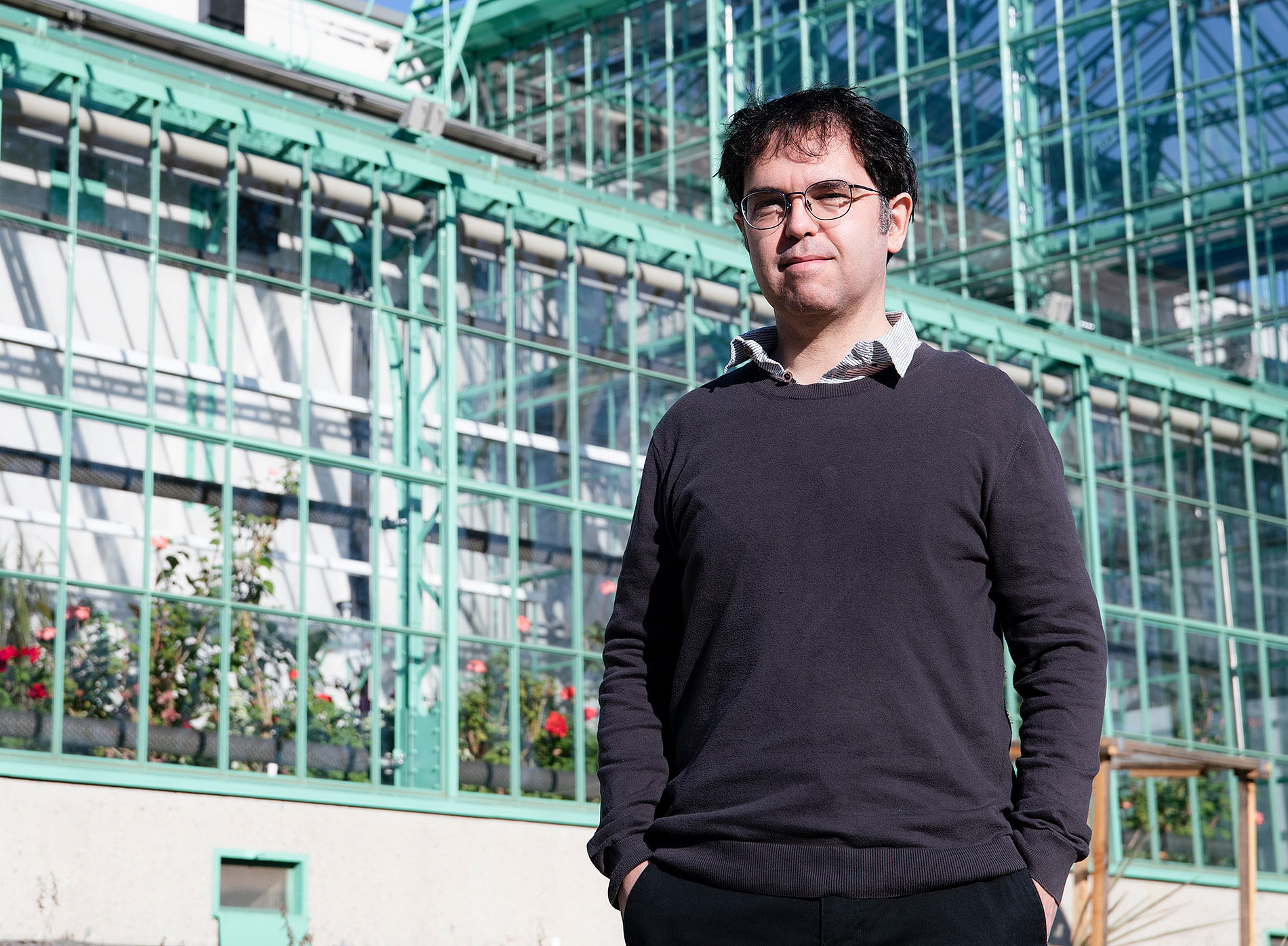
Bernat Corominas Murtra in front of the old greenhouse in the Botanical Garden of the University of Graz ©Uni Graz/Tzivanopoulos
©Uni Graz/Tzivanopoulos
Bernat Corominas Murtra conducts research in COLIBRI (Complexity of Life in Basic Research and Innovation), a field of excellence at the University of Graz. Photo: Uni Graz/Tzivanopoulos
created by Gudrun Pichler

Related news

Chemical Christmas show at the University of Graz: An explosive evening at the Schauspielh

At the beginning of December, the University of Graz transformed the theater into a laboratory: as part of “Chemical Life,” teacher training students staged a chemical Christmas show for Styrian school classes—complete with ethanol rockets, nitrogen snow, and glowing effects. An evening designed to inspire interest in studying chemistry.

Train by train: Koralm railway accelerates exchange between the Universities

Lectures at the University of Klagenfurt in the morning, seminars at the University of Graz in the afternoon: Austria's longest tunnel and a journey time of around 45 minutes make it easy. The Koralm railway increases the speed of networking between the two university locations. The collaboration builds on existing cooperation - for example in the areas of teacher training, Slavic studies and as employers, the universities are well coordinated.

On the trail of the Big Bang: University of Graz receives 1.5 million euros for doctoral programmes

The Austrian Science Fund FWF has selected the Doctoral Programme in Theoretical Particle Physics at the University of Graz for funding from the Doc.funds. Six young scientists will be funded for 3.5 years. They will gain fundamentally new insights into the origins of the world.

From trans women and knee prostheses: sports science prizes awarded

Walking better with a prosthesis, successfully getting rid of excess weight, training more effectively, more fairness for trans people in sport: these were the topics addressed by the students at the University of Graz who were awarded the sports science prizes for their Master's theses on 3 December 2025.

Begin of page section:
Additional information:

University of Graz
Universitaetsplatz 3
8010 Graz
Austria
  • Contact
  • Web Editors
  • Moodle
  • UNIGRAZonline
  • Imprint
  • Data Protection Declaration
  • Accessibility Declaration
Weatherstation
Uni Graz

End of this page section. Go to overview of page sections

End of this page section. Go to overview of page sections

Begin of page section:

End of this page section. Go to overview of page sections