



Begin of page section:
Page sections:

  • Go to contents (Accesskey 1)
  • Go to position marker (Accesskey 2)
  • Go to main navigation (Accesskey 3)
  • Go to sub navigation (Accesskey 4)
  • Go to additional information (Accesskey 5)
  • Go to page settings (user/language) (Accesskey 8)
  • Go to search (Accesskey 9)

End of this page section. Go to overview of page sections

Begin of page section:
Page settings:

English en
Deutsch de
Search
Login

End of this page section. Go to overview of page sections

Begin of page section:
Search:

Search for details about Uni Graz
Close

End of this page section. Go to overview of page sections


Search

Begin of page section:
Main navigation:

Page navigation:

  • University

    University
    • About the University
    • Organisation
    • Faculties
    • Library
    • Working at University of Graz
    • Campus
    Developing solutions for the world of tomorrow - that is our mission. Our students and our researchers take on the great challenges of society and carry the knowledge out.
  • Research Profile

    Research Profile
    • Our Expertise
    • Research Questions
    • Research Portal
    • Promoting Research
    • Research Transfer
    • Ethics in Research
    • Commission for Scientific Integrity
    Scientific excellence and the courage to break new ground. Research at the University of Graz creates the foundations for making the future worth living.
  • Studies

    Studies
    • Prospective Students
    • Students
    • Welcome Weeks for First Year Students
  • Community

    Community
    • International
    • Location
    • Research and Business
    • Alumni
    The University of Graz is a hub for international research and brings together scientists and business experts. Moreover, it fosters the exchange and cooperation in study and teaching.
Topics
  • Sustainable University
  • Researchers answer
  • Work for us
Close menu

End of this page section. Go to overview of page sections

Begin of page section:
You are here:

University of Graz News Bombenkrieg in Graz

End of this page section. Go to overview of page sections

Monday, 05 December 2016

Bombenkrieg in Graz

Ein Gedenkstein in Straßgang erinnert an dort verübte Fliegerlynchjustiz. Dieses Denkmal soll neu gestaltet werden. Foto: Hoffmann.

Ein Gedenkstein in Straßgang erinnert an dort verübte Fliegerlynchjustiz. Dieses Denkmal soll neu gestaltet werden. Foto: Hoffmann.

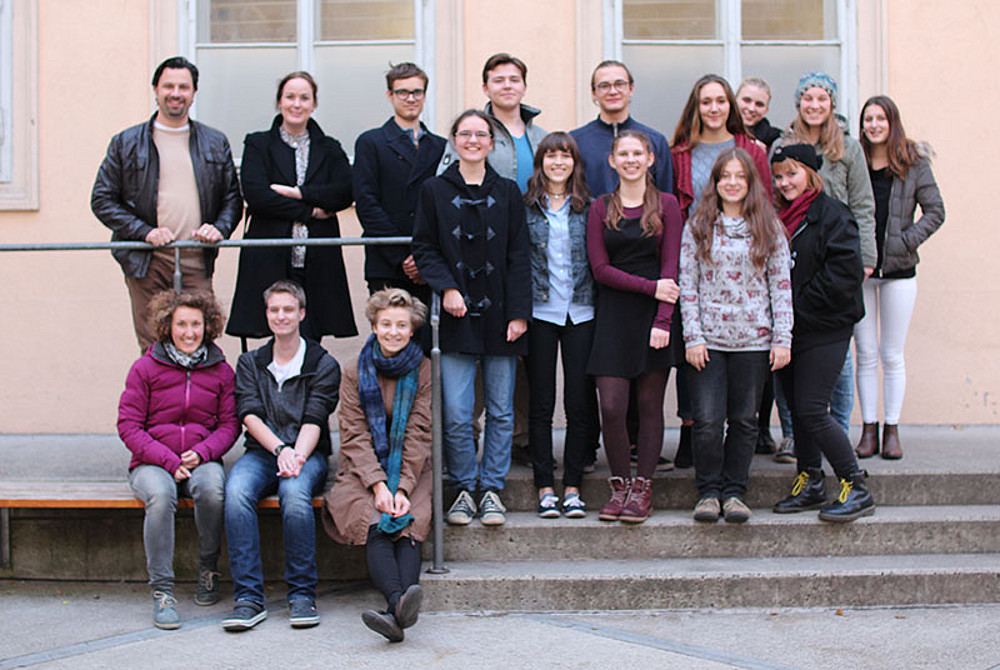
Die SchülerInnen der KLEX mit den Historikerinnen Georg Hoffmann und Nicole-Melanie Goll (hintere Reihe, 1. und 2.v.l.). Foto: KLEX.

Die SchülerInnen der KLEX mit den Historikerinnen Georg Hoffmann und Nicole-Melanie Goll (hintere Reihe, 1. und 2.v.l.). Foto: KLEX.

SchülerInnen gestalten mit HistorikerInnen der Uni Graz Ausstellung; Eröffnung morgen, 6. Dezember 2016

Mehr als 70 Jahre nach Ende des Zweiten Weltkriegs sind die alliierten Bombenangriffe gegen das nationalsozialistische Deutsche Reich nach wie vor ein umstrittenes, emotional diskutiertes Thema. „Bis heute prägen konstruierte Feindbilder sowie Zuschreibungen von Opfern und Tätern die Debatte und sorgen für vermeintliche Unversöhnlichkeiten zwischen den Generationen“, erklärt Dr. Georg Hoffmann vom Institut für Geschichte der Karl-Franzens-Universität Graz. Den Bombenkrieg in Graz haben SchülerInnen der KLEX-Schule (Klusemann Extern) nun mit Unterstützung von Hoffmann und dessen Kollegin Dr. Nicole-Melanie Goll neu aufgerollt. Im Rahmen einer Ausstellung, die morgen, am 6. Dezember 2016, um 10 Uhr in der Stadtbibliothek eröffnet wird, zeichnen die SchülerInnen Spuren und Erinnerungszeichen nach, die der Bombenkrieg in der steirischen Landeshauptstadt hinterlassen hat.

Im Dialog mit ZeitzeugInnen diskutierten die SchülerInnen, warum der Bombenkrieg noch heute ein emotional aufgeladenes Thema ist und wie an diesen erinnert wird. Dabei wurde auch die Entstehung von Gewalt, wie etwa die Lynchjustiz an alliierten Flugzeugbesatzungen, untersucht. „Auch die Frage, wie diese Gewalt über die Erinnerung an den Bombenkrieg bis heute legitimiert wird, war Teil des Projekts“, erklärt Hoffmann. Mit ehemaligen amerikanischen Fliegern tauschten sich die Jugendlichen mittels Videobotschaften aus. Die Ergebnisse wurde auf sieben Schautafeln komprimiert: „Dabei wird der Bogen vom Schloßbergstollen – als Schutz-, Flucht- aber auch Ausgrenzungsort im Bombenkrieg – bis hin zur Ermordung amerikanischer Flieger in Graz-Straßgang gespannt“, fasst Goll zusammen. Das Schicksal afro-amerikanischer Crew-Mitglieder, die aufgrund der Rassentrennung in den USA ausgegrenzt und nach dem Abschuss ihrer Maschinen auf besonders brutale Weise Opfer nationalsozialistischer Gewalt wurden, ist ebenfalls ein Schwerpunkt der Ausstellung. „Ziel des Projekts ist die Analyse gesellschaftlicher Erinnerungskultur zum Bombenkrieg und die Untersuchung der Frage, wie sich diese Erinnerung als Konfliktfeld im kollektiven Gedächtnis niederschlägt“, unterstreichen die beiden HistorikerInnen.

Hintergrund und Basis der Ausstellung ist das Forschungsprojekt „Gedächtnisort Bombenkrieg“, das am Institut für Geschichte der Uni Graz angesiedelt ist und vom Land Steiermark sowie vom Zukunftsfonds der Republik Österreich finanziert wird.

Ausstellung „BiG – Bombenkrieg in Graz“
Eröffnung: Dienstag, 6. Dezember 2016, um 10 Uhr
Ort: Stadtbibliothek Graz, Kernstockgasse 2, 8020 Graz
Dauer der Ausstellung: 6. Dezember 2016 bis 22. Dezember 2016


Freier Eintritt

created by Gerhild Kastrun

Related news

University of Graz: Working together to make Styria a sustainable centre of learning

Round table calls for sustainable funding for the 2028–2030 performance agreement period between the five Styrian universities and the federal government.

How can we teach using YouTube and AI? The University of Graz is strengthening media education in schools

A journey through the blood vessels using VR headsets brings biology lessons to life. An interactive quiz brings physics to life. The YouTube video explains the First World War. Whilst mobile phones are increasingly being banned from the classroom, social media platforms, apps and AI are playing an ever-greater role in knowledge transfer at school. But how can teaching with media be made even more effective? What are the challenges in media-based teaching? At the University of Graz, researchers are discussing these issues at a conference being held in Austria for the first time.

Jurassic Sounds: Biologist reconstructs insect songs from 165 million years ago

It was apparently not just the roars of the dinosaurs that made up the soundscape of the animal world during the Jurassic period. Crickets and grasshoppers communicated through a variety of songs and high-pitched sounds, as Thorin Jonsson from the Institute of Biology at the University of Graz discovered together with colleagues from the universities of Lincoln, Bristol (UK), Beijing (China) and Tempe (USA). The findings on what are so far the oldest traces of sound on Earth have just been published in the journal PNAS.

EU funding boosts international exchange between universities

The University of Graz is further expanding its international study opportunities through the European university alliance Arqus and is taking the lead in two key projects. In future, students will benefit from even more joint degree programmes and from simplified recognition of academic achievements through the Joint European Degree Label.

Begin of page section:
Additional information:

University of Graz
Universitaetsplatz 3
8010 Graz
Austria
  • Contact
  • Web Editors
  • Moodle
  • UNIGRAZonline
  • Imprint
  • Data Protection Declaration
  • Accessibility Declaration
Weatherstation
Uni Graz

End of this page section. Go to overview of page sections

End of this page section. Go to overview of page sections

Begin of page section:

End of this page section. Go to overview of page sections