Begin of page section:
Page sections:

  • Go to contents (Accesskey 1)
  • Go to position marker (Accesskey 2)
  • Go to main navigation (Accesskey 3)
  • Go to sub navigation (Accesskey 4)
  • Go to additional information (Accesskey 5)
  • Go to page settings (user/language) (Accesskey 8)
  • Go to search (Accesskey 9)

End of this page section. Go to overview of page sections

Begin of page section:
Page settings:

English en
Deutsch de
Search
Login

End of this page section. Go to overview of page sections

Begin of page section:
Search:

Search for details about Uni Graz
Close

End of this page section. Go to overview of page sections


Search

Begin of page section:
Main navigation:

Page navigation:

  • University

    University
    • About the University
    • Organisation
    • Faculties
    • Library
    • Working at University of Graz
    • Campus
    Developing solutions for the world of tomorrow - that is our mission. Our students and our researchers take on the great challenges of society and carry the knowledge out.
  • Research Profile

    Research Profile
    • Our Expertise
    • Research Questions
    • Research Portal
    • Promoting Research
    • Research Transfer
    • Ethics in Research
    • Commission for Scientific Integrity
    Scientific excellence and the courage to break new ground. Research at the University of Graz creates the foundations for making the future worth living.
  • Studies

    Studies
    • Prospective Students
    • Students
  • Community

    Community
    • International
    • Location
    • Research and Business
    • Alumni
    The University of Graz is a hub for international research and brings together scientists and business experts. Moreover, it fosters the exchange and cooperation in study and teaching.
  • Spotlight
Topics
  • Sustainable University
  • Researchers answer
  • Work for us
Close menu

End of this page section. Go to overview of page sections

Begin of page section:
You are here:

University of Graz News Bombenkrieg in Graz

End of this page section. Go to overview of page sections

Monday, 05 December 2016

Bombenkrieg in Graz

Ein Gedenkstein in Straßgang erinnert an dort verübte Fliegerlynchjustiz. Dieses Denkmal soll neu gestaltet werden. Foto: Hoffmann.

Ein Gedenkstein in Straßgang erinnert an dort verübte Fliegerlynchjustiz. Dieses Denkmal soll neu gestaltet werden. Foto: Hoffmann.

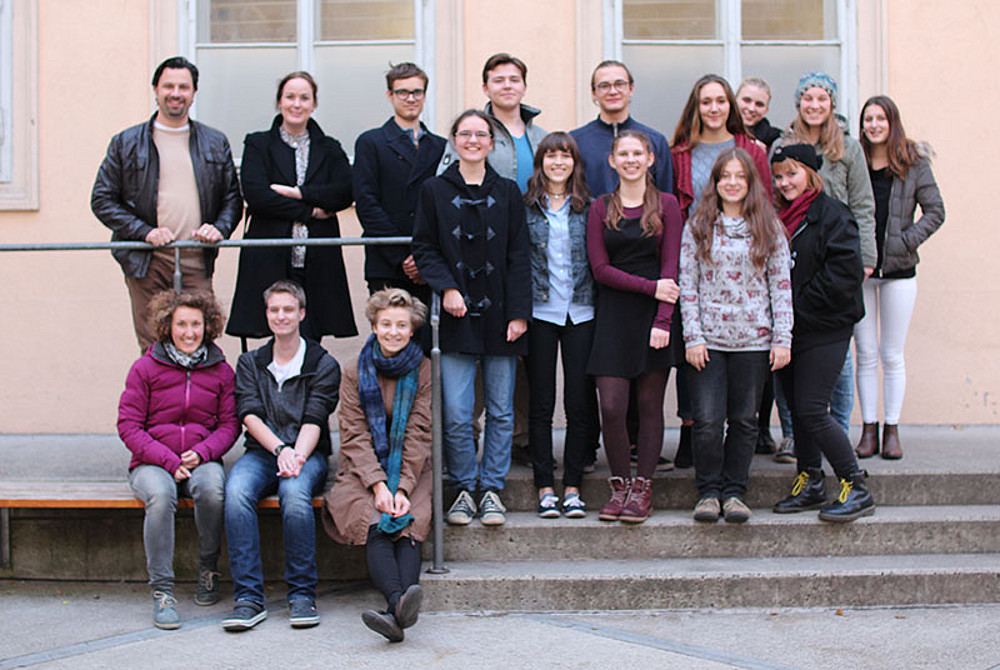
Die SchülerInnen der KLEX mit den Historikerinnen Georg Hoffmann und Nicole-Melanie Goll (hintere Reihe, 1. und 2.v.l.). Foto: KLEX.

Die SchülerInnen der KLEX mit den Historikerinnen Georg Hoffmann und Nicole-Melanie Goll (hintere Reihe, 1. und 2.v.l.). Foto: KLEX.

SchülerInnen gestalten mit HistorikerInnen der Uni Graz Ausstellung; Eröffnung morgen, 6. Dezember 2016

Mehr als 70 Jahre nach Ende des Zweiten Weltkriegs sind die alliierten Bombenangriffe gegen das nationalsozialistische Deutsche Reich nach wie vor ein umstrittenes, emotional diskutiertes Thema. „Bis heute prägen konstruierte Feindbilder sowie Zuschreibungen von Opfern und Tätern die Debatte und sorgen für vermeintliche Unversöhnlichkeiten zwischen den Generationen“, erklärt Dr. Georg Hoffmann vom Institut für Geschichte der Karl-Franzens-Universität Graz. Den Bombenkrieg in Graz haben SchülerInnen der KLEX-Schule (Klusemann Extern) nun mit Unterstützung von Hoffmann und dessen Kollegin Dr. Nicole-Melanie Goll neu aufgerollt. Im Rahmen einer Ausstellung, die morgen, am 6. Dezember 2016, um 10 Uhr in der Stadtbibliothek eröffnet wird, zeichnen die SchülerInnen Spuren und Erinnerungszeichen nach, die der Bombenkrieg in der steirischen Landeshauptstadt hinterlassen hat.

Im Dialog mit ZeitzeugInnen diskutierten die SchülerInnen, warum der Bombenkrieg noch heute ein emotional aufgeladenes Thema ist und wie an diesen erinnert wird. Dabei wurde auch die Entstehung von Gewalt, wie etwa die Lynchjustiz an alliierten Flugzeugbesatzungen, untersucht. „Auch die Frage, wie diese Gewalt über die Erinnerung an den Bombenkrieg bis heute legitimiert wird, war Teil des Projekts“, erklärt Hoffmann. Mit ehemaligen amerikanischen Fliegern tauschten sich die Jugendlichen mittels Videobotschaften aus. Die Ergebnisse wurde auf sieben Schautafeln komprimiert: „Dabei wird der Bogen vom Schloßbergstollen – als Schutz-, Flucht- aber auch Ausgrenzungsort im Bombenkrieg – bis hin zur Ermordung amerikanischer Flieger in Graz-Straßgang gespannt“, fasst Goll zusammen. Das Schicksal afro-amerikanischer Crew-Mitglieder, die aufgrund der Rassentrennung in den USA ausgegrenzt und nach dem Abschuss ihrer Maschinen auf besonders brutale Weise Opfer nationalsozialistischer Gewalt wurden, ist ebenfalls ein Schwerpunkt der Ausstellung. „Ziel des Projekts ist die Analyse gesellschaftlicher Erinnerungskultur zum Bombenkrieg und die Untersuchung der Frage, wie sich diese Erinnerung als Konfliktfeld im kollektiven Gedächtnis niederschlägt“, unterstreichen die beiden HistorikerInnen.

Hintergrund und Basis der Ausstellung ist das Forschungsprojekt „Gedächtnisort Bombenkrieg“, das am Institut für Geschichte der Uni Graz angesiedelt ist und vom Land Steiermark sowie vom Zukunftsfonds der Republik Österreich finanziert wird.

Ausstellung „BiG – Bombenkrieg in Graz“
Eröffnung: Dienstag, 6. Dezember 2016, um 10 Uhr
Ort: Stadtbibliothek Graz, Kernstockgasse 2, 8020 Graz
Dauer der Ausstellung: 6. Dezember 2016 bis 22. Dezember 2016


Freier Eintritt

created by Gerhild Kastrun

Related news

Studying at the University of Graz: How to enrol

Ready for a new chapter in your life with the start of your studies at the University of Graz in the winter semester 2026/27? Here you will find information on deadlines, admission procedures, registration, and everything else you need to successfully start your studies in the fall.

Interpreting data: Why studies sometimes get it wrong

Hilmar Brohmer and Ziva Korda from the Institute of Psychology, together with 500 international colleagues, have re-evaluated a hundred scientific publications and have often come to different conclusions.

Crystal-clear: AI method revolutionises solar observation

The Sun makes life on Earth possible. However, its magnetic fields can also cause massive disruption. This makes it all the more important to gain a better understanding of the processes taking place on our nearest star. A research team from the University of Graz and the High Altitude Observatory in Boulder (USA) has succeeded in doing just that. The astrophysicists have developed an AI-supported method that makes even the smallest structures on the Sun visible. The scientists are convinced that this will bring about a lasting change in solar observation and that the new method can be used for the planned European Solar Telescope.

Long Night of Research: How many languages are there in the world?

From a linguistic perspective, there are worlds of difference between Bern, Berlin and Vienna. A dialect impersonator will demonstrate live just how varied German can sound. How many languages are there in the world? What are their distinctive features? Which of these are spoken in Austria? These and other questions will be answered during the Long Night of Research at the University of Graz: on Friday, 24 April 2025, from 5 pm to 11 pm, in the University Library. Visitors can immerse themselves in the diversity of languages without travelling far by taking part in a quiz at the station.

Begin of page section:
Additional information:

University of Graz
Universitaetsplatz 3
8010 Graz
Austria
  • Contact
  • Web Editors
  • Moodle
  • UNIGRAZonline
  • Imprint
  • Data Protection Declaration
  • Accessibility Declaration
Weatherstation
Uni Graz

End of this page section. Go to overview of page sections

End of this page section. Go to overview of page sections

Begin of page section:

End of this page section. Go to overview of page sections