Begin of page section:
Page sections:

  • Go to contents (Accesskey 1)
  • Go to position marker (Accesskey 2)
  • Go to main navigation (Accesskey 3)
  • Go to sub navigation (Accesskey 4)
  • Go to additional information (Accesskey 5)
  • Go to page settings (user/language) (Accesskey 8)
  • Go to search (Accesskey 9)

End of this page section. Go to overview of page sections

Begin of page section:
Page settings:

English en
Deutsch de
Search
Login

End of this page section. Go to overview of page sections

Begin of page section:
Search:

Search for details about Uni Graz
Close

End of this page section. Go to overview of page sections


Search

Begin of page section:
Main navigation:

Page navigation:

  • University

    University
    • About the University
    • Organisation
    • Faculties
    • Library
    • Working at University of Graz
    • Campus
    Developing solutions for the world of tomorrow - that is our mission. Our students and our researchers take on the great challenges of society and carry the knowledge out.
  • Research Profile

    Research Profile
    • Our Expertise
    • Research Questions
    • Research Portal
    • Promoting Research
    • Research Transfer
    • Ethics in Research
    Scientific excellence and the courage to break new ground. Research at the University of Graz creates the foundations for making the future worth living.
  • Studies

    Studies
    • Prospective Students
    • Students
  • Community

    Community
    • International
    • Location
    • Research and Business
    • Alumni
    The University of Graz is a hub for international research and brings together scientists and business experts. Moreover, it fosters the exchange and cooperation in study and teaching.
  • Spotlight
Topics
  • Our digital Advent calendar
  • Sustainable University
  • Researchers answer
  • Work for us
Close menu

End of this page section. Go to overview of page sections

Begin of page section:
You are here:

University of Graz News Blick in Blackbox

End of this page section. Go to overview of page sections

Thursday, 21 April 2022

Blick in Blackbox

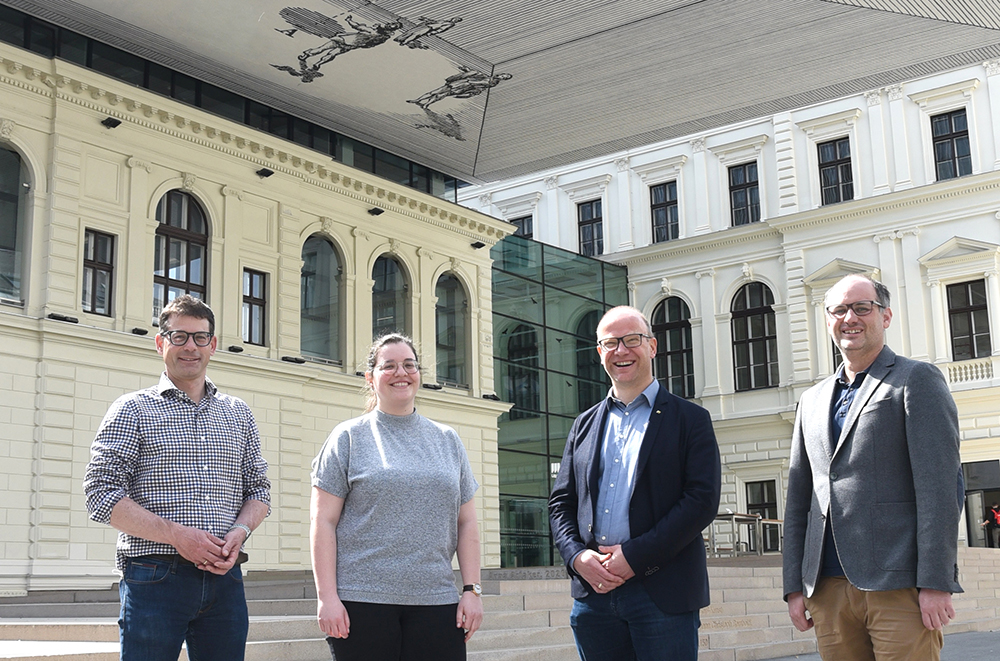
Wissenschaft wirkt in die Praxis: Christoph Koeth, Director Innovation von Fresenius Kabi, Doktorandin Anna Polzer, Projektleiter Stefan Thalmann und Jürgen Fleiß vom Business Analytics and Data Science-Center der Uni Graz (v. l.) ©Uni Graz/Schweiger

Wissenschaft wirkt in die Praxis: Christoph Koeth, Director Innovation von Fresenius Kabi, Doktorandin Anna Polzer, Projektleiter Stefan Thalmann und Jürgen Fleiß vom Business Analytics and Data Science-Center der Uni Graz (v. l.) Foto: Uni Graz/Schweiger

Uni Graz überprüft die Arbeit von künstlicher Intelligenz in der Pharmaproduktion

In der Produktion von Medikamenten kann Qualitätskontrolle über Leben und Tod bestimmen. Was passiert, wenn künstliche Intelligenz (KI) diese hochsensible Aufgabe übernimmt? WirtschaftsinformatikerInnen der Universität Graz überprüften, ob die erforderlichen Standards gewährleistet bleiben. Sie haben erstmals an einem Beispiel der Pharmaproduktion nachgewiesen, dass automatisierte Entscheidung die Anforderung erfüllt.

Die Maschine denkt. Doch tut sie das zuverlässig? Können wir ihr wirklich vertrauen? Und lässt sich ihre Tätigkeit zertifizieren? Das untersuchten ForscherInnen der Universität Graz in einer Kooperation mit dem Gesundheits-Unternehmen Fresenius Kabi Austria. „Künstliche Intelligenz soll automatisiert überprüfen, ob relevante Qualitätskriterien erfüllt sind oder Arzneimittel aus dem Prozess entfernt und verworfen werden müssen“, schildert Stefan Thalmann, Leiter des Business Analytics and Data Science-Center an der Uni Graz, die Ausgangslage. 

Der Einsatz von Software in solchen sensiblen Bereichen unterliegt Richtlinien und muss zertifiziert werden. KI nimmt jedoch eine Sonderstellung ein, da – abseits von einem Regulierungsentwurf der EU – aktuell keine Ansätze für die Zertifizierung vorhanden sind. „Denn die Technologie lernt selbstständig Entscheidungsregeln aus vergangenen Beurteilungen, die Menschen getroffen haben und die in den sogenannten Trainingsdaten abgebildet sind“, fasst der Wissenschafter zusammen.

In der Zusammenarbeit mit Fresenius Kabi ging es darum, den Prüfvorgang von sensiblen Medikamenten mit Hilfe einer KI unter die Lupe zu nehmen. Den Haken beschreibt Thalmann: „KI wird zur Blackbox, denn wir kennen diese Regeln nicht und wissen somit nicht, worauf sich die automatisierte Entscheidung begründet.“ Der Wirtschaftsinformatiker erklärt: „Wir setzten spezielle Erklär-Komponenten ein und mit künstlichen Sonderfällen wurde die KI gewissermaßen herausgefordert.“ In der Folge konnten so die Modelle verstanden und Ergebnisse besser nachvollzogen werden. Erstmals ist es damit WissenschafterInnen der Uni Graz gelungen, den Einsatz künstlicher Intelligenz im Pharmaumfeld zu zertifizieren. Stefan Thalmann: „Das Projekt zeigt, wie der KI-Regulierungsvorschlag der EU in der Praxis umgesetzt werden kann.“


Die Ergebnisse wurden in einem Fachjournal veröffentlicht.

Im Rahmen des Profilbereichs Smart Regulation arbeitet Stefan Thalmann interdisziplinär mit JuristInnen, PsychologInnen und EthikerInnen an diesem Thema weiter. 

created by Andreas Schweiger

Related news

Semester abroad without barriers: University of Graz wins award for promoting inclusion

The University of Graz has been awarded the Internationalization Award for its new inclusion initiative. Students with fewer opportunities now also receive financial support for their semester abroad outside Europe.

Fair distribution: Researchers determine just greenhouse gas budgets for all EU regions

Ten years ago, on 12 December 2015, the Paris Climate Agreement was signed at the UN Climate Conference. In order to limit global warming to well below two degrees, only a certain amount of CO2 may be emitted worldwide. While the focus was originally on national emission targets, more than 200 subnational regions and almost 300 cities have now adopted their own targets. But how many emissions are they fairly entitled to? Researchers at the University of Graz have now developed transparent criteria for fair distribution at the subnational level for the first time and determined corresponding greenhouse gas budgets for all European regions. The paper was published today in the scientific journal Nature Communications.

Chemical Christmas show at the University of Graz: An explosive evening at the Schauspielh

At the beginning of December, the University of Graz transformed the theater into a laboratory: as part of “Chemical Life,” teacher training students staged a chemical Christmas show for Styrian school classes—complete with ethanol rockets, nitrogen snow, and glowing effects. An evening designed to inspire interest in studying chemistry.

Train by train: Koralm railway accelerates exchange between the Universities

Lectures at the University of Klagenfurt in the morning, seminars at the University of Graz in the afternoon: Austria's longest tunnel and a journey time of around 45 minutes make it easy. The Koralm railway increases the speed of networking between the two university locations. The collaboration builds on existing cooperation - for example in the areas of teacher training, Slavic studies and as employers, the universities are well coordinated.

Begin of page section:
Additional information:

University of Graz
Universitaetsplatz 3
8010 Graz
Austria
  • Contact
  • Web Editors
  • Moodle
  • UNIGRAZonline
  • Imprint
  • Data Protection Declaration
  • Accessibility Declaration
Weatherstation
Uni Graz

End of this page section. Go to overview of page sections

End of this page section. Go to overview of page sections

Begin of page section:

End of this page section. Go to overview of page sections