Begin of page section:
Page sections:

  • Go to contents (Accesskey 1)
  • Go to position marker (Accesskey 2)
  • Go to main navigation (Accesskey 3)
  • Go to sub navigation (Accesskey 4)
  • Go to additional information (Accesskey 5)
  • Go to page settings (user/language) (Accesskey 8)
  • Go to search (Accesskey 9)

End of this page section. Go to overview of page sections

Begin of page section:
Page settings:

English en
Deutsch de
Search
Login

End of this page section. Go to overview of page sections

Begin of page section:
Search:

Search for details about Uni Graz
Close

End of this page section. Go to overview of page sections


Search

Begin of page section:
Main navigation:

Page navigation:

  • University

    University
    • About the University
    • Organisation
    • Faculties
    • Library
    • Working at University of Graz
    • Campus
    Developing solutions for the world of tomorrow - that is our mission. Our students and our researchers take on the great challenges of society and carry the knowledge out.
  • Research Profile

    Research Profile
    • Our Expertise
    • Research Questions
    • Research Portal
    • Promoting Research
    • Research Transfer
    • Ethics in Research
    • Commission for Scientific Integrity
    Scientific excellence and the courage to break new ground. Research at the University of Graz creates the foundations for making the future worth living.
  • Studies

    Studies
    • Prospective Students
    • Students
  • Community

    Community
    • International
    • Location
    • Research and Business
    • Alumni
    The University of Graz is a hub for international research and brings together scientists and business experts. Moreover, it fosters the exchange and cooperation in study and teaching.
  • Spotlight
Topics
  • Sustainable University
  • Researchers answer
  • Work for us
Close menu

End of this page section. Go to overview of page sections

Begin of page section:
You are here:

University of Graz News BioHealth

End of this page section. Go to overview of page sections

Tuesday, 07 March 2023

BioHealth

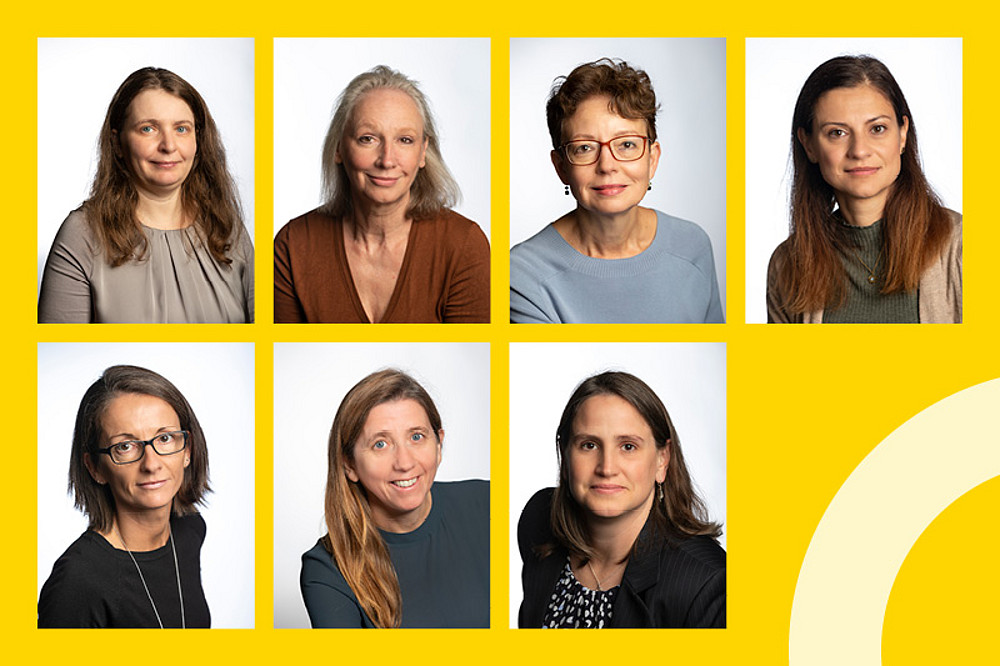
Obere Reihe v.l.: Brigitte Pertschy, Dagmar Zweytick, Ellen Zechner und Martina Schweiger. Untere Reihe v.l.: Mélanie Hall, Monika Oberer und Tea Pavkov-Keller. Im Profilbereich BioHealth forschen noch zehn Frauen als assoziierte Mitglieder. Alle Fotos: Uni Graz/Lunghammer.

Obere Reihe v.l.: Brigitte Pertschy, Dagmar Zweytick, Ellen Zechner und Martina Schweiger. Untere Reihe v.l.: Mélanie Hall, Monika Oberer und Tea Pavkov-Keller. Im Profilbereich BioHealth forschen noch zehn Frauen als assoziierte Mitglieder. Alle Fotos: Uni Graz/Lunghammer.

Sieben Frauen sind Vollmitglieder im Profilbereich "BioHealth" - zum Frauentag am 8. März 2023 stellen wir sie vor

Der Profilbereich BioHealth besteht aus einem Konsortium von Forscher:innen aus den Molekularen Biowissenschaften, der Chemie und der Pharmazie. Gemeinsam arbeiten die Wissenschaftler:innen am molekularen Verständnis von Krankheiten und deren Interventionen. Unter den Vollmitgliedern sind sieben Forscherinnen, die wir anlässlich des Frauentags am 8. März 2023 mit ausgewählten Meldungen in den Fokus rücken: 

Brigitte Pertschy weiß, wie der Bau von Ribosomen - das sind die Protein-Fabriken des Körpers - koordiniert wird

Dagmar Zweytick hat ein körpereigenes Molekül entdeckt, das im Labor Krebs­zellen zuverlässig abtötet 

Ellen Zechner untersucht mit ihrem Team, wie Bakterien-Kämpfe die Darmflora schwächen

Martina Schweiger legt die Grundlage, um den lebensbedrohlichen Gewichtsverlust bei Krebs zu bremsen

Mélanie Hall erforscht nachhaltigen Methoden der chemischen Synthese

Monika Oberer ist den Geheimnissen des Fettstofffwechsels auf der Spur

Tea Pavkov-Keller blickt in kleinste Zellstrukturen, um Krankheiten besser zu bekämpfen 


>> Mehr über BioHealth


Seven women are full members of the "BioHealth" Field of Excellence. We are introducing them on Women's Day on March 8, 2023.

The "BioHealth" Field of Excellence consists of a consortium of researchers from the molecular biosciences, chemistry and pharmacy. Together, the scientists work on the molecular understanding of diseases and their interventions. Among the full members are seven female researchers, whom we are spotlighting with selected news items on the occasion of Women's Day on March 8, 2023: 

Brigitte Pertschy knows how the construction of ribosomes - the body's protein factories - is coordinated

Dagmar Zweytick has discovered an endogenous molecule that reliably kills cancer cells in the lab 

Ellen Zechner and her team are investigating how bacterial battles weaken the intestinal flora

Martina Schweiger lays the groundwork to curb life-threatening weight loss in cancer

Mélanie Hall explores sustainable methods of chemical synthesis

Monika Oberer is on the trail of the secrets of fat metabolism

Tea Pavkov-Keller looks into the smallest cell structures to better combat diseases 
 

>> More about BioHealth


created by Gerhild Leljak

Related news

Around the world in eight stops: the Long Night of Research at the University of Graz

On 24 April from 5 pm, you can take a short trip around the globe at the University of Graz, discovering pecularities of foreign countries or new local features in the entrance hall of the University Library. The itinerary takes you through introduced animal species, political attitudes and the omnipotence of algorithms. There will also be a programme in the historic reading hall, as well as at the UniGraz@Museum and the University Archive.

Studying at the University of Graz: How to enrol

Ready for a new chapter in your life with the start of your studies at the University of Graz in the winter semester 2026/27? Here you will find information on deadlines, admission procedures, registration, and everything else you need to successfully start your studies in the fall.

Interpreting data: Why studies sometimes get it wrong

Hilmar Brohmer and Ziva Korda from the Institute of Psychology, together with 500 international colleagues, have re-evaluated a hundred scientific publications and have often come to different conclusions.

Crystal-clear: AI method revolutionises solar observation

The Sun makes life on Earth possible. However, its magnetic fields can also cause massive disruption. This makes it all the more important to gain a better understanding of the processes taking place on our nearest star. A research team from the University of Graz and the High Altitude Observatory in Boulder (USA) has succeeded in doing just that. The astrophysicists have developed an AI-supported method that makes even the smallest structures on the Sun visible. The scientists are convinced that this will bring about a lasting change in solar observation and that the new method can be used for the planned European Solar Telescope.

Begin of page section:
Additional information:

University of Graz
Universitaetsplatz 3
8010 Graz
Austria
  • Contact
  • Web Editors
  • Moodle
  • UNIGRAZonline
  • Imprint
  • Data Protection Declaration
  • Accessibility Declaration
Weatherstation
Uni Graz

End of this page section. Go to overview of page sections

End of this page section. Go to overview of page sections

Begin of page section:

End of this page section. Go to overview of page sections