Begin of page section:
Page sections:

  • Go to contents (Accesskey 1)
  • Go to position marker (Accesskey 2)
  • Go to main navigation (Accesskey 3)
  • Go to sub navigation (Accesskey 4)
  • Go to additional information (Accesskey 5)
  • Go to page settings (user/language) (Accesskey 8)
  • Go to search (Accesskey 9)

End of this page section. Go to overview of page sections

Begin of page section:
Page settings:

English en
Deutsch de
Search
Login

End of this page section. Go to overview of page sections

Begin of page section:
Search:

Search for details about Uni Graz
Close

End of this page section. Go to overview of page sections


Search

Begin of page section:
Main navigation:

Page navigation:

  • University

    University
    • About the University
    • Organisation
    • Faculties
    • Library
    • Working at University of Graz
    • Campus
    Developing solutions for the world of tomorrow - that is our mission. Our students and our researchers take on the great challenges of society and carry the knowledge out.
  • Research Profile

    Research Profile
    • Our Expertise
    • Research Questions
    • Research Portal
    • Promoting Research
    • Research Transfer
    • Ethics in Research
    Scientific excellence and the courage to break new ground. Research at the University of Graz creates the foundations for making the future worth living.
  • Studies

    Studies
    • Prospective Students
    • Students
  • Community

    Community
    • International
    • Location
    • Research and Business
    • Alumni
    The University of Graz is a hub for international research and brings together scientists and business experts. Moreover, it fosters the exchange and cooperation in study and teaching.
  • Spotlight
Topics
  • Our digital Advent calendar
  • Sustainable University
  • Researchers answer
  • Work for us
Close menu

End of this page section. Go to overview of page sections

Begin of page section:
You are here:

University of Graz News BioHealth

End of this page section. Go to overview of page sections

Tuesday, 07 March 2023

BioHealth

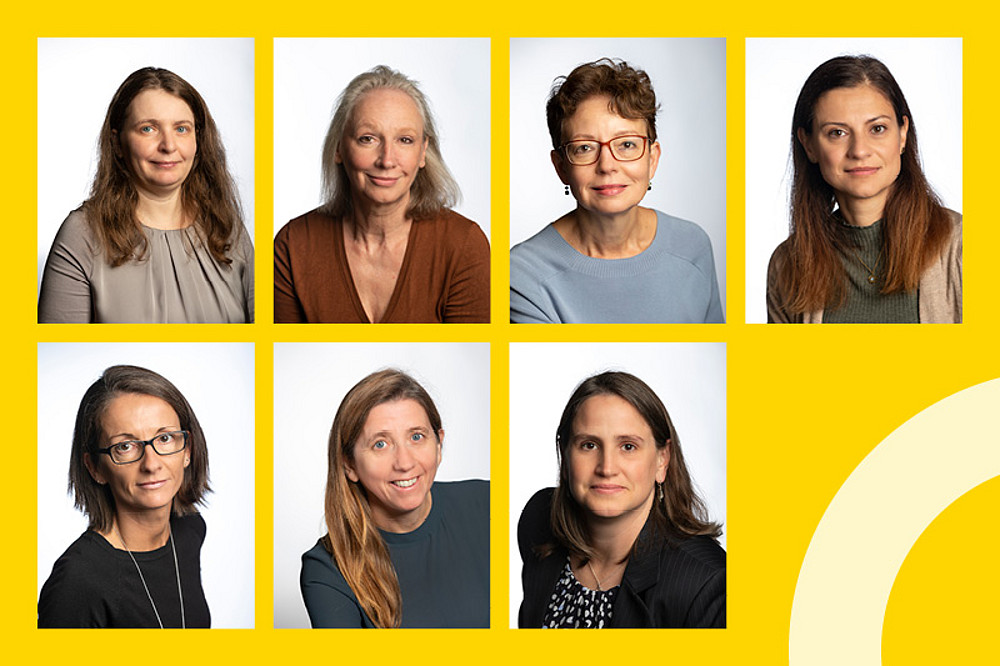
Obere Reihe v.l.: Brigitte Pertschy, Dagmar Zweytick, Ellen Zechner und Martina Schweiger. Untere Reihe v.l.: Mélanie Hall, Monika Oberer und Tea Pavkov-Keller. Im Profilbereich BioHealth forschen noch zehn Frauen als assoziierte Mitglieder. Alle Fotos: Uni Graz/Lunghammer.

Obere Reihe v.l.: Brigitte Pertschy, Dagmar Zweytick, Ellen Zechner und Martina Schweiger. Untere Reihe v.l.: Mélanie Hall, Monika Oberer und Tea Pavkov-Keller. Im Profilbereich BioHealth forschen noch zehn Frauen als assoziierte Mitglieder. Alle Fotos: Uni Graz/Lunghammer.

Sieben Frauen sind Vollmitglieder im Profilbereich "BioHealth" - zum Frauentag am 8. März 2023 stellen wir sie vor

Der Profilbereich BioHealth besteht aus einem Konsortium von Forscher:innen aus den Molekularen Biowissenschaften, der Chemie und der Pharmazie. Gemeinsam arbeiten die Wissenschaftler:innen am molekularen Verständnis von Krankheiten und deren Interventionen. Unter den Vollmitgliedern sind sieben Forscherinnen, die wir anlässlich des Frauentags am 8. März 2023 mit ausgewählten Meldungen in den Fokus rücken: 

Brigitte Pertschy weiß, wie der Bau von Ribosomen - das sind die Protein-Fabriken des Körpers - koordiniert wird

Dagmar Zweytick hat ein körpereigenes Molekül entdeckt, das im Labor Krebs­zellen zuverlässig abtötet 

Ellen Zechner untersucht mit ihrem Team, wie Bakterien-Kämpfe die Darmflora schwächen

Martina Schweiger legt die Grundlage, um den lebensbedrohlichen Gewichtsverlust bei Krebs zu bremsen

Mélanie Hall erforscht nachhaltigen Methoden der chemischen Synthese

Monika Oberer ist den Geheimnissen des Fettstofffwechsels auf der Spur

Tea Pavkov-Keller blickt in kleinste Zellstrukturen, um Krankheiten besser zu bekämpfen 


>> Mehr über BioHealth


Seven women are full members of the "BioHealth" Field of Excellence. We are introducing them on Women's Day on March 8, 2023.

The "BioHealth" Field of Excellence consists of a consortium of researchers from the molecular biosciences, chemistry and pharmacy. Together, the scientists work on the molecular understanding of diseases and their interventions. Among the full members are seven female researchers, whom we are spotlighting with selected news items on the occasion of Women's Day on March 8, 2023: 

Brigitte Pertschy knows how the construction of ribosomes - the body's protein factories - is coordinated

Dagmar Zweytick has discovered an endogenous molecule that reliably kills cancer cells in the lab 

Ellen Zechner and her team are investigating how bacterial battles weaken the intestinal flora

Martina Schweiger lays the groundwork to curb life-threatening weight loss in cancer

Mélanie Hall explores sustainable methods of chemical synthesis

Monika Oberer is on the trail of the secrets of fat metabolism

Tea Pavkov-Keller looks into the smallest cell structures to better combat diseases 


>> More about BioHealth


created by Gerhild Leljak

Related news

Chemical Christmas show at the University of Graz: An explosive evening at the Schauspielh

At the beginning of December, the University of Graz transformed the theater into a laboratory: as part of “Chemical Life,” teacher training students staged a chemical Christmas show for Styrian school classes—complete with ethanol rockets, nitrogen snow, and glowing effects. An evening designed to inspire interest in studying chemistry.

Train by train: Koralm railway accelerates exchange between the Universities

Lectures at the University of Klagenfurt in the morning, seminars at the University of Graz in the afternoon: Austria's longest tunnel and a journey time of around 45 minutes make it easy. The Koralm railway increases the speed of networking between the two university locations. The collaboration builds on existing cooperation - for example in the areas of teacher training, Slavic studies and as employers, the universities are well coordinated.

On the trail of the Big Bang: University of Graz receives 1.5 million euros for doctoral programmes

The Austrian Science Fund FWF has selected the Doctoral Programme in Theoretical Particle Physics at the University of Graz for funding from the Doc.funds. Six young scientists will be funded for 3.5 years. They will gain fundamentally new insights into the origins of the world.

From trans women and knee prostheses: sports science prizes awarded

Walking better with a prosthesis, successfully getting rid of excess weight, training more effectively, more fairness for trans people in sport: these were the topics addressed by the students at the University of Graz who were awarded the sports science prizes for their Master's theses on 3 December 2025.

Begin of page section:
Additional information:

University of Graz
Universitaetsplatz 3
8010 Graz
Austria
  • Contact
  • Web Editors
  • Moodle
  • UNIGRAZonline
  • Imprint
  • Data Protection Declaration
  • Accessibility Declaration
Weatherstation
Uni Graz

End of this page section. Go to overview of page sections

End of this page section. Go to overview of page sections

Begin of page section:

End of this page section. Go to overview of page sections