Begin of page section:
Page sections:

  • Go to contents (Accesskey 1)
  • Go to position marker (Accesskey 2)
  • Go to main navigation (Accesskey 3)
  • Go to sub navigation (Accesskey 4)
  • Go to additional information (Accesskey 5)
  • Go to page settings (user/language) (Accesskey 8)
  • Go to search (Accesskey 9)

End of this page section. Go to overview of page sections

Begin of page section:
Page settings:

English en
Deutsch de
Search
Login

End of this page section. Go to overview of page sections

Begin of page section:
Search:

Search for details about Uni Graz
Close

End of this page section. Go to overview of page sections


Search

Begin of page section:
Main navigation:

Page navigation:

  • University

    University
    • About the University
    • Organisation
    • Faculties
    • Library
    • Working at University of Graz
    • Campus
    Developing solutions for the world of tomorrow - that is our mission. Our students and our researchers take on the great challenges of society and carry the knowledge out.
  • Research Profile

    Research Profile
    • Our Expertise
    • Research Questions
    • Research Portal
    • Promoting Research
    • Research Transfer
    • Ethics in Research
    Scientific excellence and the courage to break new ground. Research at the University of Graz creates the foundations for making the future worth living.
  • Studies

    Studies
    • Prospective Students
    • Students
  • Community

    Community
    • International
    • Location
    • Research and Business
    • Alumni
    The University of Graz is a hub for international research and brings together scientists and business experts. Moreover, it fosters the exchange and cooperation in study and teaching.
  • Spotlight
Topics
  • Our digital Advent calendar
  • Sustainable University
  • Researchers answer
  • Work for us
Close menu

End of this page section. Go to overview of page sections

Begin of page section:
You are here:

University of Graz News Bio-plastics and baroque theatre: Awards for two researchers from the University of Graz

End of this page section. Go to overview of page sections

Friday, 07 November 2025

Bio-plastics and baroque theatre: Awards for two researchers from the University of Graz

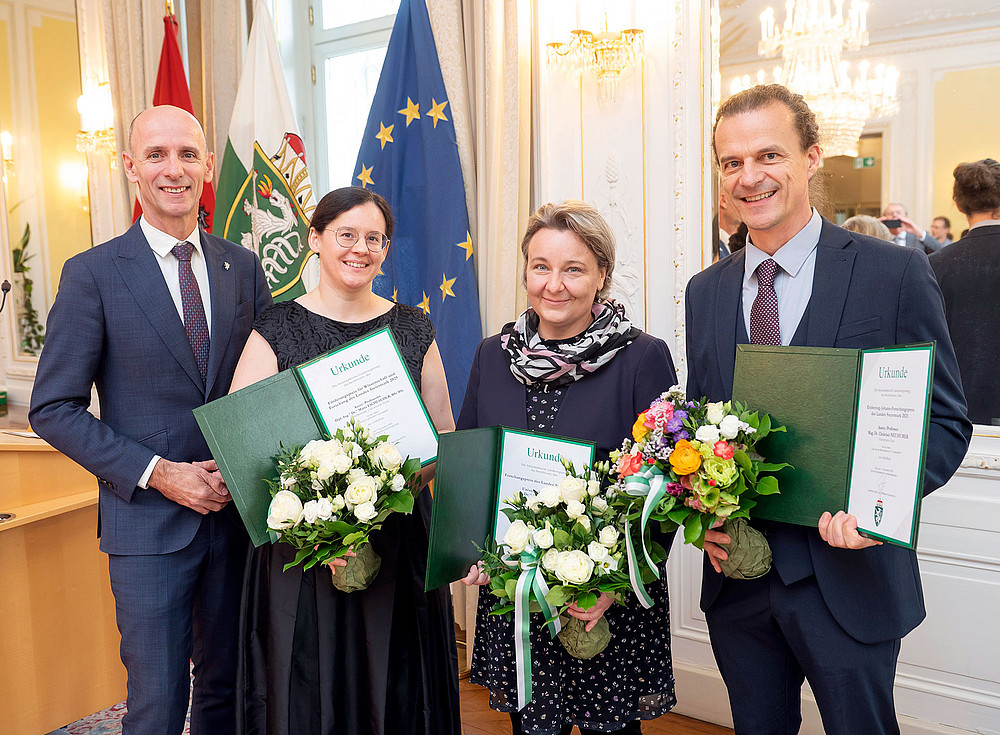
Presentation of the 2025 Research Awards of the Province of Styria: Willibald Ehrenhöfer, Maria Eichlseder, Katalin Barta Weissert, Christian Neuhuber (from left) ©Foto Fischer

Provincial Councillor Willibald Ehrenhöfer (left) presented the Forschungspreis des Landes Steiermark to Katalin Barta Weissert (centre), the Erzherzog-Johann-Forschungspreis to Christian Neuhuber, both from the University of Graz, and the Förderungspreis des Landes Steiermark to Maria Eichlseder from Graz University of Technology. @ Foto Fischer

Chemist Katalin Barta Weissert received this year's "Forschungspreis des Landes Steiermark", while Germanist Christian Neuhuber received the "Erzherzog-Johann-Forschungspreis". The awards are endowed with 12,000 euros each and are presented for outstanding achievements in the field of science and research. Provincial Councillor Willibald Ehrenhöfer presented the awards on 7 November 2025 in the White Hall of Graz Castle.


“I am delighted about the awards presented by the Province of Styria to two outstanding researchers from the University of Graz. They once again underline the high quality and importance of research at our university. The spectrum ranges from new perspectives on historical developments to solutions for the major challenges in shaping the future,” says Rector Peter Riedler.

Revolutionary bio-plastics
It is a milestone that combines environmental protection and economic efficiency: Katalin Barta Weissert from the Department of Chemistry at the University of Graz and her team have developed a fully recyclable, bio-based epoxy resin. The innovation has far-reaching implications, as epoxy plastics is used as a very robust lightweight material in numerous products, including skateboard ramps, aeroplanes, boats, cars and wind turbines. However, commercially available epoxy products are based on petroleum and are not currently recyclable. Now, researchers at the University of Graz have developed an epoxy resin thermoset that is made exclusively from renewable raw materials. In addition, the material dissolves easily in methanol, allowing all the original building blocks to be recovered.
Read more in the article “University of Graz develops sustainable and recyclable bio-plastics”

Graz, city of theatre
Theatre enjoyed great popularity during the Baroque period. Christian Neuhuber from the Department of German Studies at the University of Graz researched the significance of Graz in connection with professional theatre in the 17th century. Based on years of research in numerous archives in Austria and abroad, he was able to paint a completely new picture of the Styrian theatre landscape during the Baroque period. English theatre was admired in the Inner Austrian residential city of Graz earlier than in Vienna. Many of the most important German-speaking ensembles of their time entertained Styrian audiences, and even some Italian stars launched their international careers from the city on the Mur.
More on this in the book Graz und das Berufstheater im 17. Jahrhundert

created by Gudrun Pichler

Related news

On the trail of the Big Bang: University of Graz receives 1.5 million euros for doctoral programmes

The Austrian Science Fund FWF has selected the Doctoral Programme in Theoretical Particle Physics at the University of Graz for funding from the Doc.funds. Six young scientists will be funded for 3.5 years. They will gain fundamentally new insights into the origins of the world.

From trans women and knee prostheses: sports science prizes awarded

Walking better with a prosthesis, successfully getting rid of excess weight, training more effectively, more fairness for trans people in sport: these were the topics addressed by the students at the University of Graz who were awarded the sports science prizes for their Master's theses on 3 December 2025.

Influential: Rupert Baumgartner and Holger Hoff among the highly cited researchers

The number of publications in scientific journals is considered to be a measure of a researcher's scientific achievement. How often these works are cited by colleagues provides information about the relevance of the publications. Sustainability researcher Rupert Baumgartner and transdisciplinarity expert Holger Hoff from the University of Graz are among the top 1 per cent of the most cited scientists in their fields of research.

Nobel Lecture 2025: How evolution enters chemistry

During the Nobel Lecture at BioTechMed-Graz, Nobel Prize winner in Chemistry Frances H. Arnold provided insight into her research on the directed evolution of enzymes.

Begin of page section:
Additional information:

University of Graz
Universitaetsplatz 3
8010 Graz
Austria
  • Contact
  • Web Editors
  • Moodle
  • UNIGRAZonline
  • Imprint
  • Data Protection Declaration
  • Accessibility Declaration
Weatherstation
Uni Graz

End of this page section. Go to overview of page sections

End of this page section. Go to overview of page sections

Begin of page section:

End of this page section. Go to overview of page sections