Begin of page section:
Page sections:

  • Go to contents (Accesskey 1)
  • Go to position marker (Accesskey 2)
  • Go to main navigation (Accesskey 3)
  • Go to sub navigation (Accesskey 4)
  • Go to additional information (Accesskey 5)
  • Go to page settings (user/language) (Accesskey 8)
  • Go to search (Accesskey 9)

End of this page section. Go to overview of page sections

Begin of page section:
Page settings:

English en
Deutsch de
Search
Login

End of this page section. Go to overview of page sections

Begin of page section:
Search:

Search for details about Uni Graz
Close

End of this page section. Go to overview of page sections


Search

Begin of page section:
Main navigation:

Page navigation:

  • University

    University
    • About the University
    • Organisation
    • Faculties
    • Library
    • Working at University of Graz
    • Campus
    Developing solutions for the world of tomorrow - that is our mission. Our students and our researchers take on the great challenges of society and carry the knowledge out.
  • Research Profile

    Research Profile
    • Our Expertise
    • Research Questions
    • Research Portal
    • Promoting Research
    • Research Transfer
    • Ethics in Research
    Scientific excellence and the courage to break new ground. Research at the University of Graz creates the foundations for making the future worth living.
  • Studies

    Studies
    • Prospective Students
    • Students
  • Community

    Community
    • International
    • Location
    • Research and Business
    • Alumni
    The University of Graz is a hub for international research and brings together scientists and business experts. Moreover, it fosters the exchange and cooperation in study and teaching.
  • Spotlight
Topics
  • Our digital Advent calendar
  • Sustainable University
  • Researchers answer
  • Work for us
Close menu

End of this page section. Go to overview of page sections

Begin of page section:
You are here:

University of Graz News Bewegt

End of this page section. Go to overview of page sections

Tuesday, 23 November 2021

Bewegt

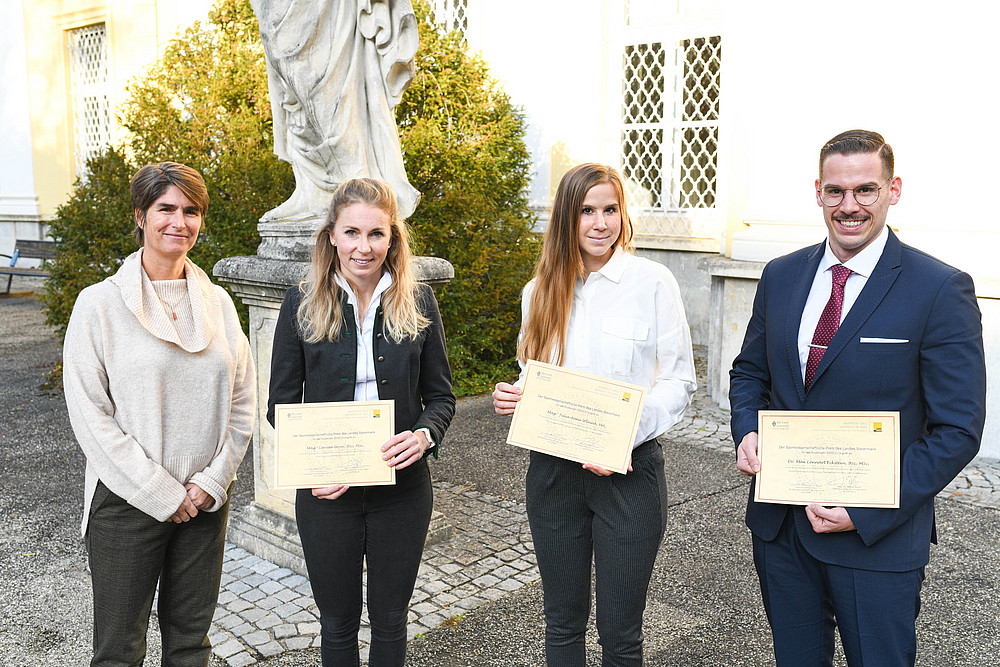
von links nach rechts: Institutsleiterin Mireille van Poppel, Larissa Geyer, Julia Wlasak, Max Eckstein (fehlt am Bild: Maximilian Stangl)

von links nach rechts: Institutsleiterin Mireille van Poppel, Larissa Geyer, Julia Wlasak, Max Eckstein (fehlt am Bild: Maximilian Stangl)

Uni Graz verleiht sportwissenschaftlichen Preis des Landes Steiermark für die besten Abschlussarbeiten.

Wie SchülerInnen mit Koordinationsübungen ihre Konzentration verbessern, welche Nerven für den aufrechten Gang sorgen oder wie Sport DiabetikerInnen hilft: Das sind Themen, mit denen sich die TrägerInnen der heurigen sportwissenschaftlichen Preise beschäftigt haben. Vier AbsolventInnen des Instituts für Bewegungswissenschaften, Sport und Gesundheit der Universität Graz wurden heute mit den sportwissenschaftlichen Preisen des Landes Steiermark, gestiftet von Sportlandesrat Christopher Drexler, prämiert.

Die Bewegungswissenschaften sind eine Querschnittsmaterie, die Probleme und Erscheinungsformen im Umfeld von Sport und Bewegung in den Fokus stellen. „In einem derart breiten Forschungsfeld zum Abschluss des Studiums die beste Arbeit des Fachbereichs geschrieben zu haben, ist etwas ganz Besonderes“, so Institutsleiterin Mireille van Poppel im Zuge der Preisverleihung.

Der mit je 500 Euro dotierte Preis ging an:

Larissa Geyer
befasste sich in ihrer Masterarbeit aus dem Bereich Bewegung und Public Health mit den Auswirkungen von Koordinationsübungen auf Aufmerksamkeit und Konzentration bei 12- bis 13-jährigen SchülerInnen. Ein 30-minütiges Training einmal pro Woche begünstigte eindeutig die Konzentrationsleistung der Kinder, weshalb koordinative Elemente in den Unterricht eingebaut werden sollten.

Julia Ann Wlasak
untersucht in ihrer Masterarbeit aus dem Bereich Bewegungs- und Sportpädagogik die Bedeutung von Sportvereinen als Bildungsinstitutionen. Sie konnte belegen, dass diese die soziale Kompetenz sowie eine gesunde Zukunft von Kindern, Jugendlichen und Erwachsenen fördern. In dieser Funktion sind sie allerdings im Bildungsbereich nicht anerkannt.

Max Lennart Eckstein
Seine Dissertation im Forschungsbereich Sportphysiologie, Trainingswissenschaften und Trainingstherapie untersucht die Auswirkungen von Anstrengung, Unter- oder Überzuckerung auf die Herzleitung von Personen mit Diabetes Mellitus Typ 1. Sein Ergebnis: Körperliche Aktivität hat eine Vielzahl an positiven Effekten.

Maximilian Stangl
Seine Masterarbeit aus dem Forschungsbereich Biomechanik, Bewegungs- und Trainingswissenschaft bringt einen schlüssign Beleg, dass ein angeborenes Netzwerk im menschlichen Rückenmark für einen aufrechten Gang mit verantwortlich ist. Es koordiniert Informationen zentral und generiert ein neuromuskuläres Muster.

created by Joachim Hirtenfellner

Related news

Semester abroad without barriers: University of Graz wins award for promoting inclusion

The University of Graz has been awarded the Internationalization Award for its new inclusion initiative. Students with fewer opportunities now also receive financial support for their semester abroad outside Europe.

Fair distribution: Researchers determine just greenhouse gas budgets for all EU regions

Ten years ago, on 12 December 2015, the Paris Climate Agreement was signed at the UN Climate Conference. In order to limit global warming to well below two degrees, only a certain amount of CO2 may be emitted worldwide. While the focus was originally on national emission targets, more than 200 subnational regions and almost 300 cities have now adopted their own targets. But how many emissions are they fairly entitled to? Researchers at the University of Graz have now developed transparent criteria for fair distribution at the subnational level for the first time and determined corresponding greenhouse gas budgets for all European regions. The paper was published today in the scientific journal Nature Communications.

Chemical Christmas show at the University of Graz: An explosive evening at the Schauspielh

At the beginning of December, the University of Graz transformed the theater into a laboratory: as part of “Chemical Life,” teacher training students staged a chemical Christmas show for Styrian school classes—complete with ethanol rockets, nitrogen snow, and glowing effects. An evening designed to inspire interest in studying chemistry.

Train by train: Koralm railway accelerates exchange between the Universities

Lectures at the University of Klagenfurt in the morning, seminars at the University of Graz in the afternoon: Austria's longest tunnel and a journey time of around 45 minutes make it easy. The Koralm railway increases the speed of networking between the two university locations. The collaboration builds on existing cooperation - for example in the areas of teacher training, Slavic studies and as employers, the universities are well coordinated.

Begin of page section:
Additional information:

University of Graz
Universitaetsplatz 3
8010 Graz
Austria
  • Contact
  • Web Editors
  • Moodle
  • UNIGRAZonline
  • Imprint
  • Data Protection Declaration
  • Accessibility Declaration
Weatherstation
Uni Graz

End of this page section. Go to overview of page sections

End of this page section. Go to overview of page sections

Begin of page section:

End of this page section. Go to overview of page sections