



Begin of page section:
Page sections:

  • Go to contents (Accesskey 1)
  • Go to position marker (Accesskey 2)
  • Go to main navigation (Accesskey 3)
  • Go to sub navigation (Accesskey 4)
  • Go to additional information (Accesskey 5)
  • Go to page settings (user/language) (Accesskey 8)
  • Go to search (Accesskey 9)

End of this page section. Go to overview of page sections

Begin of page section:
Page settings:

English en
Deutsch de
Search
Login

End of this page section. Go to overview of page sections

Begin of page section:
Search:

Search for details about Uni Graz
Close

End of this page section. Go to overview of page sections


Search

Begin of page section:
Main navigation:

Page navigation:

  • University

    University
    • About the University
    • Organisation
    • Faculties
    • Library
    • Working at University of Graz
    • Campus
    Developing solutions for the world of tomorrow - that is our mission. Our students and our researchers take on the great challenges of society and carry the knowledge out.
  • Research Profile

    Research Profile
    • Our Expertise
    • Research Questions
    • Research Portal
    • Promoting Research
    • Research Transfer
    • Ethics in Research
    • Commission for Scientific Integrity
    Scientific excellence and the courage to break new ground. Research at the University of Graz creates the foundations for making the future worth living.
  • Studies

    Studies
    • Prospective Students
    • Students
    • Registration for Study Programme (Winter semester 2026/27)
    • Study Days 22-26 June 2026
  • Community

    Community
    • International
    • Location
    • Research and Business
    • Alumni
    The University of Graz is a hub for international research and brings together scientists and business experts. Moreover, it fosters the exchange and cooperation in study and teaching.
Topics
  • Sustainable University
  • Researchers answer
  • Work for us
Close menu

End of this page section. Go to overview of page sections

Begin of page section:
You are here:

University of Graz News Bewegt

End of this page section. Go to overview of page sections

Tuesday, 23 November 2021

Bewegt

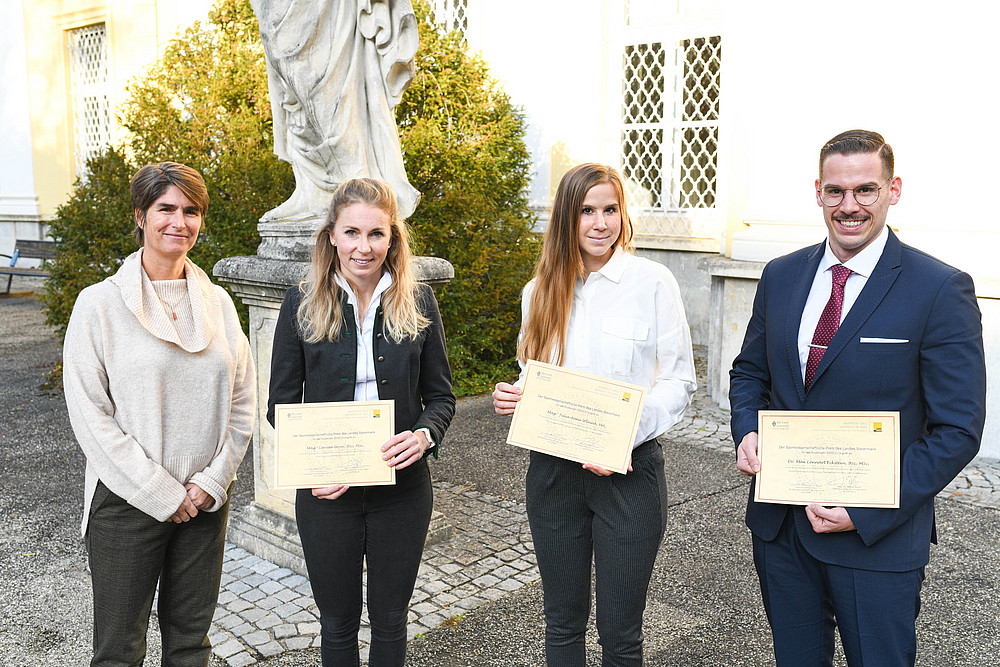
von links nach rechts: Institutsleiterin Mireille van Poppel, Larissa Geyer, Julia Wlasak, Max Eckstein (fehlt am Bild: Maximilian Stangl)

von links nach rechts: Institutsleiterin Mireille van Poppel, Larissa Geyer, Julia Wlasak, Max Eckstein (fehlt am Bild: Maximilian Stangl)

Uni Graz verleiht sportwissenschaftlichen Preis des Landes Steiermark für die besten Abschlussarbeiten.

Wie SchülerInnen mit Koordinationsübungen ihre Konzentration verbessern, welche Nerven für den aufrechten Gang sorgen oder wie Sport DiabetikerInnen hilft: Das sind Themen, mit denen sich die TrägerInnen der heurigen sportwissenschaftlichen Preise beschäftigt haben. Vier AbsolventInnen des Instituts für Bewegungswissenschaften, Sport und Gesundheit der Universität Graz wurden heute mit den sportwissenschaftlichen Preisen des Landes Steiermark, gestiftet von Sportlandesrat Christopher Drexler, prämiert.

Die Bewegungswissenschaften sind eine Querschnittsmaterie, die Probleme und Erscheinungsformen im Umfeld von Sport und Bewegung in den Fokus stellen. „In einem derart breiten Forschungsfeld zum Abschluss des Studiums die beste Arbeit des Fachbereichs geschrieben zu haben, ist etwas ganz Besonderes“, so Institutsleiterin Mireille van Poppel im Zuge der Preisverleihung.

Der mit je 500 Euro dotierte Preis ging an:

Larissa Geyer
befasste sich in ihrer Masterarbeit aus dem Bereich Bewegung und Public Health mit den Auswirkungen von Koordinationsübungen auf Aufmerksamkeit und Konzentration bei 12- bis 13-jährigen SchülerInnen. Ein 30-minütiges Training einmal pro Woche begünstigte eindeutig die Konzentrationsleistung der Kinder, weshalb koordinative Elemente in den Unterricht eingebaut werden sollten.

Julia Ann Wlasak
untersucht in ihrer Masterarbeit aus dem Bereich Bewegungs- und Sportpädagogik die Bedeutung von Sportvereinen als Bildungsinstitutionen. Sie konnte belegen, dass diese die soziale Kompetenz sowie eine gesunde Zukunft von Kindern, Jugendlichen und Erwachsenen fördern. In dieser Funktion sind sie allerdings im Bildungsbereich nicht anerkannt.

Max Lennart Eckstein
Seine Dissertation im Forschungsbereich Sportphysiologie, Trainingswissenschaften und Trainingstherapie untersucht die Auswirkungen von Anstrengung, Unter- oder Überzuckerung auf die Herzleitung von Personen mit Diabetes Mellitus Typ 1. Sein Ergebnis: Körperliche Aktivität hat eine Vielzahl an positiven Effekten.

Maximilian Stangl
Seine Masterarbeit aus dem Forschungsbereich Biomechanik, Bewegungs- und Trainingswissenschaft bringt einen schlüssign Beleg, dass ein angeborenes Netzwerk im menschlichen Rückenmark für einen aufrechten Gang mit verantwortlich ist. Es koordiniert Informationen zentral und generiert ein neuromuskuläres Muster.

created by Joachim Hirtenfellner

Related news

Full effort in the heat: the Sports Centre was in full swing at the Kleeblattlauf

On 19 June 2026, 2,000 runners and hundreds of supporters made their way to the Rosenhain for a sporting end-of-term event.

Save, invest or guarantee: What Austrians expect from the state

Austria needs to make savings. But where? And what should the Republic actually be spending its money on? The answers are provided by the initial findings of a major study involving the University of Graz. 99 per cent of those surveyed are in favour of the state ensuring healthcare provision. Almost three-quarters would like to see more public funding for education, whilst only around three per cent are in favour of cuts in this sector.

Science meets blockbuster: Campus cinema at the University of Graz

A cinematic treat for the scientific community: the courtyard of the University of Graz’s main building is once again being transformed into an atmospheric open-air cinema this year. From 29 June to 10 July 2026 (Mondays to Fridays from 8.30 pm), blockbusters and documentaries will be shown on the open-air screen. Academics from the University of Graz will be taking a closer look at the films shown, examining them to distinguish fact from fiction.

Complying with the norm: Why Do Standards Shape Our Lives, Elisabeth Staudegger?

Standards determine whether a sheet of paper fits in a printer or whether a charging plug can power multiple devices. These standards shape our everyday lives. But who actually sets these standards? Where are the weaknesses, and how could science help to improve them? Elisabeth Staudegger, Head of the ‘Law and IT’ Department at the Institute for Legal Foundations at the University of Graz, host the Academic Standards Day on 16 June. Here she relays how sciences can contribute to the topic of standardisation and reveals her personal favourite standard.

Begin of page section:
Additional information:

University of Graz
Universitaetsplatz 3
8010 Graz
Austria
  • Contact
  • Web Editors
  • Moodle
  • UNIGRAZonline
  • Imprint
  • Data Protection Declaration
  • Accessibility Declaration
Weatherstation
Uni Graz

End of this page section. Go to overview of page sections

End of this page section. Go to overview of page sections

Begin of page section:

End of this page section. Go to overview of page sections

