



Begin of page section:
Page sections:

  • Go to contents (Accesskey 1)
  • Go to position marker (Accesskey 2)
  • Go to main navigation (Accesskey 3)
  • Go to sub navigation (Accesskey 4)
  • Go to additional information (Accesskey 5)
  • Go to page settings (user/language) (Accesskey 8)
  • Go to search (Accesskey 9)

End of this page section. Go to overview of page sections

Begin of page section:
Page settings:

English en
Deutsch de
Search
Login

End of this page section. Go to overview of page sections

Begin of page section:
Search:

Search for details about Uni Graz
Close

End of this page section. Go to overview of page sections


Search

Begin of page section:
Main navigation:

Page navigation:

  • University

    University
    • About the University
    • Organisation
    • Faculties
    • Library
    • Working at University of Graz
    • Campus
    Developing solutions for the world of tomorrow - that is our mission. Our students and our researchers take on the great challenges of society and carry the knowledge out.
  • Research Profile

    Research Profile
    • Our Expertise
    • Research Questions
    • Research Portal
    • Promoting Research
    • Research Transfer
    • Ethics in Research
    • Commission for Scientific Integrity
    Scientific excellence and the courage to break new ground. Research at the University of Graz creates the foundations for making the future worth living.
  • Studies

    Studies
    • Prospective Students
    • Students
    • Welcome Weeks for First Year Students
  • Community

    Community
    • International
    • Location
    • Research and Business
    • Alumni
    The University of Graz is a hub for international research and brings together scientists and business experts. Moreover, it fosters the exchange and cooperation in study and teaching.
Topics
  • Sustainable University
  • Researchers answer
  • Work for us
Close menu

End of this page section. Go to overview of page sections

Begin of page section:
You are here:

University of Graz News Bester Betreuer

End of this page section. Go to overview of page sections

Friday, 02 June 2017

Bester Betreuer

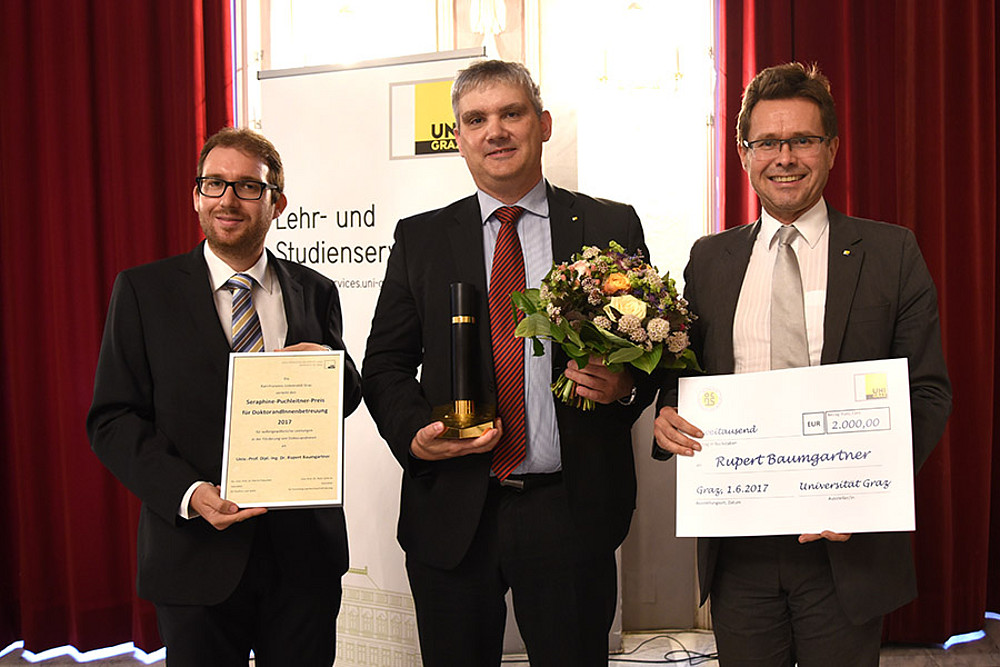
Seraphine-Puchleitner-Preis 2017 für Rupert Baumgartner (Mitte), überreicht von Stefan Dreisiebner (links) und Vizerektor Martin Polaschek. Fotos: Uni Graz/Schweiger

Seraphine-Puchleitner-Preis 2017 für Rupert Baumgartner (Mitte), überreicht von Stefan Dreisiebner (links) und Vizerektor Martin Polaschek. Fotos: Uni Graz/Schweiger

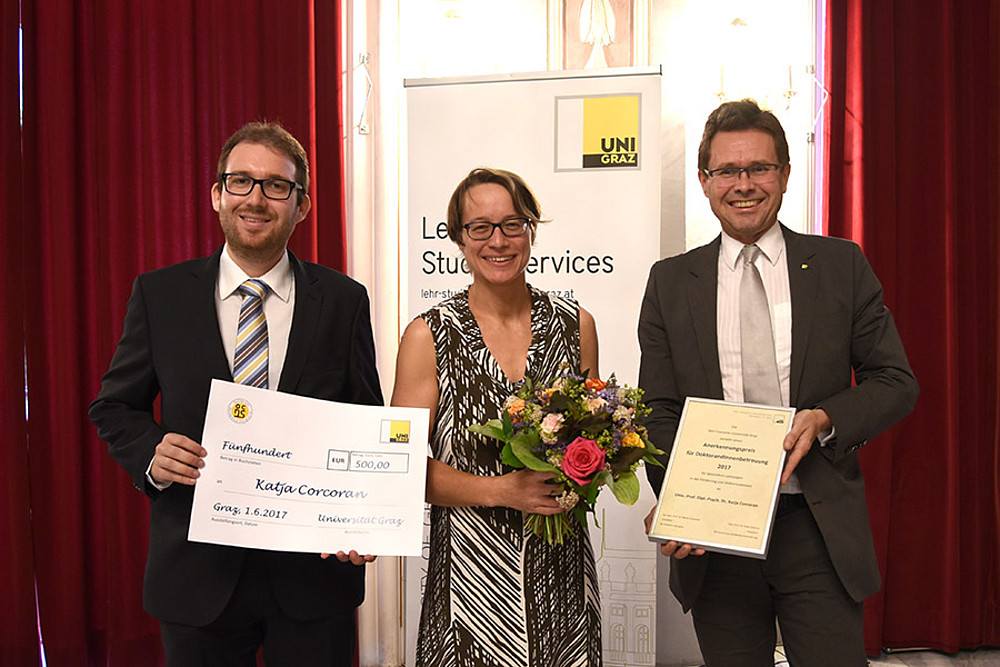
Mit einem Anerkennungspreis würdigte die Jury die „konstruktive Feedbackkultur“ von Katja Corcoran.

Mit einem Anerkennungspreis würdigte die Jury die „konstruktive Feedbackkultur“ von Katja Corcoran.

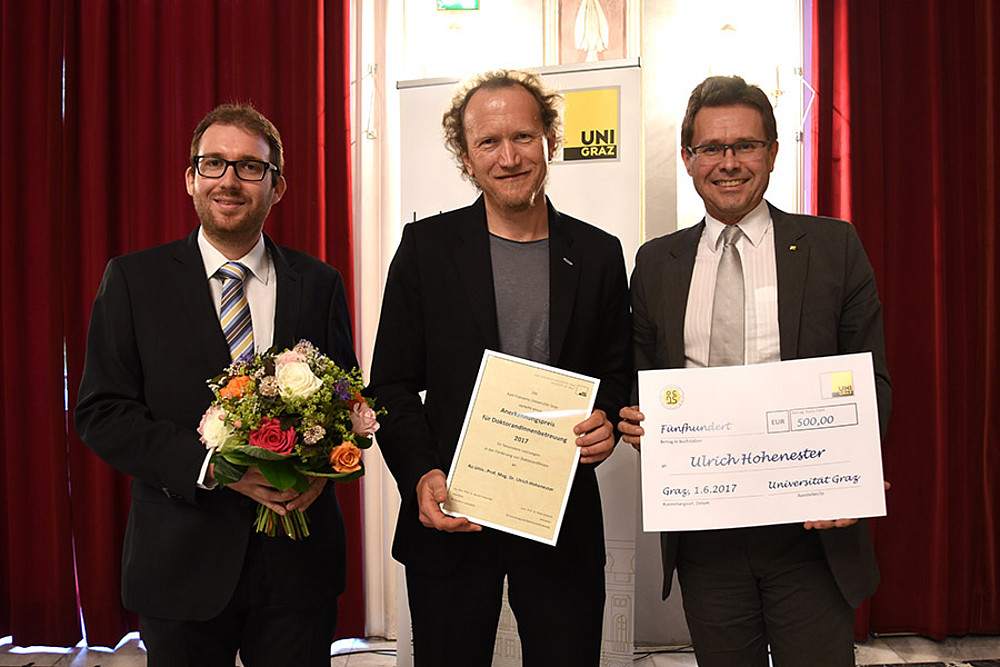
Anerkennungspreisträger Ulrich Hohenester sorgt unter anderem für die Einbindung seiner DissertantInnen in die Scientific Community.

Anerkennungspreisträger Ulrich Hohenester sorgt unter anderem für die Einbindung seiner DissertantInnen in die Scientific Community.

Seraphine-Puchleitner-Preis an Systemwissenschafter Rupert Baumgartner

Benannt nach der ersten Doktoratsabsolventin der Uni Graz (1902) wurde am 1. Juni 2017 im Meerscheinschlössl zum vierten Mal der Seraphine-Puchleitner-Preis für DoktorandInnenbetreuung vergeben. Der diesjährige Hauptpreis ging an Univ.-Prof. Dr. Rupert Baumgartner, Professor am Institut für Systemwissenschaften, Innovations- und Nachhaltigkeitsforschung. Drei Anerkennungspreise erhielten Psychologin Univ.-Prof. Dr. Katja Corcoran, Volkswirt Univ.-Prof. PhD Robert Hill und Physiker Ao.Univ.-Prof. Dr. Ulrich Hohenester.


„Es ist die erste und nach wie vor die einzige Auszeichnung in Österreich, mit der die Betreuung von DoktorandInnen gewürdigt und prämiert wird“, unterstrich Vizerektor Ao.Univ.-Prof. Dr. Martin Polaschek das Alleinstellungsmerkmal des Seraphine-Puchleitner-Preises. Aus insgesamt 22 Nominierungen wählte die Jury den mit 2000 Euro dotierten Hauptpreis sowie drei Anerkennungspreise im Wert von je 500 Euro aus. Vizerektor Polaschek und Mag. Stefan Dreisiebner von der ÖH Uni Graz stellten die Begründungen vor und überreichten die Anerkennungspreise an die Psychologin Katja Corcoran und Physiker Ulrich Hohenester, Robert Hill war terminlich verhindert.
Über den Hauptpreis 2017 freute sich Systemwissenschafter Rupert Baumgartner, zugleich auch Vizedekan der Umwelt-, Regional- und Bildungswissenschaftlichen Fakultät, der in seiner Dankesrede seine Motivation beschrieb: „Es ist der schönste Beruf, den Freiraum nutzen zu können und mit wissenschaftlicher Neugier, Antworten auf wichtige Fragen zu finden. Dabei kann ich junge Menschen begleiten, dass sie selbstständige und kritische WissenschafterInnen werden.“
Die Jury hob besonders Rupert Baumgartners „unterstützende Begleitung hervor, die auf Vermittlung von Methodenkompetenz und strukturiertes Arbeiten abzielt“. „Er fördert das Verfassen von wissenschaftlichen Publikationen, die Teilnahme an fachrelevanten Konferenzen und achtet darauf, dass seine DoktorandInnen die großen inhaltlichen Zusammenhänge ihrer Dissertationsprojekte im Auge behalten.“ Zudem pflege Rupert Baumgartner eine Feedbackkultur, die mit sachlicher Kritik und Verbesserungsvorschlägen maßgeblich zum Gelingen der Dissertationsprojekte beitrage.


Die Verleihung war in die Tagung für NachwuchsforscherInnen „Was soll Universität?“ eingebettet, zu der das Doc-Service am heute, 2. Juni 2017 eingeladen hatte. Im Mittelpunkt standen scheinbar widersprüchliche Fragestellungen, darunter ob die Universität die Effektivität steigern und sich an wissenschaftlichen und außerwissenschaftlichen Arbeitsmärkten orientieren oder das Humboldt’sche Bildungsideal bewahren soll? Oder soll Universität den Forschungsoutput und die Drittmittelstärke erhöhen oder wissenschaftlich-kritisches Denken und soziales Verantwortungsbewusstsein vermitteln? Die Antworten darauf versuchten zahlreiche ReferentInnen im Vortrag und Diskurs zu finden, darunter Christian Fleck, Seraphine-Puchleitner-Preisträger 2013, Birgit Roßmanith (Universität des Saarlandes), Katja Urbatsch (ArbeiterKind.de), Claudia Mertens von der Hochschule Ostwestfalen-Lippe, Maike Wiethoff von der Ruhr-Universität Bochum, die Weiner Publizistin Birge Krondorfer und Rudolf Egger von der Uni Graz.


created by Andreas Schweiger

Related news

Jurassic Sounds: Biologist reconstructs insect songs from 165 million years ago

It was apparently not just the roars of the dinosaurs that made up the soundscape of the animal world during the Jurassic period. Crickets and grasshoppers communicated through a variety of songs and high-pitched sounds, as Thorin Jonsson from the Institute of Biology at the University of Graz discovered together with colleagues from the universities of Lincoln, Bristol (UK), Beijing (China) and Tempe (USA). The findings on what are so far the oldest traces of sound on Earth have just been published in the journal PNAS.

EU funding boosts international exchange between universities

The University of Graz is further expanding its international study opportunities through the European university alliance Arqus and is taking the lead in two key projects. In future, students will benefit from even more joint degree programmes and from simplified recognition of academic achievements through the Joint European Degree Label.

Rescue and risks: Researchers have surveyed public perceptions of AI

The use of artificial intelligence has had to be made transparent since 2 August 2026. The EU’s AI Act, which has been in force since then, also sets out how risky an application is and which security measures apply as a result. However, the assessment of risks by the legislation differs in some cases significantly from the perceptions of the Austrian public. This is the finding of a representative study carried out by data scientist Stefan Thalmann from the University of Graz and his team.

The Healing Sea: Researchers discover new approaches to treating chronic inflammation in sponges

Chronic inflammation plays a key role in many diseases, ranging from metabolic disorders and cardiovascular diseases to tissue damage following injuries or infections. “Normally, the body is able to resolve inflammation on its own. If this process becomes unbalanced, immune cells remain permanently active and continue to drive negative changes in the tissue,” explains Andreas Koeberle, a pharmacist at the University of Graz.

Begin of page section:
Additional information:

University of Graz
Universitaetsplatz 3
8010 Graz
Austria
  • Contact
  • Web Editors
  • Moodle
  • UNIGRAZonline
  • Imprint
  • Data Protection Declaration
  • Accessibility Declaration
Weatherstation
Uni Graz

End of this page section. Go to overview of page sections

End of this page section. Go to overview of page sections

Begin of page section:

End of this page section. Go to overview of page sections

